 Add to Chrome
 Add to Firefox
 Add to Edge
Internalizing Geometric Law: Learning from Solver Residuals for Precision-Critical Generation
Jun 08, 2026
Large Language Models frequently hallucinate in precision-critical domains such as technical diagramming and mechanical design, where outputs must satisfy strict geometric constraints. We study open-ended geometric synthesis from natural language: translating free-form descriptions into precise constructions whose entities must simultaneously satisfy dozens of interacting constraints. To make this tractable, we release PyGeoX, a programmable geometric DSL that compiles declarative constraints into a differentiable loss, and PyGeoX-Bench, a stratified suite of 300 problems with per-constraint verifiable rewards. Using PyGeoX as a verifier, we identify a failure mode we call Outlier Gradient Masking: under global-norm rewards (any scheme that aggregates residuals through a single norm, for example, $\exp(-\mathrm{MSE})$), a single outlier constraint can nullify the learning signal across all others. To address this, we propose Saturating Additive Rewards (SAR), which decompose the reward into bounded per-constraint terms, preserving partial progress and ensuring consistent gradients even under severe violations. Against MSE-based rewards, the natural baseline for geometry solvers, SAR improves the hard-tier solving rate by $2.3\times$, and the resulting 8B model is competitive with much larger frontier systems on this benchmark. We release the engine, benchmark, and data at https://github.com/Huawei-AI4Math/PyGeoX.

From Coin to Data: The Impact of Object Detection on Digital Numismatics
Dec 26, 2024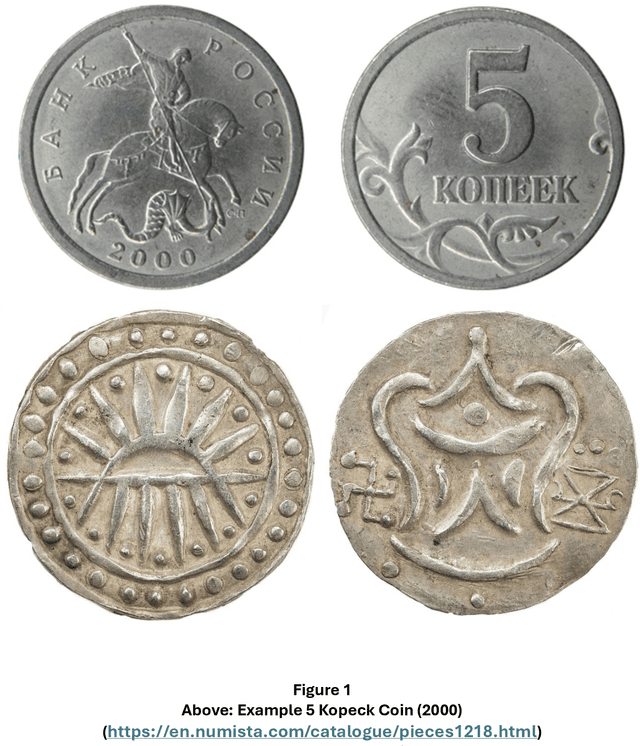

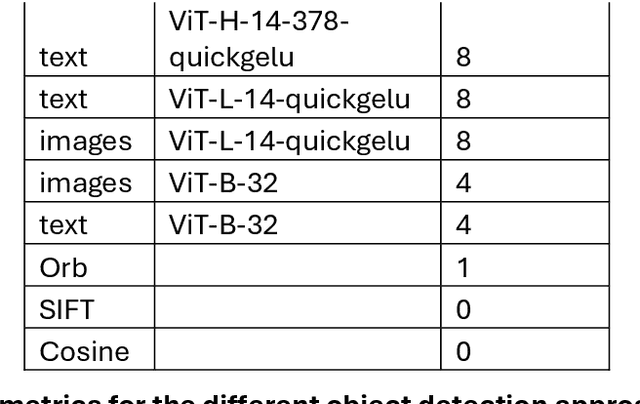
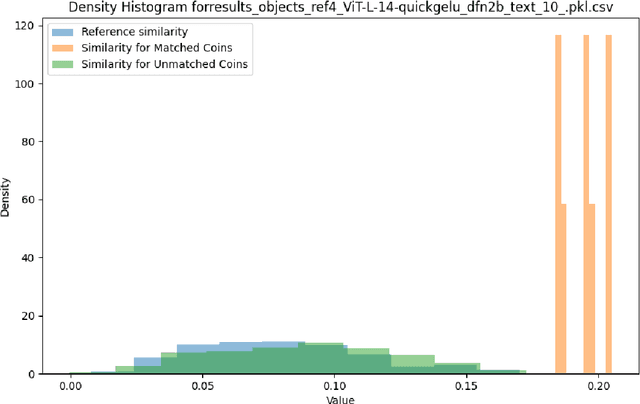
In this work we investigate the application of advanced object detection techniques to digital numismatics, focussing on the analysis of historical coins. Leveraging models such as Contrastive Language-Image Pre-training (CLIP), we develop a flexible framework for identifying and classifying specific coin features using both image and textual descriptions. By examining two distinct datasets, modern Russian coins featuring intricate "Saint George and the Dragon" designs and degraded 1st millennium AD Southeast Asian coins bearing Hindu-Buddhist symbols, we evaluate the efficacy of different detection algorithms in search and classification tasks. Our results demonstrate the superior performance of larger CLIP models in detecting complex imagery, while traditional methods excel in identifying simple geometric patterns. Additionally, we propose a statistical calibration mechanism to enhance the reliability of similarity scores in low-quality datasets. This work highlights the transformative potential of integrating state-of-the-art object detection into digital numismatics, enabling more scalable, precise, and efficient analysis of historical artifacts. These advancements pave the way for new methodologies in cultural heritage research, artefact provenance studies, and the detection of forgeries.