 Add to Chrome
 Add to Firefox
 Add to Edge
CascadeDebate: Multi-Agent Deliberation for Cost-Aware LLM Cascades
Apr 14, 2026
Cascaded LLM systems coordinate models of varying sizes with human experts to balance accuracy, cost, and abstention under uncertainty. However, single-model tiers at each stage often struggle with ambiguous queries, triggering premature escalations to costlier models or experts due to under-confidence and inefficient compute scaling. CascadeDebate addresses this gap by inserting multi-agent deliberation directly at each tier's escalation boundary. Confidence-based routers activate lightweight agent ensembles only for uncertain cases, enabling consensus-driven resolution of ambiguities internally without invoking higher-cost upgrades. Our unified architecture alternates single-model inference with selective multi-agent deliberation across model scales, culminating in human experts as the final fallback. This design scales test-time compute dynamically according to query difficulty. Across five benchmarks spanning science, medicine, and general knowledge, CascadeDebate outperforms strong single-model cascades and standalone multi-agent systems by up to 26.75 percent. An online threshold optimizer proves essential, boosting accuracy by 20.98 to 52.33 percent relative improvement over fixed policies and enabling elastic adaptation to real-world distributions.

GEMMAS: Graph-based Evaluation Metrics for Multi Agent Systems
Jul 17, 2025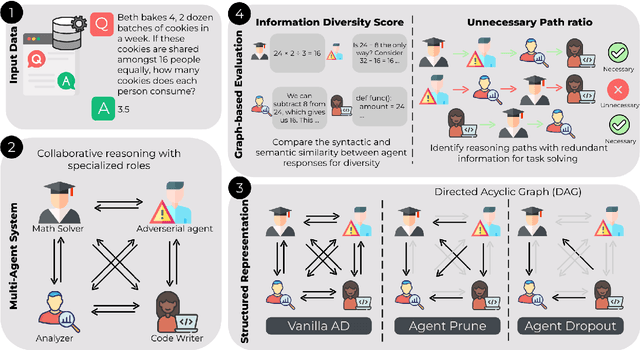
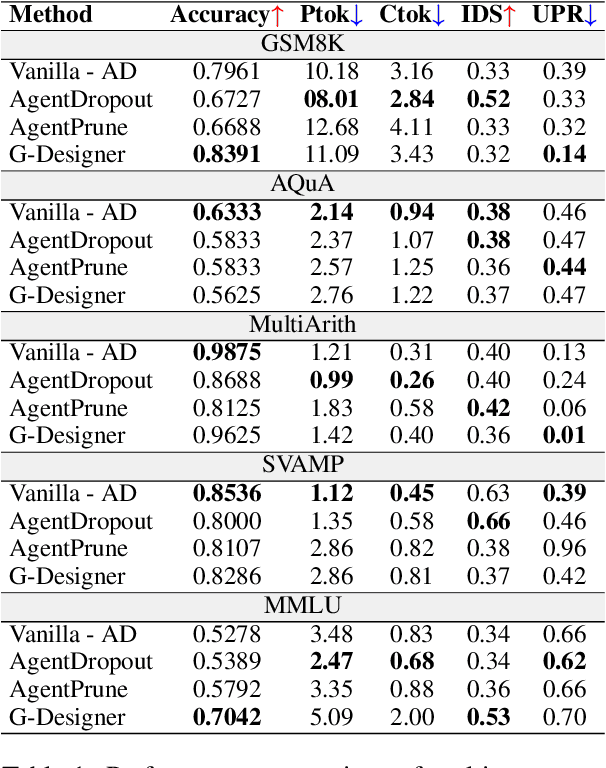
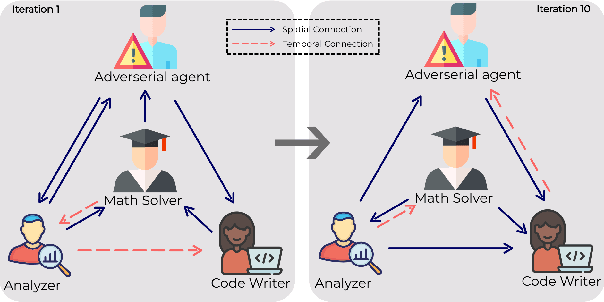
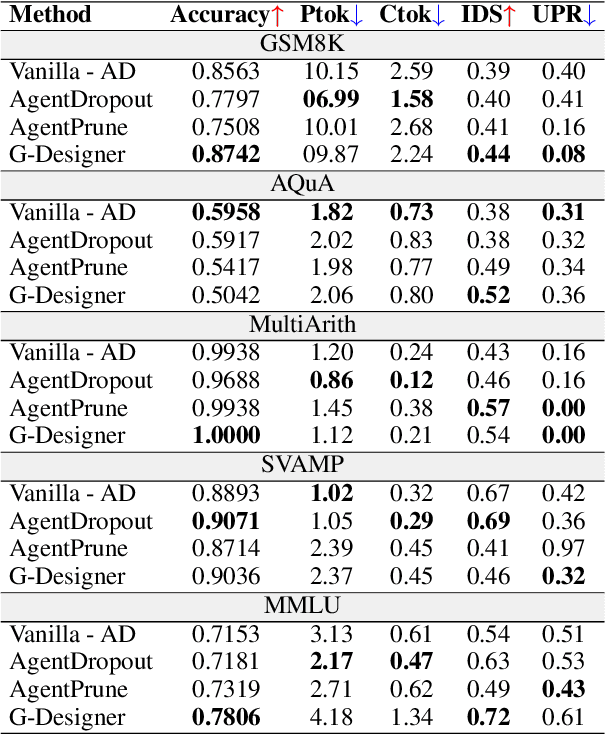
Multi-agent systems built on language models have shown strong performance on collaborative reasoning tasks. However, existing evaluations focus only on the correctness of the final output, overlooking how inefficient communication and poor coordination contribute to redundant reasoning and higher computational costs. We introduce GEMMAS, a graph-based evaluation framework that analyzes the internal collaboration process by modeling agent interactions as a directed acyclic graph. To capture collaboration quality, we propose two process-level metrics: Information Diversity Score (IDS) to measure semantic variation in inter-agent messages, and Unnecessary Path Ratio (UPR) to quantify redundant reasoning paths. We evaluate GEMMAS across five benchmarks and highlight results on GSM8K, where systems with only a 2.1% difference in accuracy differ by 12.8% in IDS and 80% in UPR, revealing substantial variation in internal collaboration. These findings demonstrate that outcome-only metrics are insufficient for evaluating multi-agent performance and highlight the importance of process-level diagnostics in designing more interpretable and resource-efficient collaborative AI systems.