 Add to Chrome
 Add to Firefox
 Add to Edge
RunAgent SuperBrowser: A Theory of Autonomous Web Navigation Grounded in Human Browsing Behaviour
Jun 08, 2026
We present SUPERBROWSER, an autonomous web-navigation agent designed against a single guiding hypothesis: a web agent should browse the way a person browses. A human reading a page does not retain every pixel they have seen; they look at a few candidate targets, decide on one, and remember only what is needed to keep the goal alive. We operationalize this perception-cognition-action triad as three coupled mechanisms. First, a vision-first bounding-box pipeline labels candidate interactive regions on every screenshot and feeds them, asynchronously prefetched, to the language model so that the "eye" precedes the "hand". Second, a three-role brain -- an Orchestrator that classifies and routes, a Planner that evaluates progress every few steps, and a Worker that emits per-step actions -- separates strategic from operational reasoning. Third, a structured Ledger stores only what a person would: the goal, the last three actions, a small set of facts and dead-ends, and a handful of checkpoints; a six-phase eviction loop systematically discards stale screenshots, state blobs, and reasoning traces from the live context. Action execution is a three-tier click cascade (Chrome DevTools Protocol to Puppeteer to scripted) with humanized Bezier motion, plus a chevron-aware bounding-box snapper that resolves the "small arrow beside a large label" ambiguity. On the Mind2Web Hard benchmark (66 tasks), SUPERBROWSER attains 89.47% success, placing third overall and ahead of every published open/research browser-agent baseline by a large margin. We argue that the gain comes not from any single trick but from the consistent application of a cognitive contract throughout the system.

G-RAG: Knowledge Expansion in Material Science
Nov 21, 2024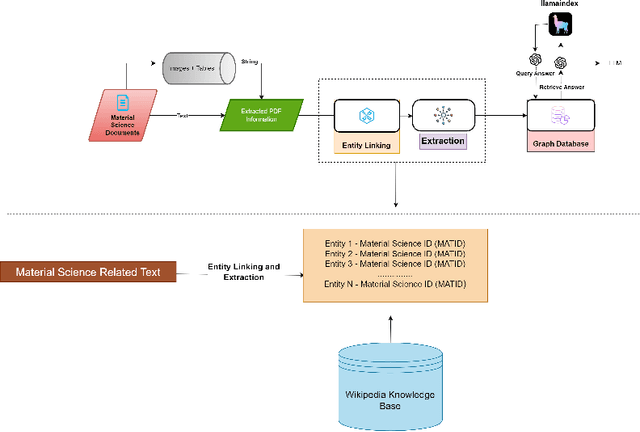
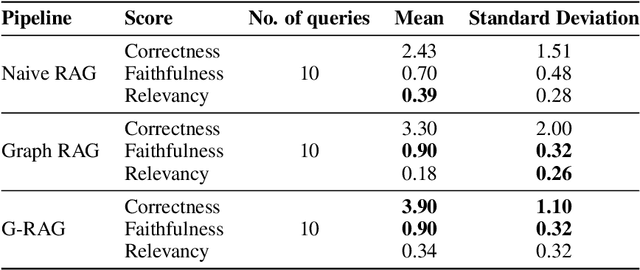
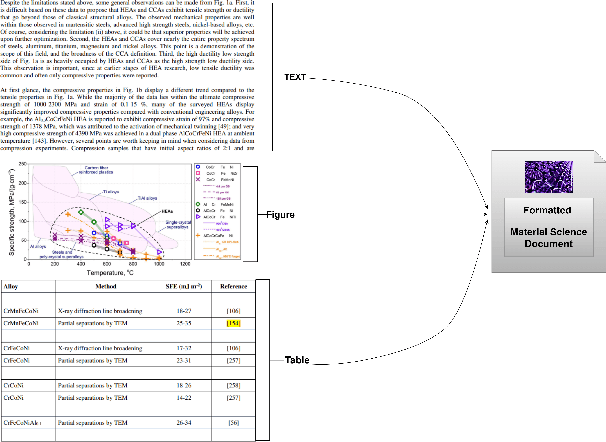
In the field of Material Science, effective information retrieval systems are essential for facilitating research. Traditional Retrieval-Augmented Generation (RAG) approaches in Large Language Models (LLMs) often encounter challenges such as outdated information, hallucinations, limited interpretability due to context constraints, and inaccurate retrieval. To address these issues, Graph RAG integrates graph databases to enhance the retrieval process. Our proposed method processes Material Science documents by extracting key entities (referred to as MatIDs) from sentences, which are then utilized to query external Wikipedia knowledge bases (KBs) for additional relevant information. We implement an agent-based parsing technique to achieve a more detailed representation of the documents. Our improved version of Graph RAG called G-RAG further leverages a graph database to capture relationships between these entities, improving both retrieval accuracy and contextual understanding. This enhanced approach demonstrates significant improvements in performance for domains that require precise information retrieval, such as Material Science.