 Add to Chrome
 Add to Firefox
 Add to Edge
SPyCer: Semi-Supervised Physics-Guided Contextual Attention for Near-Surface Air Temperature Estimation from Satellite Imagery
Mar 05, 2026
Modern Earth observation relies on satellites to capture detailed surface properties. Yet, many phenomena that affect humans and ecosystems unfold in the atmosphere close to the surface. Near-ground sensors provide accurate measurements of certain environmental characteristics, such as near-surface air temperature (NSAT). However, they remain sparse and unevenly distributed, limiting their ability to provide continuous spatial measurements. To bridge this gap, we introduce SPyCer, a semi-supervised physics-guided network that can leverage pixel information and physical modeling to guide the learning process through meaningful physical properties. It is designed for continuous estimation of NSAT by proxy using satellite imagery. SPyCer frames NSAT prediction as a pixel-wise vision problem, where each near-ground sensor is projected onto satellite image coordinates and positioned at the center of a local image patch. The corresponding sensor pixel is supervised using both observed NSAT and physics-based constraints, while surrounding pixels contribute through physics-guided regularization derived from the surface energy balance and advection-diffusion-reaction partial differential equations. To capture the physical influence of neighboring pixels, SPyCer employs a multi-head attention guided by land cover characteristics and modulated with Gaussian distance weighting. Experiments on real-world datasets demonstrate that SPyCer produces spatially coherent and physically consistent NSAT estimates, outperforming existing baselines in terms of accuracy, generalization, and alignment with underlying physical processes.

WGAST: Weakly-Supervised Generative Network for Daily 10 m Land Surface Temperature Estimation via Spatio-Temporal Fusion
Aug 08, 2025Urbanization, climate change, and agricultural stress are increasing the demand for precise and timely environmental monitoring. Land Surface Temperature (LST) is a key variable in this context and is retrieved from remote sensing satellites. However, these systems face a trade-off between spatial and temporal resolution. While spatio-temporal fusion methods offer promising solutions, few have addressed the estimation of daily LST at 10 m resolution. In this study, we present WGAST, a Weakly-Supervised Generative Network for Daily 10 m LST Estimation via Spatio-Temporal Fusion of Terra MODIS, Landsat 8, and Sentinel-2. WGAST is the first end-to-end deep learning framework designed for this task. It adopts a conditional generative adversarial architecture, with a generator composed of four stages: feature extraction, fusion, LST reconstruction, and noise suppression. The first stage employs a set of encoders to extract multi-level latent representations from the inputs, which are then fused in the second stage using cosine similarity, normalization, and temporal attention mechanisms. The third stage decodes the fused features into high-resolution LST, followed by a Gaussian filter to suppress high-frequency noise. Training follows a weakly supervised strategy based on physical averaging principles and reinforced by a PatchGAN discriminator. Experiments demonstrate that WGAST outperforms existing methods in both quantitative and qualitative evaluations. Compared to the best-performing baseline, on average, WGAST reduces RMSE by 17.18% and improves SSIM by 11.00%. Furthermore, WGAST is robust to cloud-induced LST and effectively captures fine-scale thermal patterns, as validated against 33 ground-based sensors. The code is available at https://github.com/Sofianebouaziz1/WGAST.git.
Deep Learning for Spatio-Temporal Fusion in Land Surface Temperature Estimation: A Comprehensive Survey, Experimental Analysis, and Future Trends
Dec 21, 2024
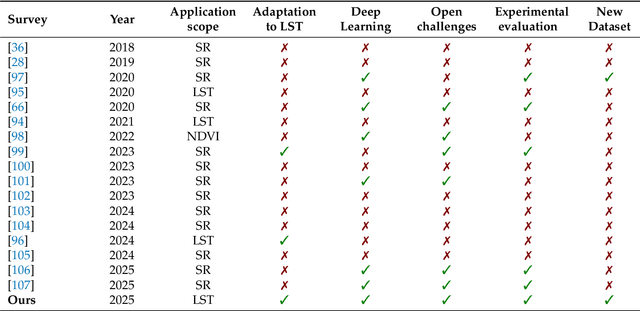
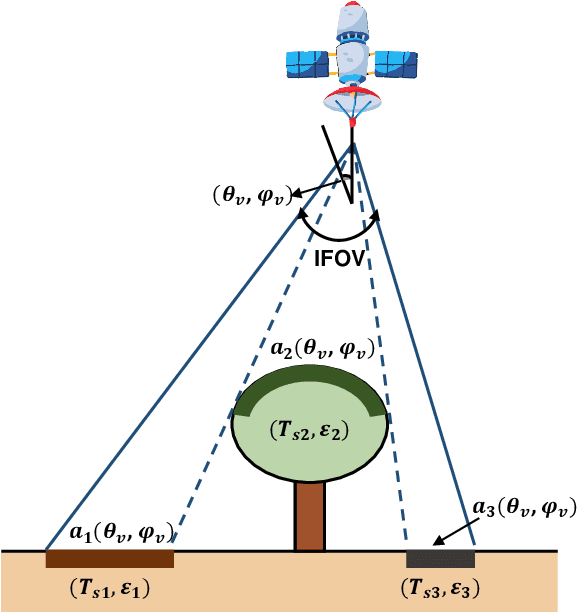
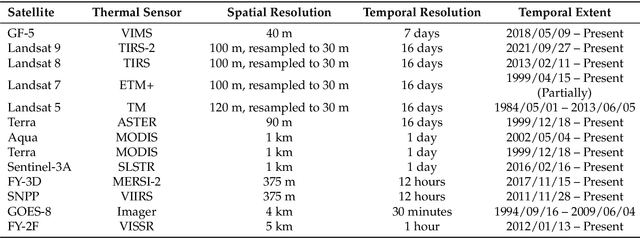
The rapid advancements in satellite remote sensing have enhanced the capability to monitor and analyze the Earth's surface. Among the many variables captured through satellite sensors, Land Surface Temperature (LST) plays a critical role in understanding key environmental processes. However, obtaining high-resolution LST data remains a challenge, as satellite sensors often face a trade-off between spatial and temporal resolutions. In response, Spatio-Temporal Fusion (STF) has emerged as a powerful method to integrate two satellite data sources, one providing high spatial but low temporal resolution, and the other offering high temporal but low spatial resolution. Although a range of STF techniques have been proposed, from traditional methods to cutting-edge deep learning (DL) models, most have focused on surface reflectance, with limited application to LST estimation. DL approaches, in particular, show promise in improving the spatial and temporal resolutions of LST by capturing complex, non-linear relationships between input and output LST data. This paper offers a comprehensive review of the latest advancements in DL-based STF techniques for LST estimation. We analyze key research developments, mathematically formulate the STF problem, and introduce a novel taxonomy for DL-based STF methods. Furthermore, we discuss the challenges faced by current methods and highlight future research directions. In addition, we present the first open-source benchmark STF dataset for LST estimation, consisting of 51 pairs of MODIS-Landsat images spanning from 2013 to 2024. To support our findings, we conduct extensive experiments on state-of-the-art methods and present both quantitative and qualitative assessments. This is the first survey paper focused on DL-based STF for LST estimation. We hope it serves as a valuable reference for researchers and paves the way for future research in this field.