 Add to Chrome
 Add to Firefox
 Add to Edge
Enhancing Cellular-enabled Collaborative Robots Planning through GNSS data for SAR Scenarios
Feb 25, 2026
Cellular-enabled collaborative robots are becoming paramount in Search-and-Rescue (SAR) and emergency response. Crucially dependent on resilient mobile network connectivity, they serve as invaluable assets for tasks like rapid victim localization and the exploration of hazardous, otherwise unreachable areas. However, their reliance on battery power and the need for persistent, low-latency communication limit operational time and mobility. To address this, and considering the evolving capabilities of 5G/6G networks, we propose a novel SAR framework that includes Mission Planning and Mission Execution phases and that optimizes robot deployment. By considering parameters such as the exploration area size, terrain elevation, robot fleet size, communication-influenced energy profiles, desired exploration rate, and target response time, our framework determines the minimum number of robots required and their optimal paths to ensure effective coverage and timely data backhaul over mobile networks. Our results demonstrate the trade-offs between number of robots, explored area, and response time for wheeled and quadruped robots. Further, we quantify the impact of terrain elevation data on mission time and energy consumption, showing the benefits of incorporating real-world environmental factors that might also affect mobile signal propagation and connectivity into SAR planning. This framework provides critical insights for leveraging next-generation mobile networks to enhance autonomous SAR operations.

Cellular-enabled Collaborative Robots Planning and Operations for Search-and-Rescue Scenarios
Mar 14, 2024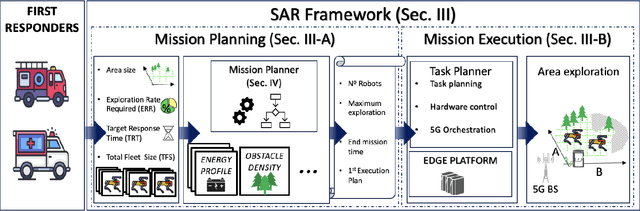
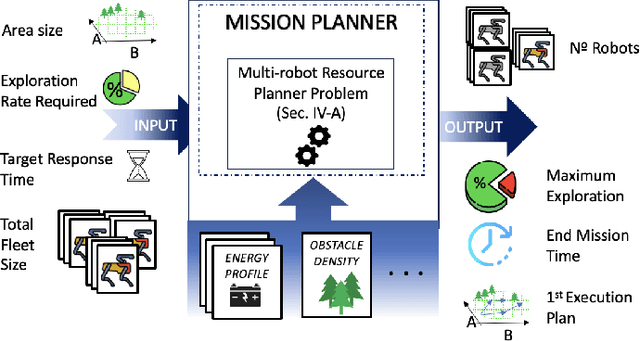
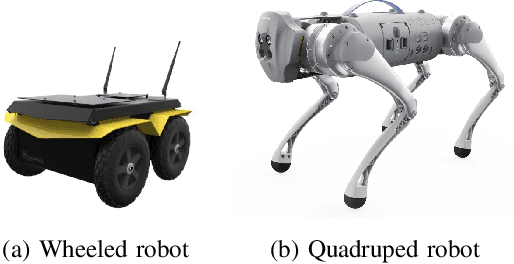
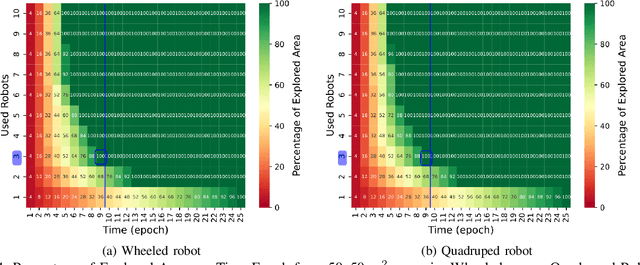
Mission-critical operations, particularly in the context of Search-and-Rescue (SAR) and emergency response situations, demand optimal performance and efficiency from every component involved to maximize the success probability of such operations. In these settings, cellular-enabled collaborative robotic systems have emerged as invaluable assets, assisting first responders in several tasks, ranging from victim localization to hazardous area exploration. However, a critical limitation in the deployment of cellular-enabled collaborative robots in SAR missions is their energy budget, primarily supplied by batteries, which directly impacts their task execution and mobility. This paper tackles this problem, and proposes a search-and-rescue framework for cellular-enabled collaborative robots use cases that, taking as input the area size to be explored, the robots fleet size, their energy profile, exploration rate required and target response time, finds the minimum number of robots able to meet the SAR mission goals and the path they should follow to explore the area. Our results, i) show that first responders can rely on a SAR cellular-enabled robotics framework when planning mission-critical operations to take informed decisions with limited resources, and, ii) illustrate the number of robots versus explored area and response time trade-off depending on the type of robot: wheeled vs quadruped.