 Add to Chrome
 Add to Firefox
 Add to Edge
Planning Method for Skill-Based Control of Robots Using a PLC as Skill Trigger
Feb 28, 2026
Skill-based programming of robots provides a flexible approach for automation. Existing solutions neglect the optimization of motion sequences, leading to inefficiencies in execution. This work introduces a planning method that enhances skill-based robot programming by integrating motion sequence optimization. This optimization leads to a new MoveContinuousSkill. The software for executing the MoveContinuousSkill is implemented on a Programmable Logic Controller and applied across multiple robotic systems. Experimental results demonstrate a significant improvement in execution time through optimized motion sequence.

Multi-Level Feature Fusion for Continual Learning in Visual Quality Inspection
Jan 02, 2026Deep neural networks show great potential for automating various visual quality inspection tasks in manufacturing. However, their applicability is limited in more volatile scenarios, such as remanufacturing, where the inspected products and defect patterns often change. In such settings, deployed models require frequent adaptation to novel conditions, effectively posing a continual learning problem. To enable quick adaptation, the necessary training processes must be computationally efficient while still avoiding effects like catastrophic forgetting. This work presents a multi-level feature fusion (MLFF) approach that aims to improve both aspects simultaneously by utilizing representations from different depths of a pretrained network. We show that our approach is able to match the performance of end-to-end training for different quality inspection problems while using significantly less trainable parameters. Furthermore, it reduces catastrophic forgetting and improves generalization robustness to new product types or defects.
A Dataset and Baseline for Deep Learning-Based Visual Quality Inspection in Remanufacturing
Nov 19, 2025Remanufacturing describes a process where worn products are restored to like-new condition and it offers vast ecological and economic potentials. A key step is the quality inspection of disassembled components, which is mostly done manually due to the high variety of parts and defect patterns. Deep neural networks show great potential to automate such visual inspection tasks but struggle to generalize to new product variants, components, or defect patterns. To tackle this challenge, we propose a novel image dataset depicting typical gearbox components in good and defective condition from two automotive transmissions. Depending on the train-test split of the data, different distribution shifts are generated to benchmark the generalization ability of a classification model. We evaluate different models using the dataset and propose a contrastive regularization loss to enhance model robustness. The results obtained demonstrate the ability of the loss to improve generalisation to unseen types of components.
Knowledge Graph Enhanced Retrieval-Augmented Generation for Failure Mode and Effects Analysis
Jun 26, 2024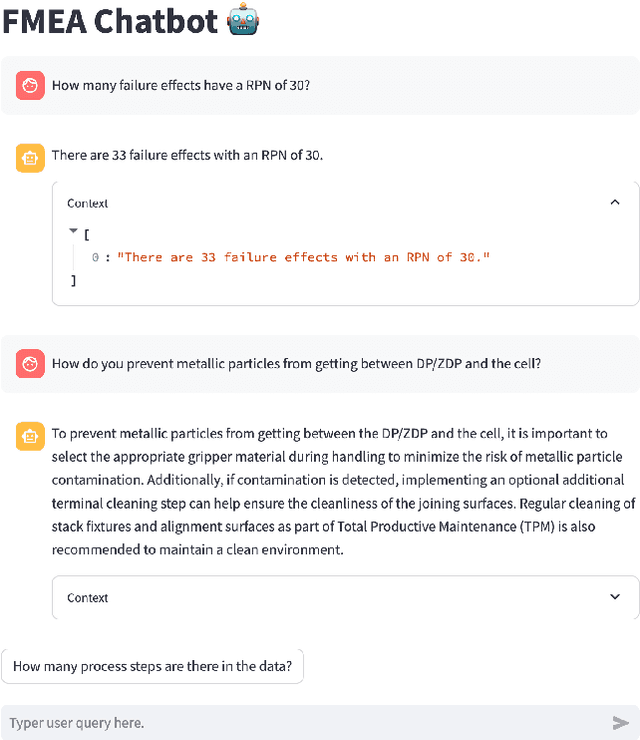
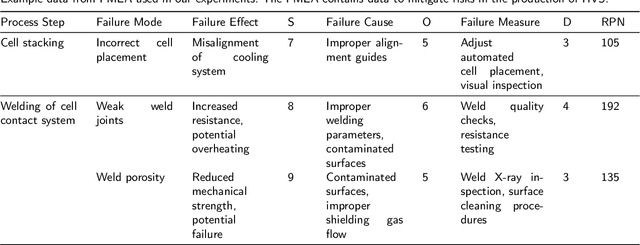
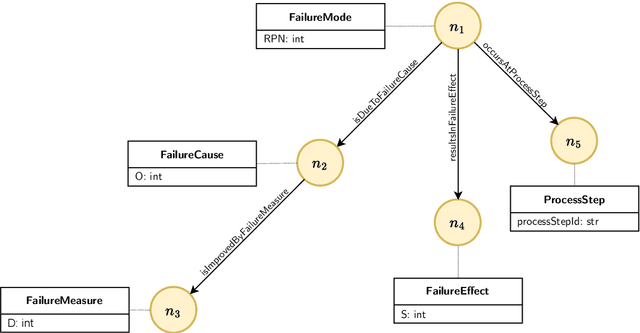

Failure mode and effects analysis (FMEA) is a critical tool for mitigating potential failures, particular during ramp-up phases of new products. However, its effectiveness is often limited by the missing reasoning capabilities of the FMEA tools, which are usually tabular structured. Meanwhile, large language models (LLMs) offer novel prospects for fine-tuning on custom datasets for reasoning within FMEA contexts. However, LLMs face challenges in tasks that require factual knowledge, a gap that retrieval-augmented generation (RAG) approaches aim to fill. RAG retrieves information from a non-parametric data store and uses a language model to generate responses. Building on this idea, we propose to advance the non-parametric data store with a knowledge graph (KG). By enhancing the RAG framework with a KG, our objective is to leverage analytical and semantic question-answering capabilities on FMEA data. This paper contributes by presenting a new ontology for FMEA observations, an algorithm for creating vector embeddings from the FMEA KG, and a KG enhanced RAG framework. Our approach is validated through a human study and we measure the performance of the context retrieval recall and precision.