 Add to Chrome
 Add to Firefox
 Add to Edge
A dual-system approach for epilepsy diagnosis: integrating mamba-Bi-LSTM architecture with SHAP-based verification
Jun 06, 2026
This study develops a medical AI-assisted diagnosis system based on deep learning, which provides intelligent diagnostic solutions for epilepsy, a disease that seriously threatens the life and health of patients. Epilepsy has sudden and unpredictable seizures. Traditional diagnostic methods mainly rely on doctors' manual interpretation of EEG, which is time-consuming and dependent by experience. In response to the above challenges, this study designed a dual-system intelligent diagnosis framework, which includes two core components: the main discrimination system and the verification system. The main discrimination system uses a deep learning model that combines the innovative Mamba architecture with the Bi-LSTM structure to integrate and analyze heterogeneous data to achieve extremely high diagnostic accuracy; the verification system provides an explainable diagnostic basis through the SHAP method to enhance the credibility of the results. This system establishes a cross-modal database to realize intelligent analysis of multi-source heterogeneous data-fusion EEG signals and clinical text data for epilepsy. The system outputs results based on diagnostic consistency and confidence levels, and high-confidence predictions can also be used as automatic feedback sources to optimize the model. The experimental results show that the accuracy of the main discriminant model of the intelligent diagnosis system for epilepsy has increased from 92.6% to 98.7% and the F1 score has increased from 0.895 to 0.992, all of which have exceeded the existing optimal methods; the average processing time for verification system feedback integration is only 220 ms, which increases the overall diagnostic accuracy by 5.1%.
* 18 pages, 11 figures, 16 tables

CG-MambaNet: A spatiotemporal framework for cross-patient epileptic seizure prediction using CNN-GCN-Mamba-BiLSTM with event-level clinical evaluation
Jun 06, 2026Epileptic seizure prediction from scalp EEG is critical for closed-loop neurostimulation therapy. Existing deep-learning methods share two architectural limitations: they model EEG channels independently, neglecting inter-channel spatial synchrony, and process raw time-domain samples without frequency decomposition. A methodological limitation also affects the field: most studies use data splits that permit patient-level information leakage, yielding optimistic estimates that do not generalise to unseen patients. We present CG-MambaNet, a spatiotemporal seizure prediction framework addressing all three limitations. A depthwise separable CNN front-end decomposes each EEG patch into multi-scale spectro-temporal features, capturing delta-to-gamma band dynamics before sequence modelling. A two-layer graph convolutional network with a learnable adjacency matrix captures inter-channel functional synchrony without montage-specific coordinates, applicable to bipolar (CHB-MIT) and referential (SIENA) montages. A bidirectional Mamba encoder followed by a bidirectional LSTM models long- and short-range temporal dynamics, and a two-layer MLP produces the final seizure probability. This serial hierarchy ensures frequency decomposition precedes spatial mixing, which precedes temporal integration. Under strict leave-one-patient-out cross-validation with five independent random seeds, CG-MambaNet achieves AUC-ROC of 0.8152+/-0.0176 on CHB-MIT (n=22) and 0.7104+/-0.0261 on SIENA (n=6), surpassing all published cross-patient methods without domain adaptation. An event-level evaluation framework merging consecutive alarmed windows via a persistence filter reduces false predictions to 0.32 alarms/hour on CHB-MIT, demonstrating clinically meaningful alarm burden.
Artificial Open World for Evaluating AGI: a Conceptual Design
Jun 02, 2022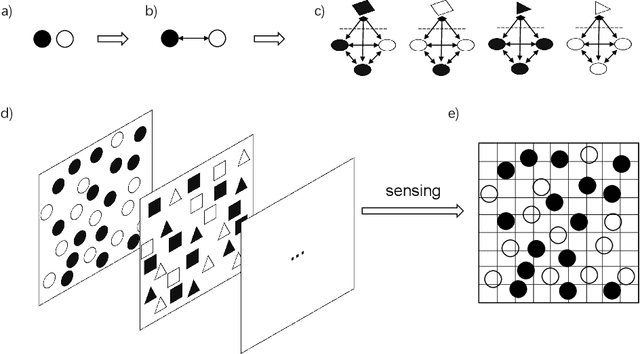
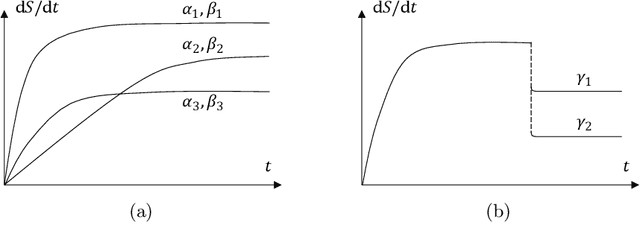
How to evaluate Artificial General Intelligence (AGI) is a critical problem that is discussed and unsolved for a long period. In the research of narrow AI, this seems not a severe problem, since researchers in that field focus on some specific problems as well as one or some aspects of cognition, and the criteria for evaluation are explicitly defined. By contrast, an AGI agent should solve problems that are never-encountered by both agents and developers. However, once a developer tests and debugs the agent with a problem, the never-encountered problem becomes the encountered problem, as a result, the problem is solved by the developers to some extent, exploiting their experience, rather than the agents. This conflict, as we call the trap of developers' experience, leads to that this kind of problems is probably hard to become an acknowledged criterion. In this paper, we propose an evaluation method named Artificial Open World, aiming to jump out of the trap. The intuition is that most of the experience in the actual world should not be necessary to be applied to the artificial world, and the world should be open in some sense, such that developers are unable to perceive the world and solve problems by themselves before testing, though after that they are allowed to check all the data. The world is generated in a similar way as the actual world, and a general form of problems is proposed. A metric is proposed aiming to quantify the progress of research. This paper describes the conceptual design of the Artificial Open World, though the formalization and the implementation are left to the future.
4D Attention-based Neural Network for EEG Emotion Recognition
Jan 14, 2021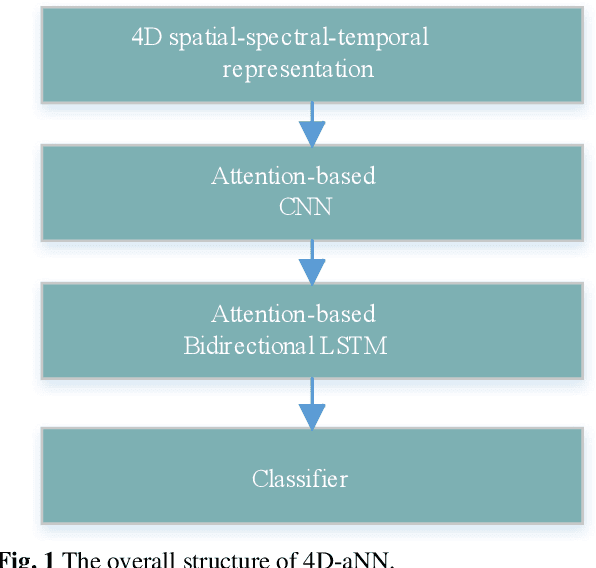
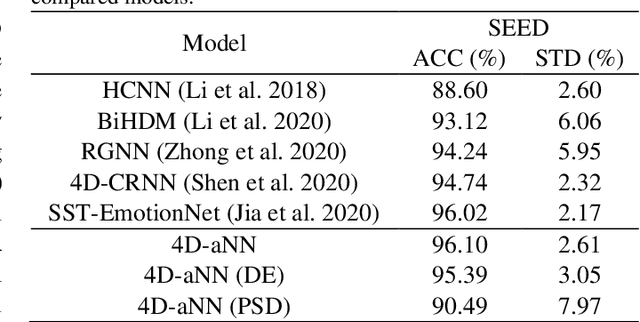
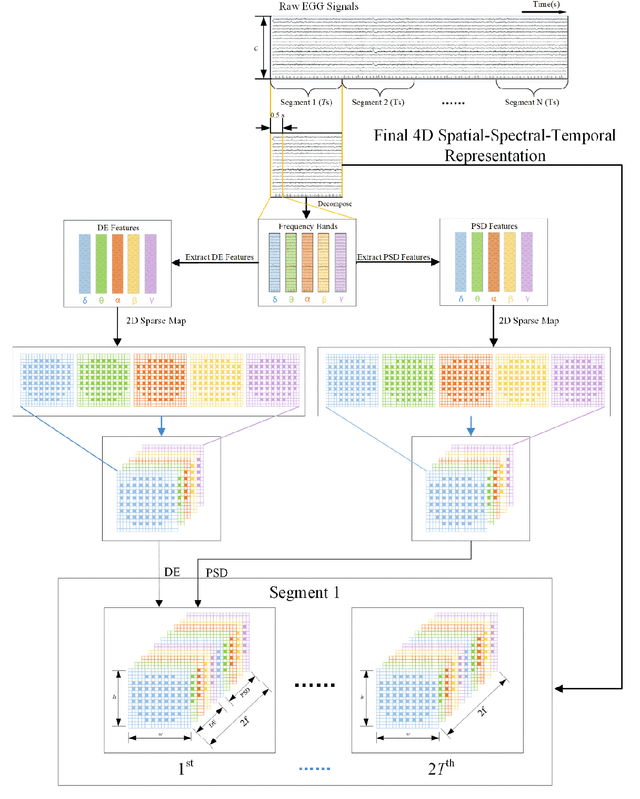
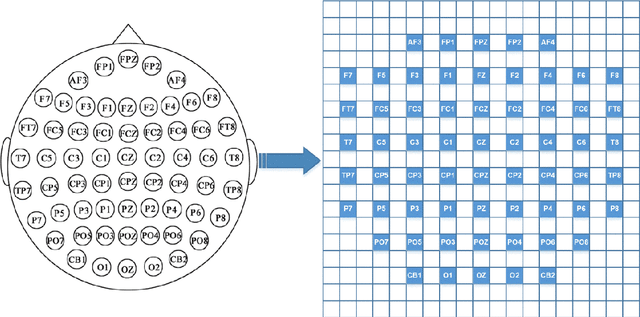
Electroencephalograph (EEG) emotion recognition is a significant task in the brain-computer interface field. Although many deep learning methods are proposed recently, it is still challenging to make full use of the information contained in different domains of EEG signals. In this paper, we present a novel method, called four-dimensional attention-based neural network (4D-aNN) for EEG emotion recognition. First, raw EEG signals are transformed into 4D spatial-spectral-temporal representations. Then, the proposed 4D-aNN adopts spectral and spatial attention mechanisms to adaptively assign the weights of different brain regions and frequency bands, and a convolutional neural network (CNN) is utilized to deal with the spectral and spatial information of the 4D representations. Moreover, a temporal attention mechanism is integrated into a bidirectional Long Short-Term Memory (LSTM) to explore temporal dependencies of the 4D representations. Our model achieves state-of-the-art performance on the SEED dataset under intra-subject splitting. The experimental results have shown the effectiveness of the attention mechanisms in different domains for EEG emotion recognition.