 Add to Chrome
 Add to Firefox
 Add to Edge
Bounding Global and Local Compression Error of Signal Parameterizations
May 28, 2026
Differentiable signal parameterizations such as implicit neural representations (INRs) and hybrid models are increasingly central to computational imaging, yet principled tools for evaluating reconstruction fidelity at finite model size remain limited when ground truth is unavailable. We introduce a framework for predicting the reconstruction error of compressive signal parameterizations, yielding non-asymptotic, signal-specific bounds that are both theoretically sound and efficiently computable without access to the ground truth signal. Specifically, we prove that when parameterization-based compression satisfies certain natural properties, the compression error at any compression level is bounded by a simple scaled difference between model predictions at different compression levels. We verify these properties for representative model families including interpolated grids, Fourier feature networks, multi-resolution hash encodings, and tensor factorizations, and show empirically that the resulting worst-case guarantees can be efficiently adapted into signal-specific error predictors that are tight and generalizable. Across direct fitting of synthetic and natural signals, and inverse problems including radiance field and MRI reconstruction, our method closely tracks global error curves and yields informative local error heatmaps without ground-truth access. Code is available at https://github.com/voilalab/global_error_bound.

Multi-modal deformable image registration using untrained neural networks
Nov 04, 2024
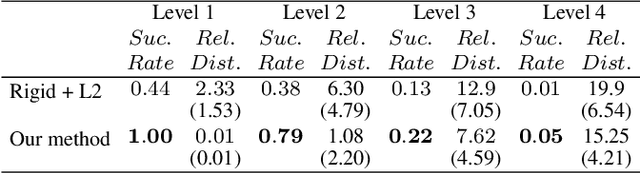
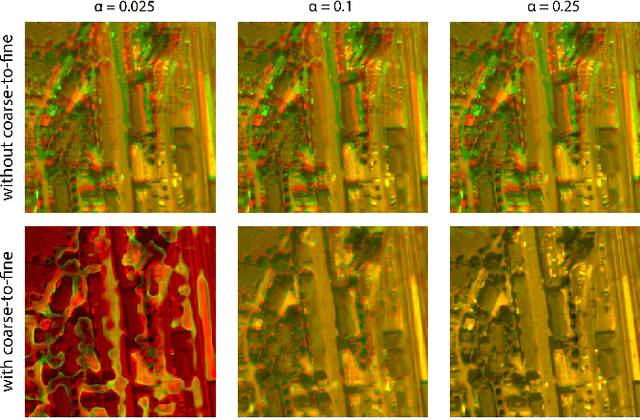
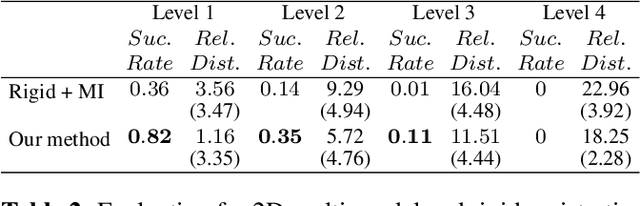
Image registration techniques usually assume that the images to be registered are of a certain type (e.g. single- vs. multi-modal, 2D vs. 3D, rigid vs. deformable) and there lacks a general method that can work for data under all conditions. We propose a registration method that utilizes neural networks for image representation. Our method uses untrained networks with limited representation capacity as an implicit prior to guide for a good registration. Unlike previous approaches that are specialized for specific data types, our method handles both rigid and non-rigid, as well as single- and multi-modal registration, without requiring changes to the model or objective function. We have performed a comprehensive evaluation study using a variety of datasets and demonstrated promising performance.