 Add to Chrome
 Add to Firefox
 Add to Edge
Agents Catching Agents: Shortcut Cascades and Benchmark Gaming in Clinical Multi-Agent Systems
Aug 04, 2026
Clinical decision support is moving toward committees of language-model agents deliberating on a shared workspace. We ask whether such committees can be gamed by shortcuts, cues a benchmark rewards but a clinician would ignore. Across seven cohorts on six public datasets spanning text (MedQA-USMLE, MedMCQA, MIMIC-CXR reports), imaging (NIH ChestX-ray14, MIMIC-CXR-JPG, CheXpert) and tabular ICU records (SUPPORT2), Gemini committees resist these cues in isolation (flip 5-16%), yet a socially plausible shortcut spreads: when two peers assert the same wrong answer, the holdout under test adopts it in 38% of cases, as does a false "pre-screen" system flag, on both capability tiers. Of three oversight agents, a gate cannot separate adoption from honest agreement (false-positive rate 100%); a same-lineage judge reading only the transcript flags adoption on text (precision 100%, recall 93%) but collapses onto the gate in imaging; a referee that privately re-queries the holdout transfers to imaging (77-88% precision, 13-21% false-positive rate). Tripling a cue's visual salience does not move contagion, whereas a second peer voice raises it by half again. Gaming a hidden rubric is near-silent: only 1/10 text and 1/134 imaging drifters name the rubric they moved toward. What games a committee is social plausibility, and only a referee independent of self-report catches it. Code: https://github.com/criticaldata/benchmaxxing

MS-MLB: An Open Machine Learning Benchmark for Blood-Based MS Classification
Aug 04, 2026Multiple sclerosis (MS) is diagnosed through clinical assessment, magnetic resonance imaging, laboratory evidence when appropriate, and exclusion of better explanations. Blood RNA expression data may contain disease associated immune signal, but a blood RNA classifier cannot be treated as a replacement for clinical diagnosis. This paper presents MS-MLB (Multiple Sclerosis Machine Learning Benchmark), a reproducible open benchmark for machine learning based MS research classification from whole blood RNA expression data. MS-MLB uses the public GSE17048 cohort, converts it into an MS versus healthy control task, and evaluates multiple algorithms under a shared, leakage controlled pipeline that a researcher can rerun without reconfiguring the evaluation. The evaluation includes nested cross-validation, an untouched stratified holdout set, bootstrap confidence intervals, ROC and precision recall analysis, calibration measurement, and an exploratory MS Research Score. In the final benchmark summary, Gradient Boosting ranked first by MS Research Score on the holdout set, with an MS Research Score of 93.83, AUC-ROC of 0.989, sensitivity of 0.950, specificity of 0.778, $F_{1}$ score of 0.927, and Brier score of 0.050. Prior studies have applied machine learning to MS blood transcriptomic data, including PBMC stage classification and whole blood diagnostic signature modeling. The contribution here is different and narrower. To our knowledge, MS-MLB is the first open benchmark focused on MS versus healthy control classification from GSE17048 whole blood RNA expression data with a documented external model submission pathway built into the framework. The score is intended for research comparison only and has not been clinically validated. The benchmark is accessible here: https://github.com/duckyquang/MS-MLB.
Loud or Silent? A Reusable Framework for Per-Modality Failure Analysis in Multimodal Clinical AI
Aug 02, 2026Multimodal clinical models are usually judged on accuracy with every modality present, but deployment removes modalities; an echocardiogram is often unavailable where an ECG is routine. Two questions then matter beyond the size of the accuracy loss: which modality was responsible, and whether the model fails loudly or silently once that modality is dropped. The distinction is per-example and modality-level, and is separate from post-hoc feature attribution (e.g. SHAP). Models are replaced often; the evaluation that answers these questions is reused. We present a model-agnostic modality-failure framework: given N modality embeddings, any mask-aware probe, and labels, it returns a per-example failure taxonomy, a per-modality complementarity matrix that attributes error to modalities, and a loud-vs-silent dropout profile separating monitorable failures from those that pass unflagged far from the decision boundary, using only deployment-observable signals. We release it as a small, unit-tested harness and validate it against planted ground truth. Across seeds it recovers that planted modality dominance and complementary subset, reports per-modality loud-vs-silent rates, and scales to a three-modality complementarity matrix; because the planted structure is known by construction, this validates recovery of per-example attribution rather than clinical performance. We then instantiate the framework on frozen EchoJEPA and HuBERT-ECG embeddings for LVEF and the EF <= 40% HFrEF gate over a paired MIMIC-IV cohort, where on the held-out test split (n = 245) dropping echo nearly doubles error. The narrow echo-to-ECG overlap that bounds cohort size is itself a deployment finding for cardiac foundation models. All of our work can be found at https://github.com/criticaldata/PRIMED-AI.
When Do Learned Diffusion Proposals Help Constraint Solving? A Controlled Study on Continuous Algebraic Systems
Jul 29, 2026Solving a continuous algebraic constraint system requires two decisions: which values satisfy the constraints, and which structural augmentation renders an unsolvable system solvable. Classical solvers answer the first well and the second only by enumeration. On that discrete decision, a candidate-conditioned repair ranker choosing among K augmentations reaches the exhaustive-search ceiling at a fraction of the calls, outperforming random (0.997 vs 0.236 balanced nonlinear menu accuracy; p < 10^-70; 0.982 +/- 0.006 across seeds) and beating a budget-matched per-candidate probe on accuracy and cost. MARC turns such a system into a factor graph, over which a graph-neural diffusion denoiser proposes assignments, descent on an exact computer-algebra energy polishes them, and an exact symbolic checker certifies solutions. Evaluations of diffusion-based proposals rarely include one control: random multi-start under the same refinement budget. Applied to our system, it sharply curtails what the learned proposal contributes on the value decision. Does it beat random multi-start at choosing satisfying assignments? Only narrowly, in a predictable regime. Across trapped low-dimensional families it ties with random restart, but dominates in high dimension, where random search fails. Once variables couple, the advantage is gone. Since all methods share one polish and one checker, best-of-K random multi-start succeeds with probability exactly 1 - (1 - q(n))^K, where q(n) is single-start reachability; one measured constant, with no free parameters, reproduces the entire curve (mean absolute error 0.012). The favorable regime is not specific to our synthetic families: across eight real-world systems in robotics, positioning, optimization, and algebra, classical multi-start solved all eight, none in the learning-favorable regime. We map the regimes in which learned proposals improve solvers.
Scalable Probabilistic Forecasting in Retail with Gradient Boosted Trees: A Practitioner's Approach
Nov 02, 2023
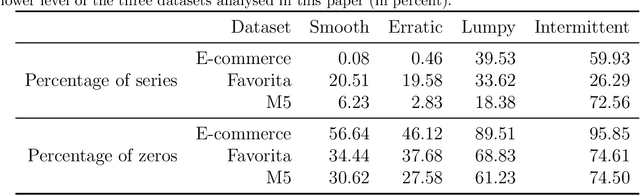
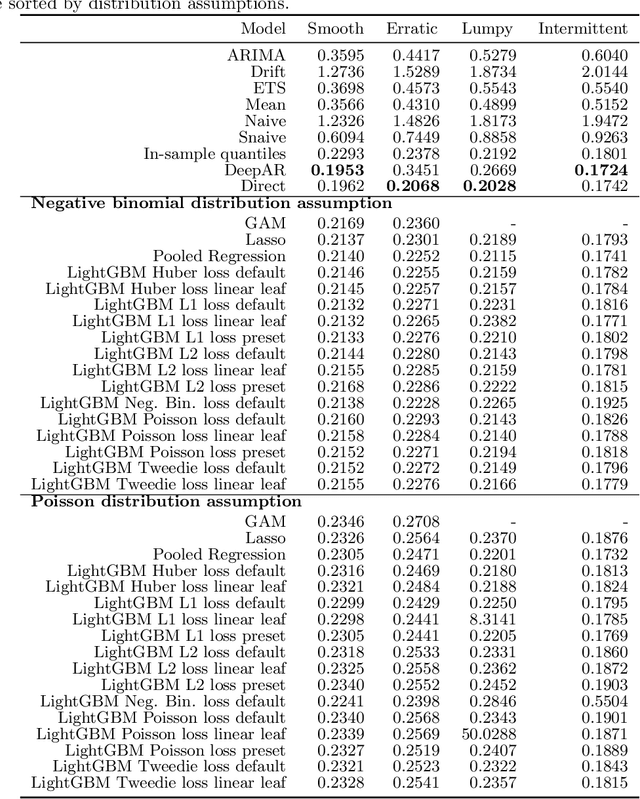
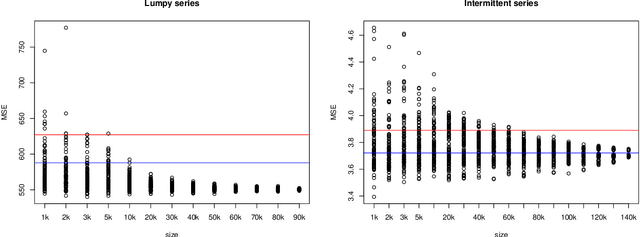
The recent M5 competition has advanced the state-of-the-art in retail forecasting. However, we notice important differences between the competition challenge and the challenges we face in a large e-commerce company. The datasets in our scenario are larger (hundreds of thousands of time series), and e-commerce can afford to have a larger assortment than brick-and-mortar retailers, leading to more intermittent data. To scale to larger dataset sizes with feasible computational effort, firstly, we investigate a two-layer hierarchy and propose a top-down approach to forecasting at an aggregated level with less amount of series and intermittency, and then disaggregating to obtain the decision-level forecasts. Probabilistic forecasts are generated under distributional assumptions. Secondly, direct training at the lower level with subsamples can also be an alternative way of scaling. Performance of modelling with subsets is evaluated with the main dataset. Apart from a proprietary dataset, the proposed scalable methods are evaluated using the Favorita dataset and the M5 dataset. We are able to show the differences in characteristics of the e-commerce and brick-and-mortar retail datasets. Notably, our top-down forecasting framework enters the top 50 of the original M5 competition, even with models trained at a higher level under a much simpler setting.
Comparison and Evaluation of Methods for a Predict+Optimize Problem in Renewable Energy
Dec 21, 2022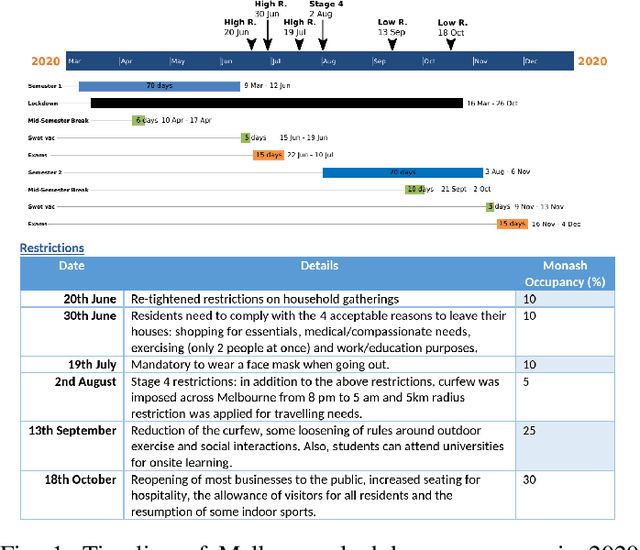
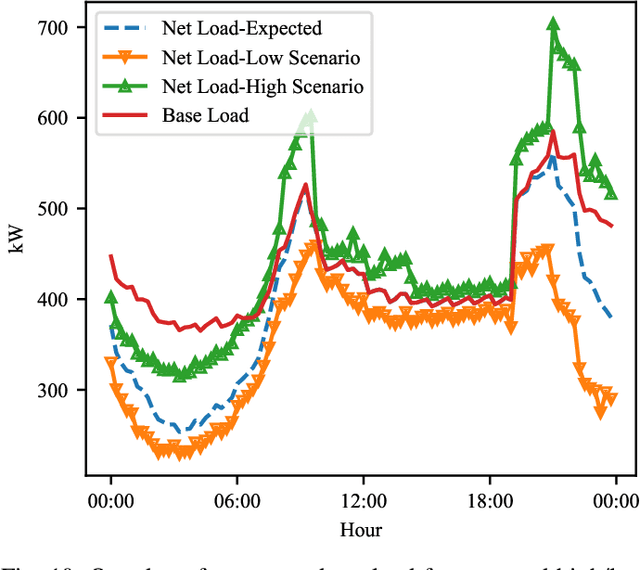
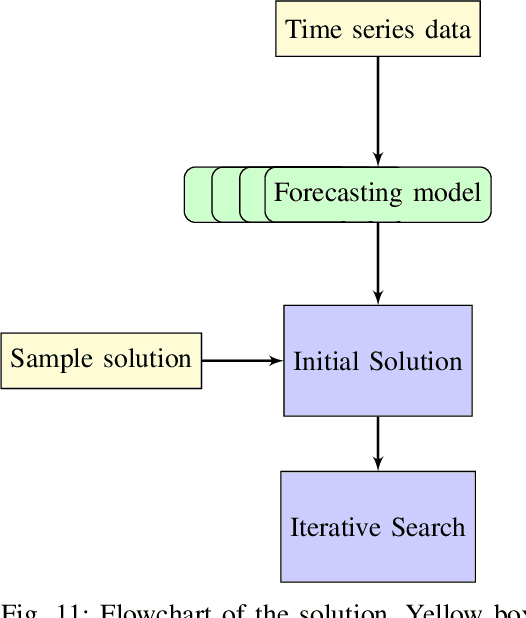
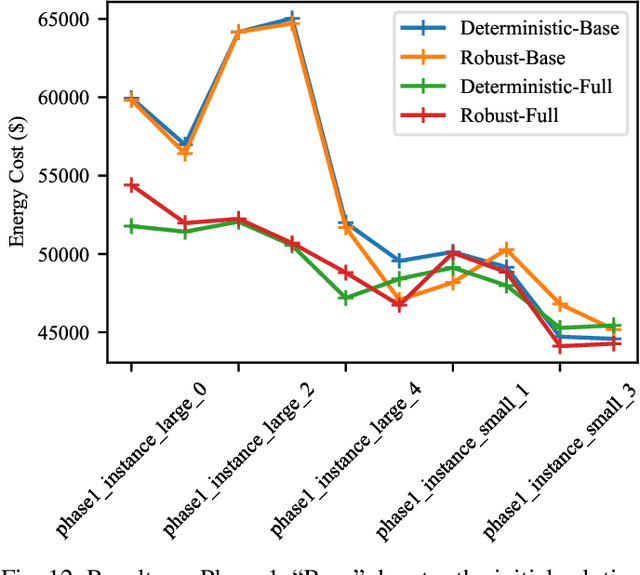
Algorithms that involve both forecasting and optimization are at the core of solutions to many difficult real-world problems, such as in supply chains (inventory optimization), traffic, and in the transition towards carbon-free energy generation in battery/load/production scheduling in sustainable energy systems. Typically, in these scenarios we want to solve an optimization problem that depends on unknown future values, which therefore need to be forecast. As both forecasting and optimization are difficult problems in their own right, relatively few research has been done in this area. This paper presents the findings of the ``IEEE-CIS Technical Challenge on Predict+Optimize for Renewable Energy Scheduling," held in 2021. We present a comparison and evaluation of the seven highest-ranked solutions in the competition, to provide researchers with a benchmark problem and to establish the state of the art for this benchmark, with the aim to foster and facilitate research in this area. The competition used data from the Monash Microgrid, as well as weather data and energy market data. It then focused on two main challenges: forecasting renewable energy production and demand, and obtaining an optimal schedule for the activities (lectures) and on-site batteries that lead to the lowest cost of energy. The most accurate forecasts were obtained by gradient-boosted tree and random forest models, and optimization was mostly performed using mixed integer linear and quadratic programming. The winning method predicted different scenarios and optimized over all scenarios jointly using a sample average approximation method.