 Add to Chrome
 Add to Firefox
 Add to Edge
Multi-Resolution End-to-End Deep Neural Network for Optimizing Latency-Accuracy Tradeoff in Autonomous Driving
May 27, 2026
Latency-accuracy tradeoffs are fundamental in real-time applications of deep neural networks (DNNs) for cyber-physical systems. In autonomous driving, in particular, safety depends on both prediction quality and the end-to-end delay from sensing to actuation. We observe that (1) when latency is accounted for, the latency-optimal network configuration varies with scene context and compute availability; and (2) a single fixed-resolution model becomes suboptimal as conditions change. We present a multi-resolution, end-to-end deep neural network for the CARLA urban driving challenge using monocular camera input. Our approach employs a convolutional neural network (CNN) that supports multiple input resolutions through per-resolution batch normalization, enabling runtime selection of an ideal input scale under a latency budget, as well as resolution retargeting, which allows multi-resolution training without access to the original training dataset. We implement and evaluate our multi-resolution end-to-end CNN in CARLA to explore the latency-safety frontier. Results show consistent improvements in per-route safety metrics - lane invasions, red-light infractions, and collisions - relative to fixed-resolution baselines.

TinyLidarNet: 2D LiDAR-based End-to-End Deep Learning Model for F1TENTH Autonomous Racing
Oct 09, 2024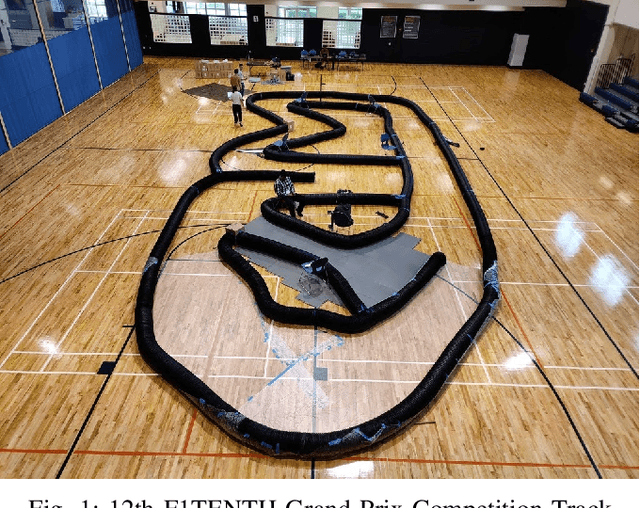
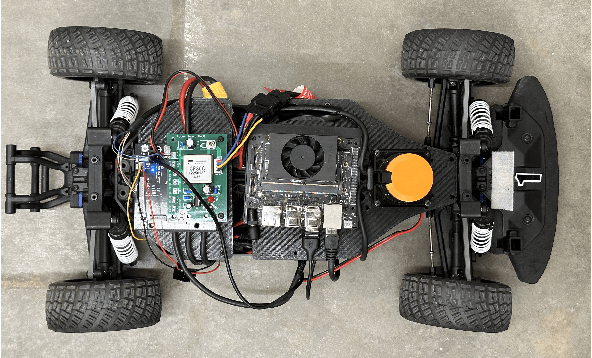
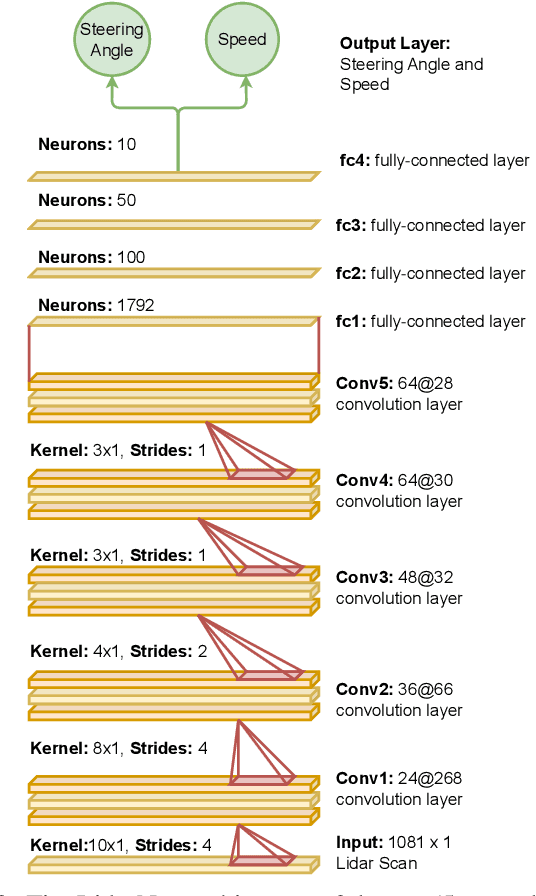
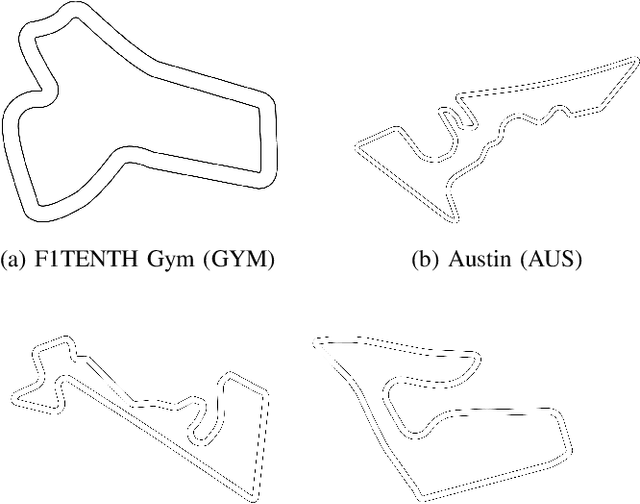
Prior research has demonstrated the effectiveness of end-to-end deep learning for robotic navigation, where the control signals are directly derived from raw sensory data. However, the majority of existing end-to-end navigation solutions are predominantly camera-based. In this paper, we introduce TinyLidarNet, a lightweight 2D LiDAR-based end-to-end deep learning model for autonomous racing. An F1TENTH vehicle using TinyLidarNet won 3rd place in the 12th F1TENTH Autonomous Grand Prix competition, demonstrating its competitive performance. We systematically analyze its performance on untrained tracks and computing requirements for real-time processing. We find that TinyLidarNet's 1D Convolutional Neural Network (CNN) based architecture significantly outperforms widely used Multi-Layer Perceptron (MLP) based architecture. In addition, we show that it can be processed in real-time on low-end micro-controller units (MCUs).