 Add to Chrome
 Add to Firefox
 Add to Edge
Structural Guidance for Unified Joint Demosaicing and Denoising
Aug 07, 2026
Joint demosaicing and denoising is a fundamental step in camera image signal processing, yet remains challenging because different Bayer-like color filter arrays (CFAs) and sensor noise jointly corrupt both color sampling and image content. Existing unified restoration networks explicitly model CFA geometry but are still driven primarily by pixel-level supervision, making them prone to structural degradation around edges, repetitive textures, and moiré patterns where local evidence is unreliable. We attribute this limitation partly to the absence of explicit structural guidance beyond pixel-level reconstruction supervision. Motivated by this observation, we propose a structural-guided unified restoration framework that injects pretrained structural knowledge into CFA-aware image restoration. Our model receives a unified five-channel observation consisting of the raw mosaic, CFA masks, and a noise-level map. A SwinIR restoration branch reconstructs pixel details under CFA-conditioned modulation, while a parallel structural reasoning branch extracts complementary structural cues from a sparse pseudo-RGB observation. To bridge the substantial domain gap between sparse noisy sensor data and the natural-image pretraining domain of the structural encoder, we introduce a lightweight trainable adapter before residually fusing structural and restoration features. A shared decoder jointly predicts the restored RGB image and an auxiliary clean mosaic, providing supervision in both image and sensor domains. Extensive experiments across multiple CFA patterns and noise levels demonstrate consistent improvements over state-of-the-art unified and CFA-specific methods, indicating that adapted structural priors can enhance robust camera image restoration. The source codes and dataset are provided in the supplementary material.

LLEMamba: Low-Light Enhancement via Relighting-Guided Mamba with Deep Unfolding Network
Jun 03, 2024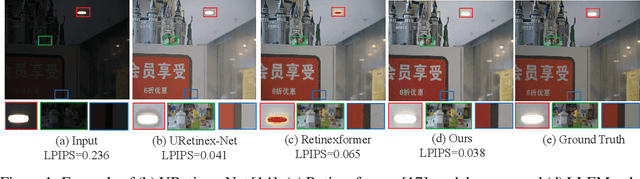
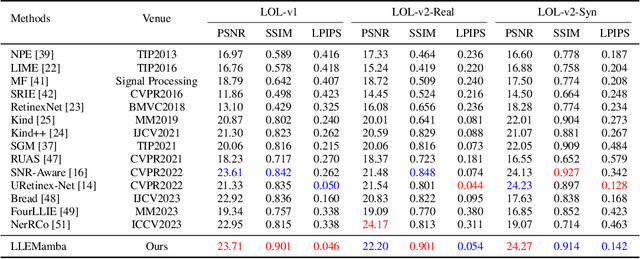
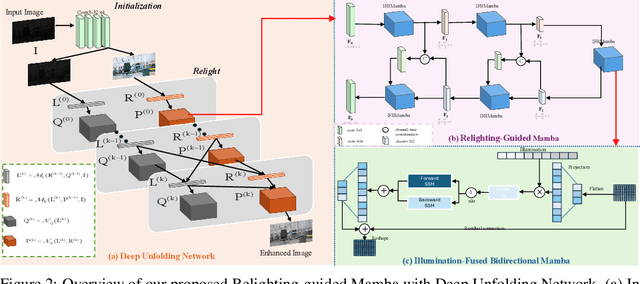

Transformer-based low-light enhancement methods have yielded promising performance by effectively capturing long-range dependencies in a global context. However, their elevated computational demand limits the scalability of multiple iterations in deep unfolding networks, and hence they have difficulty in flexibly balancing interpretability and distortion. To address this issue, we propose a novel Low-Light Enhancement method via relighting-guided Mamba with a deep unfolding network (LLEMamba), whose theoretical interpretability and fidelity are guaranteed by Retinex optimization and Mamba deep priors, respectively. Specifically, our LLEMamba first constructs a Retinex model with deep priors, embedding the iterative optimization process based on the Alternating Direction Method of Multipliers (ADMM) within a deep unfolding network. Unlike Transformer, to assist the deep unfolding framework with multiple iterations, the proposed LLEMamba introduces a novel Mamba architecture with lower computational complexity, which not only achieves light-dependent global visual context for dark images during reflectance relight but also optimizes to obtain more stable closed-form solutions. Experiments on the benchmarks show that LLEMamba achieves superior quantitative evaluations and lower distortion visual results compared to existing state-of-the-art methods.