 Add to Chrome
 Add to Firefox
 Add to Edge
What Makes a Peer? Valuation-Anchored Similarity in Private Markets
Aug 12, 2026
As more investors contemplate private markets and contend with limited transparency, sparse disclosures, and infrequent transactions, identifying economically meaningful peer companies for comparison is a fundamental challenge for valuation, due diligence, portfolio construction, and risk management. We propose an ensemble tree-based supervised similarity learning framework that defines company similarity through the lens of market valuation rather than static feature matching or semantic descriptions. Specifically, we train a CatBoost gradient-boosted decision tree model on observed private company valuations and derive a valuation-aware similarity metric from importance-weighted leaf-node co-occurrences across the ensemble. The similarity metric captures shared valuation drivers while accommodating nonlinear relationships, mixed data types, and pervasive missing data common in private markets. Using a global private-market universe of approximately 270,000 companies, including more than 53,000 firms with observed or derivable post-money valuations spanning multiple industries, geographies, and deal stages, we demonstrate that the proposed similarity framework improves upon traditional distance-based and text-embedding-based approaches in downstream k-nearest-neighbor valuation tasks in the evaluated industry groups, while retaining case-based explainability.

Machine learning dynamics of phase separation in correlated electron magnets
Jun 07, 2020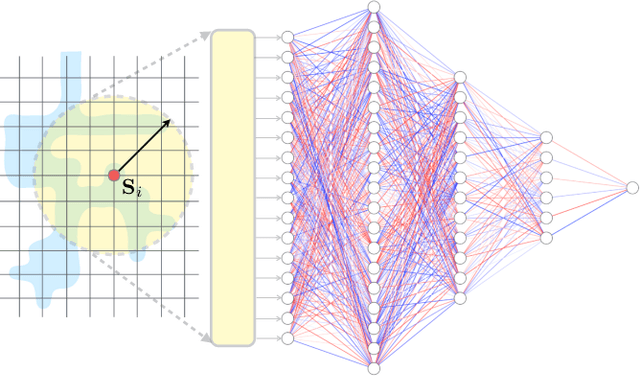
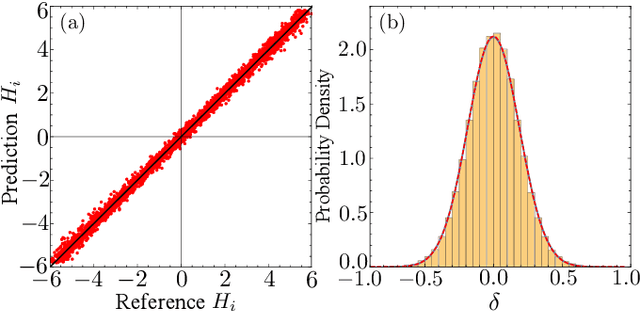
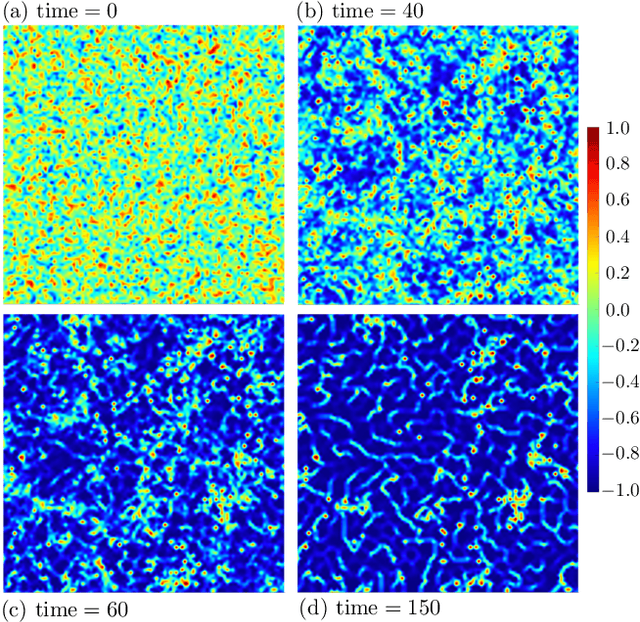
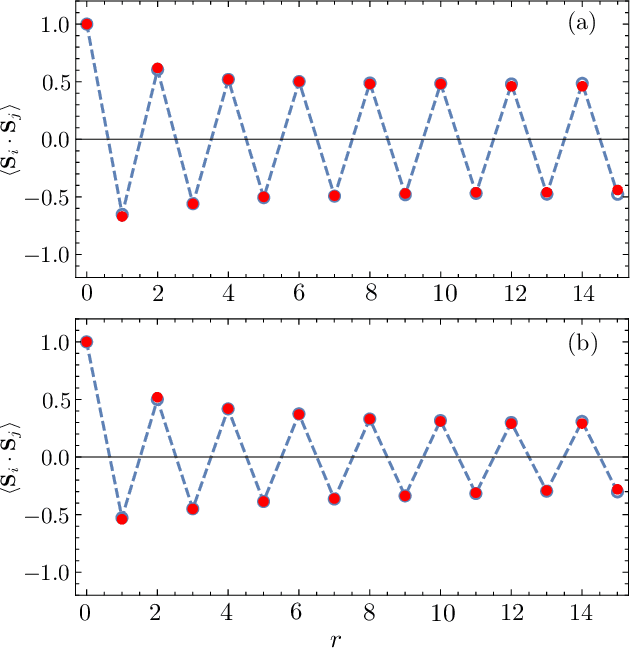
We demonstrate machine-learning enabled large-scale dynamical simulations of electronic phase separation in double-exchange system. This model, also known as the ferromagnetic Kondo lattice model, is believed to be relevant for the colossal magnetoresistance phenomenon. Real-space simulations of such inhomogeneous states with exchange forces computed from the electron Hamiltonian can be prohibitively expensive for large systems. Here we show that linear-scaling exchange field computation can be achieved using neural networks trained by datasets from exact calculation on small lattices. Our Landau-Lifshitz dynamics simulations based on machine-learning potentials nicely reproduce not only the nonequilibrium relaxation process, but also correlation functions that agree quantitatively with exact simulations. Our work paves the way for large-scale dynamical simulations of correlated electron systems using machine-learning models.