 Add to Chrome
 Add to Firefox
 Add to Edge
Understanding Calibration and Truncation Error Propagation in Training-Free Low-Rank Compression for LLMs
Aug 09, 2026
Training-free low-rank compression frameworks have been gaining prominence for LLM compression given their effectiveness in reducing model parameter count while maintaining task-level accuracy. However, existing SOTA frameworks share two key limitations: (1) residual errors in calibration data activations accumulate across layers during compression, causing misalignment between representations simulated at compression time and those experienced at inference; (2) the assumption that layer importance distribution is preserved post-compression does not hold. Together, these two effects introduce misalignment in the compression process in relation to the deployed model. We study these effects and propose a simple, training-free methodology compatible with existing frameworks to mitigate them, comprising: (1) Layer-by-Layer Compression with Calibration Correction; (2) Iterative Compression with Rank Allocation Correction. Implemented atop an existing SOTA decomposition framework, and evaluated on Llama and Qwen3 models across various benchmarks and compression rates, our approach demonstrates up to ~1-2.5 accuracy point improvements over per-weight and joint decomposition baselines on zero-shot tasks.

CARVQ: Corrective Adaptor with Group Residual Vector Quantization for LLM Embedding Compression
Oct 14, 2025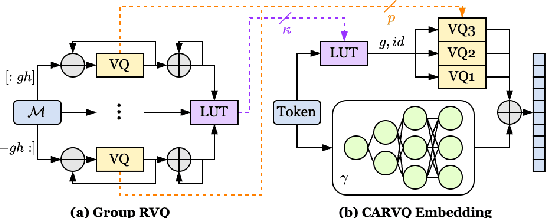
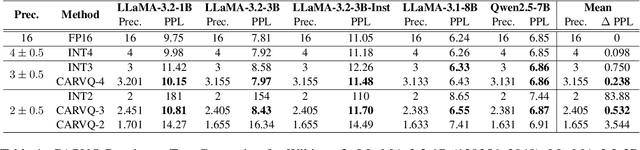
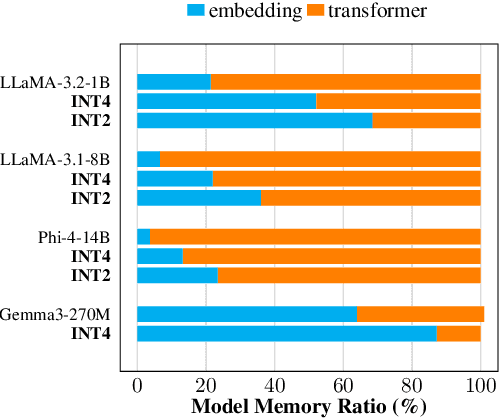
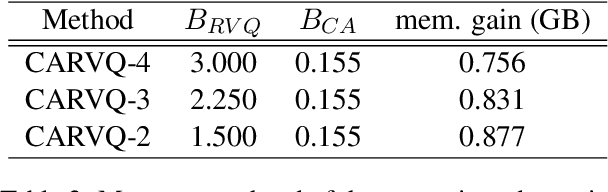
Large Language Models (LLMs) typically rely on a large number of parameters for token embedding, leading to substantial storage requirements and memory footprints. In particular, LLMs deployed on edge devices are memory-bound, and reducing the memory footprint by compressing the embedding layer not only frees up the memory bandwidth but also speeds up inference. To address this, we introduce CARVQ, a post-training novel Corrective Adaptor combined with group Residual Vector Quantization. CARVQ relies on the composition of both linear and non-linear maps and mimics the original model embedding to compress to approximately 1.6 bits without requiring specialized hardware to support lower-bit storage. We test our method on pre-trained LLMs such as LLaMA-3.2-1B, LLaMA-3.2-3B, LLaMA-3.2-3B-Instruct, LLaMA-3.1-8B, Qwen2.5-7B, Qwen2.5-Math-7B and Phi-4, evaluating on common generative, discriminative, math and reasoning tasks. We show that in most cases, CARVQ can achieve lower average bitwidth-per-parameter while maintaining reasonable perplexity and accuracy compared to scalar quantization. Our contributions include a novel compression technique that is compatible with state-of-the-art transformer quantization methods and can be seamlessly integrated into any hardware supporting 4-bit memory to reduce the model's memory footprint in memory-constrained devices. This work demonstrates a crucial step toward the efficient deployment of LLMs on edge devices.