 Add to Chrome
 Add to Firefox
 Add to Edge
Cascade: Composing Software-Hardware Attack Gadgets for Adversarial Threat Amplification in Compound AI Systems
Mar 12, 2026
Rapid progress in generative AI has given rise to Compound AI systems - pipelines comprised of multiple large language models (LLM), software tools and database systems. Compound AI systems are constructed on a layered traditional software stack running on a distributed hardware infrastructure. Many of the diverse software components are vulnerable to traditional security flaws documented in the Common Vulnerabilities and Exposures (CVE) database, while the underlying distributed hardware infrastructure remains exposed to timing attacks, bit-flip faults, and power-based side channels. Today, research targets LLM-specific risks like model extraction, training data leakage, and unsafe generation -- overlooking the impact of traditional system vulnerabilities. This work investigates how traditional software and hardware vulnerabilities can complement LLM-specific algorithmic attacks to compromise the integrity of a compound AI pipeline. We demonstrate two novel attacks that combine system-level vulnerabilities with algorithmic weaknesses: (1) Exploiting a software code injection flaw along with a guardrail Rowhammer attack to inject an unaltered jailbreak prompt into an LLM, resulting in an AI safety violation, and (2) Manipulating a knowledge database to redirect an LLM agent to transmit sensitive user data to a malicious application, thus breaching confidentiality. These attacks highlight the need to address traditional vulnerabilities; we systematize the attack primitives and analyze their composition by grouping vulnerabilities by their objective and mapping them to distinct stages of an attack lifecycle. This approach enables a rigorous red-teaming exercise and lays the groundwork for future defense strategies.

SoK: A Systems Perspective on Compound AI Threats and Countermeasures
Nov 20, 2024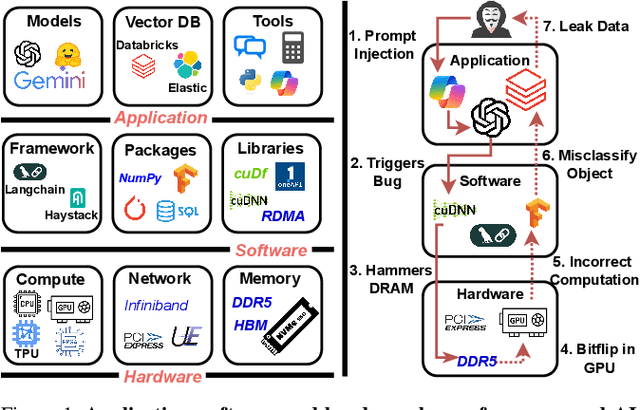
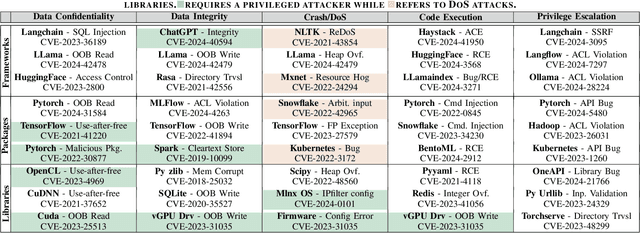
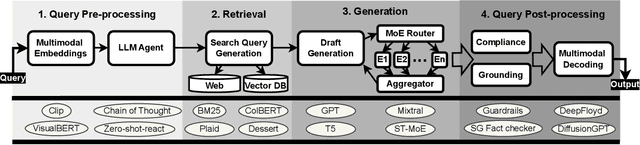
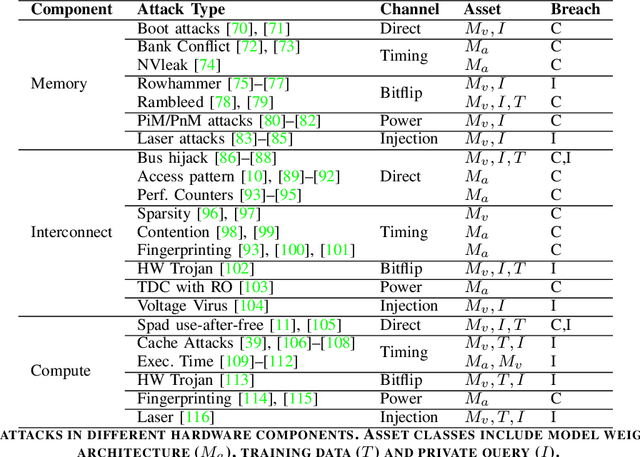
Large language models (LLMs) used across enterprises often use proprietary models and operate on sensitive inputs and data. The wide range of attack vectors identified in prior research - targeting various software and hardware components used in training and inference - makes it extremely challenging to enforce confidentiality and integrity policies. As we advance towards constructing compound AI inference pipelines that integrate multiple large language models (LLMs), the attack surfaces expand significantly. Attackers now focus on the AI algorithms as well as the software and hardware components associated with these systems. While current research often examines these elements in isolation, we find that combining cross-layer attack observations can enable powerful end-to-end attacks with minimal assumptions about the threat model. Given, the sheer number of existing attacks at each layer, we need a holistic and systemized understanding of different attack vectors at each layer. This SoK discusses different software and hardware attacks applicable to compound AI systems and demonstrates how combining multiple attack mechanisms can reduce the threat model assumptions required for an isolated attack. Next, we systematize the ML attacks in lines with the Mitre Att&ck framework to better position each attack based on the threat model. Finally, we outline the existing countermeasures for both software and hardware layers and discuss the necessity of a comprehensive defense strategy to enable the secure and high-performance deployment of compound AI systems.
ConfusedPilot: Confused Deputy Risks in RAG-based LLMs
Aug 15, 2024Retrieval augmented generation (RAG) is a process where a large language model (LLM) retrieves useful information from a database and then generates the responses. It is becoming popular in enterprise settings for daily business operations. For example, Copilot for Microsoft 365 has accumulated millions of businesses. However, the security implications of adopting such RAG-based systems are unclear. In this paper, we introduce ConfusedPilot, a class of security vulnerabilities of RAG systems that confuse Copilot and cause integrity and confidentiality violations in its responses. First, we investigate a vulnerability that embeds malicious text in the modified prompt in RAG, corrupting the responses generated by the LLM. Second, we demonstrate a vulnerability that leaks secret data, which leverages the caching mechanism during retrieval. Third, we investigate how both vulnerabilities can be exploited to propagate misinformation within the enterprise and ultimately impact its operations, such as sales and manufacturing. We also discuss the root cause of these attacks by investigating the architecture of a RAG-based system. This study highlights the security vulnerabilities in today's RAG-based systems and proposes design guidelines to secure future RAG-based systems.
ConfusedPilot: Compromising Enterprise Information Integrity and Confidentiality with Copilot for Microsoft 365
Aug 09, 2024Retrieval augmented generation (RAG) is a process where a large language model (LLM) retrieves useful information from a database and then generates the responses. It is becoming popular in enterprise settings for daily business operations. For example, Copilot for Microsoft 365 has accumulated millions of businesses. However, the security implications of adopting such RAG-based systems are unclear. In this paper, we introduce ConfusedPilot, a class of security vulnerabilities of RAG systems that confuse Copilot and cause integrity and confidentiality violations in its responses. First, we investigate a vulnerability that embeds malicious text in the modified prompt in RAG, corrupting the responses generated by the LLM. Second, we demonstrate a vulnerability that leaks secret data, which leverages the caching mechanism during retrieval. Third, we investigate how both vulnerabilities can be exploited to propagate misinformation within the enterprise and ultimately impact its operations, such as sales and manufacturing. We also discuss the root cause of these attacks by investigating the architecture of a RAG-based system. This study highlights the security vulnerabilities in today's RAG-based systems and proposes design guidelines to secure future RAG-based systems.