 Add to Chrome
 Add to Firefox
 Add to Edge
Over-the-Air Transmission of Zak-OTFS on mmWave Communications Testbed
Nov 10, 2025

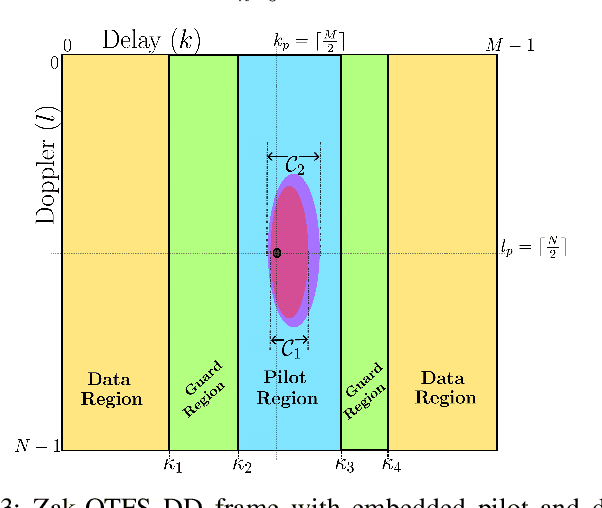
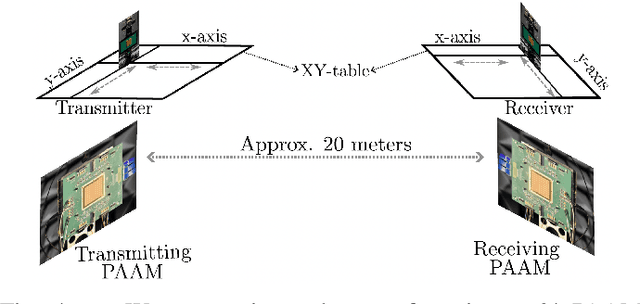
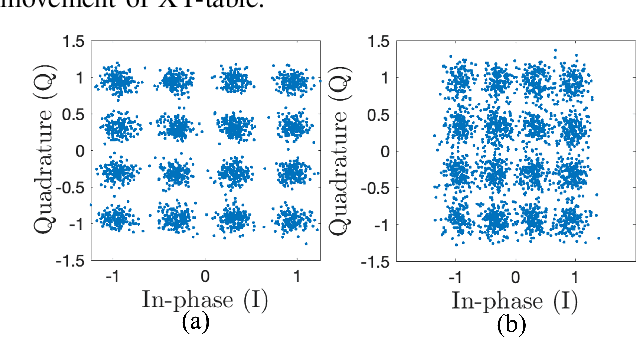
Millimeter-wave (mmWave) communication offers vast bandwidth for next-generation wireless systems but faces severe path loss, Doppler effects, and hardware impairments. Orthogonal Time Frequency Space (OTFS) modulation has emerged as a robust waveform for high-mobility and doubly dispersive channels, outperforming OFDM under strong Doppler. However, the most studied multicarrier OTFS (MC-OTFS) is not easily predictable because the input-output (I$/$O) relation is not given by (twisted) convolution. Recently, the Zak-transform based OTFS (Zak-OTFS or OTFS 2$.$0) was proposed, which provides a single domain delay Doppler (DD) processing framework with predictable I$/$O behavior. This paper presents one of the first over-the-air (OTA) demonstrations of Zak-OTFS at mmWave frequencies. We design a complete Zak-OTFS based mmWave OTA system featuring root-raised-cosine (RRC) filtering for enhanced DD-domain predictability, higher-order modulations up to 16-QAM, and a low-overhead preamble for synchronization. A comprehensive signal model incorporating carrier frequency offset (CFO) and timing impairments is developed, showing these effects can be jointly captured within the effective DD-domain channel. Experimental validation on the COSMOS testbed confirms the feasibility and robustness of Zak-OTFS under realistic mmWave conditions, highlighting its potential for efficient implementations in beyond-5G and 6G systems.

Wall-Street: Smart Surface-Enabled 5G mmWave for Roadside Networking
May 10, 2024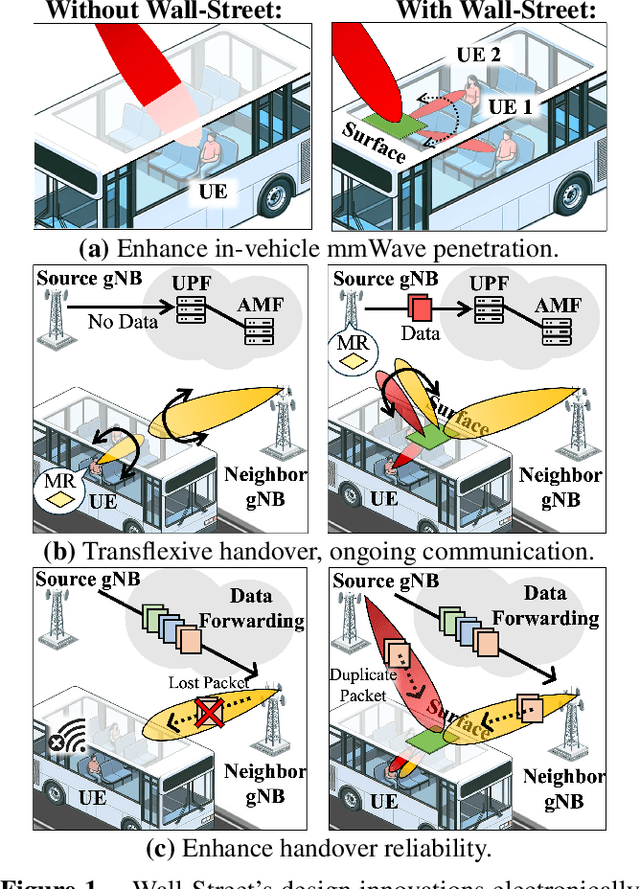
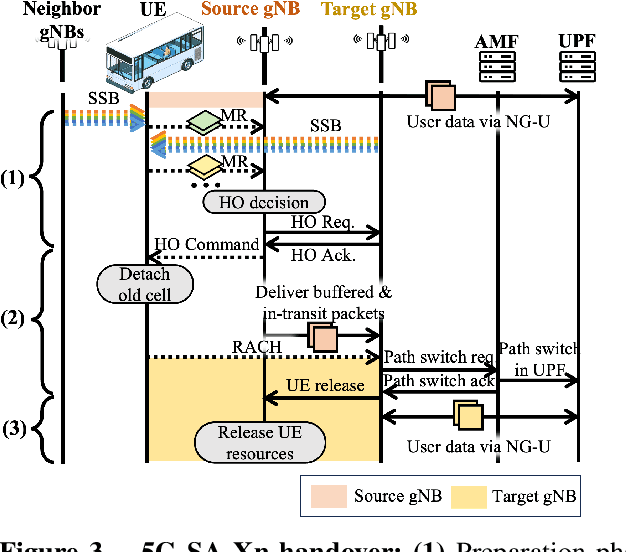
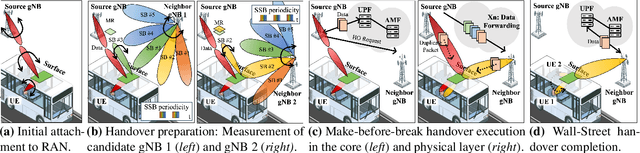
5G mmWave roadside networks promise high-speed wireless connectivity, but face significant challenges in maintaining reliable connections for users moving at high speed. Frequent handovers, complex beam alignment, and signal attenuation due to obstacles like car bodies lead to service interruptions and degraded performance. We present Wall-Street, a smart surface installed on vehicles to enhance 5G mmWave connectivity for users inside. Wall-Street improves mobility management by (1) steering outdoor mmWave signals into the vehicle, ensuring coverage for all users; (2) enabling simultaneous serving cell data transfer and candidate handover cell measurement, allowing seamless handovers without service interruption; and (3) combining beams from source and target cells during a handover to increase reliability. Through its flexible and diverse signal manipulation capabilities, Wall-Street provides uninterrupted high-speed connectivity for latency-sensitive applications in challenging mobile environments. We have implemented and integrated Wall-Street in the COSMOS testbed and evaluated its real-time performance with four gNBs and a mobile client inside a surface-enabled vehicle, driving on a nearby road. Wall-Street achieves a 2.5-3.4x TCP throughput improvement and a 0.4-0.8x reduction in delay over a baseline 5G Standalone handover protocol.
Implementation of FGPA based Channel Sounder for Large scale antenna systems using RFNoC on USRP Platform
Jan 12, 2022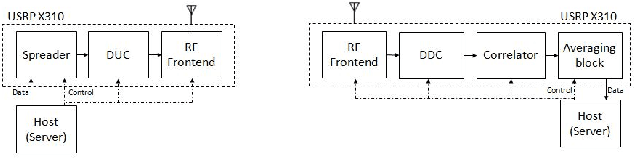
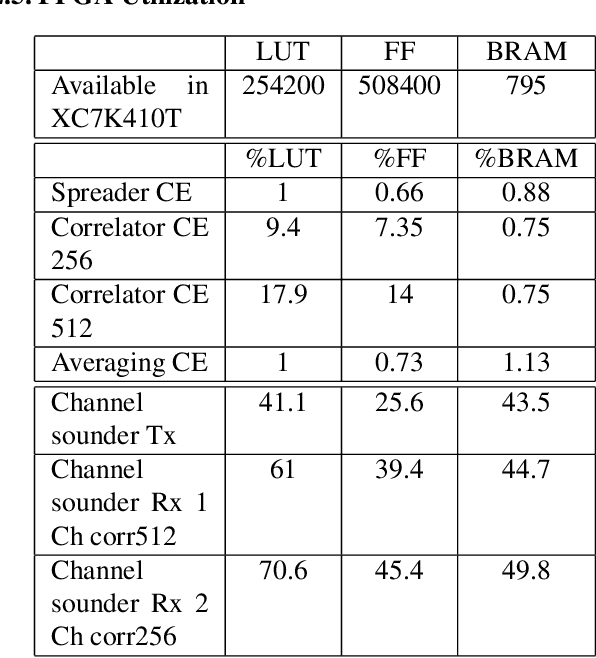
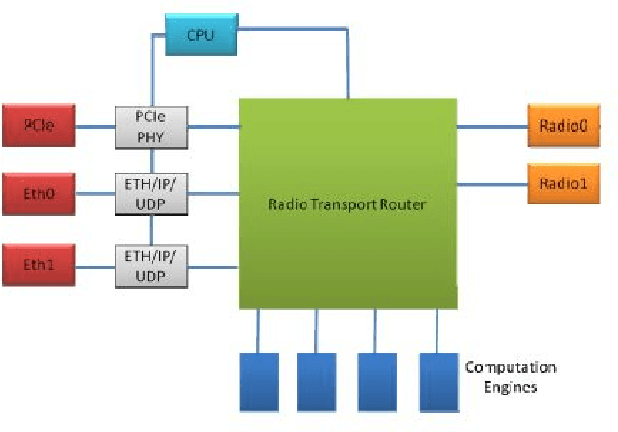
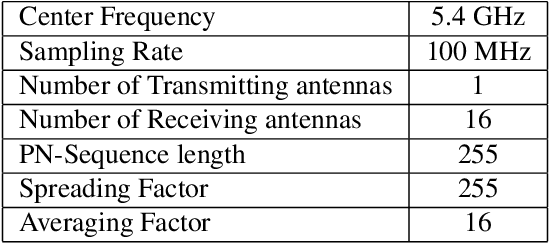
This paper concentrates on building a multi-antenna FPGA based Channel Sounder with single transmitter and multiple receivers to realize wireless propagation characteristics of an indoor environment. A DSSS signal (spread with a real maximum length PN sequence) is transmitted, which is correlated with the same PN sequence at each receiver to obtain the power delay profile . Multiple power delay profiles are averaged and the result is then sent to host. To utilize high bandwidth, the computationally expensive tasks related to generation and parallel correlation of PN sequences are moved to the FPGA present in each USRP (Universal Software Radio Peripheral). Channel sounder blocks were built using Vivado HLS and integrated with RFNoC (RF Network on Chip) framework, which were then used on USRP X310 devices.
* This paper was presented in GRCon 2017 and published in the Proceedings of the GNU Radio Conference