 Add to Chrome
 Add to Firefox
 Add to Edge
Chaotic CNN for Limited Data Image Classification
Apr 16, 2026
Convolutional neural networks (CNNs) often exhibit poor generalisation in limited training data scenarios due to overfitting and insufficient feature diversity. In this work, a simple and effective chaos-based feature transformation is proposed to enhance CNN performance without increasing model complexity. The method applies nonlinear transformations using logistic, skew tent, and sine maps to normalised feature vectors before the classification layer, thereby reshaping the feature space and improving class separability. The approach is evaluated on greyscale datasets (MNIST and Fashion-MNIST) and an RGB dataset (CIFAR-10) using CNN architectures of varying depth under limited data conditions. The results show consistent improvement over the standalone (SA) CNN across all datasets. Notably, a maximum performance gain of 5.43% is achieved on MNIST using the skew tent map with a 3-layer CNN at 40 samples per class. A higher gain of 9.11% is observed on Fashion-MNIST using the sine map with a 3-layer CNN at 50 samples per class. Additionally, a strong gain of 7.47% is obtained on CIFAR-10 using the skew tent map at 200 samples per class. The consistent improvements across different chaotic maps indicate that the performance gain is driven by the shared nonlinear and dynamical properties of chaotic systems. The proposed method is computationally efficient, requires no additional trainable parameters, and can be easily integrated into existing CNN architectures, making it a practical solution for data-scarce image classification tasks.

Self-Training the Neurochaos Learning Algorithm
Jan 03, 2026In numerous practical applications, acquiring substantial quantities of labelled data is challenging and expensive, but unlabelled data is readily accessible. Conventional supervised learning methods frequently underperform in scenarios characterised by little labelled data or imbalanced datasets. This study introduces a hybrid semi-supervised learning (SSL) architecture that integrates Neurochaos Learning (NL) with a threshold-based Self-Training (ST) method to overcome this constraint. The NL architecture converts input characteristics into chaos-based ring-rate representations that encapsulate nonlinear relationships within the data, whereas ST progressively enlarges the labelled set utilising high-confidence pseudo-labelled samples. The model's performance is assessed using ten benchmark datasets and five machine learning classifiers, with 85% of the training data considered unlabelled and just 15% utilised as labelled data. The proposed Self-Training Neurochaos Learning (NL+ST) architecture consistently attains superior performance gain relative to standalone ST models, especially on limited, nonlinear and imbalanced datasets like Iris (188.66%), Wine (158.58%) and Glass Identification (110.48%). The results indicate that using chaos-based feature extraction with SSL improves generalisation, resilience, and classification accuracy in low-data contexts.
Biologically inspired ChaosNet architecture for Hypothetical Protein Classification
Feb 05, 2023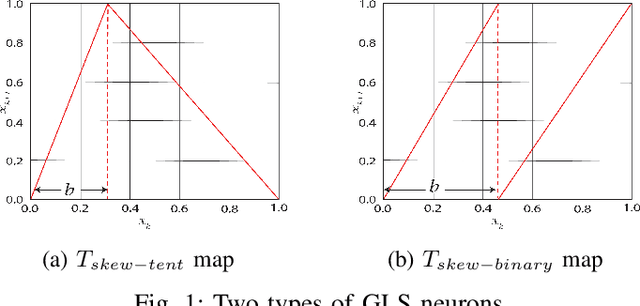
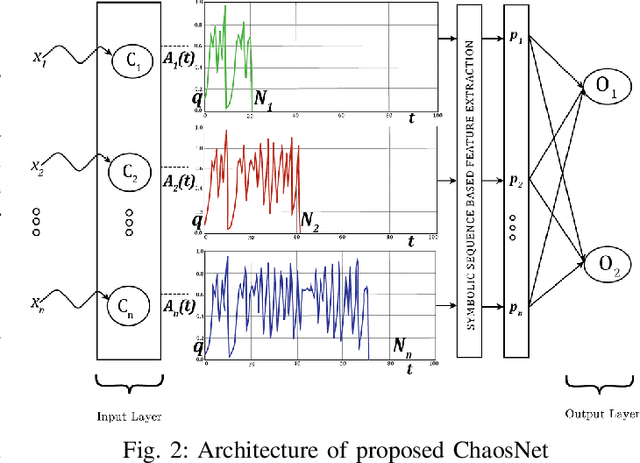

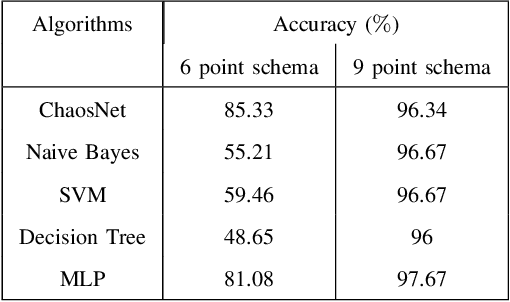
ChaosNet is a type of artificial neural network framework developed for classification problems and is influenced by the chaotic property of the human brain. Each neuron of the ChaosNet architecture is the one-dimensional chaotic map called the Generalized Luroth Series (GLS). The addition of GLS as neurons in ChaosNet makes the computations straightforward while utilizing the advantageous elements of chaos. With substantially less data, ChaosNet has been demonstrated to do difficult classification problems on par with or better than traditional ANNs. In this paper, we use Chaosnet to perform a functional classification of Hypothetical proteins [HP], which is indeed a topic of great interest in bioinformatics. The results obtained with significantly lesser training data are compared with the standard machine learning techniques used in the literature.
Physics-informed Neural Networks approach to solve the Blasius function
Dec 31, 2022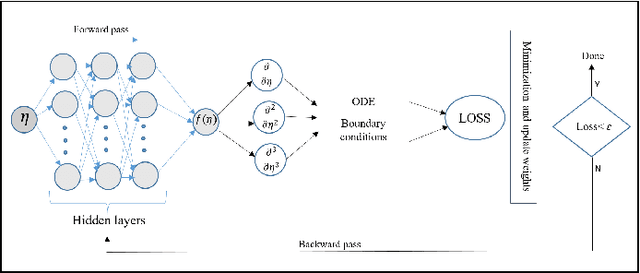
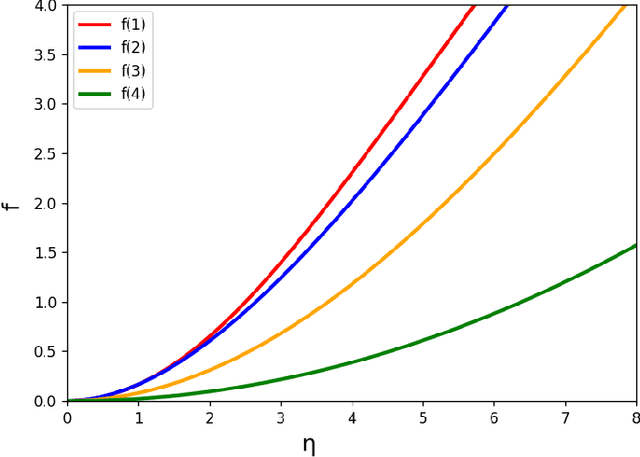
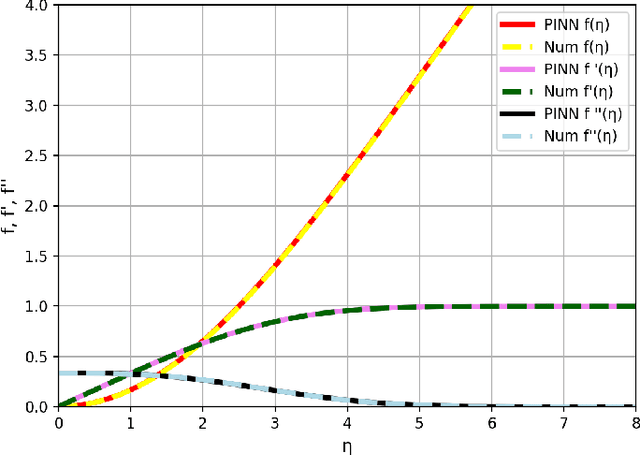
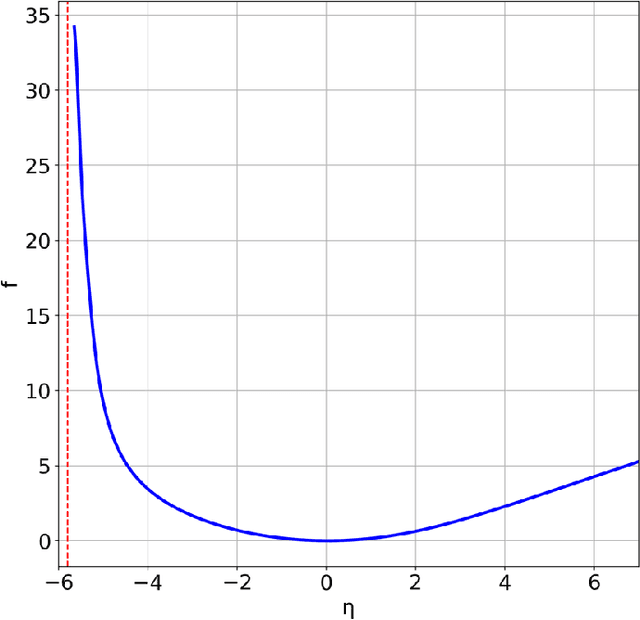
Deep learning techniques with neural networks have been used effectively in computational fluid dynamics (CFD) to obtain solutions to nonlinear differential equations. This paper presents a physics-informed neural network (PINN) approach to solve the Blasius function. This method eliminates the process of changing the non-linear differential equation to an initial value problem. Also, it tackles the convergence issue arising in the conventional series solution. It is seen that this method produces results that are at par with the numerical and conventional methods. The solution is extended to the negative axis to show that PINNs capture the singularity of the function at $\eta=-5.69$