 Add to Chrome
 Add to Firefox
 Add to Edge
MK-ResRecon: Multi-Kernel Residual Framework for Texture-Aware 3D MRI Refinement from Sparse 2D Slices
May 05, 2026
Magnetic Resonance Imaging (MRI) acquisition remains a time-intensive and patient-straining process, as prolonged scan dura- tions increase the likelihood of motion artifacts, which degrade image quality and frequently require repeated scans. To address these chal- lenges, we propose a novel framework with two models MK-ResRecon and IdentityRefineNet3D to reconstruct high-fidelity 3D MRI volumes from sparsely sampled 2D slices-requiring only 12.5% of the axial slices for full resolution 3D reconstruction. MK-ResRecon predicts missing in- termediate 2D slices using a multi-kernel texture-aware loss, preserving fine anatomical details. IdentityRefineNet3D refines the predicted slices and the original sparse slices as a single 3D volume to obtain a smooth anatomical structure. We train the models on a large T1-sequence POST- contrast brain MRI dataset and evaluate on a large heterogeneous brain MRI cohort. The work provides accurate, hallucination-free, generaliz- able and clinically validated framework for 3D MRI reconstruction from highly sparse inputs and enables a clinically viable path towards faster and more patient-friendly MRI imaging.

Separation of Unconscious Robots with Obstructed Visibility
Oct 25, 2025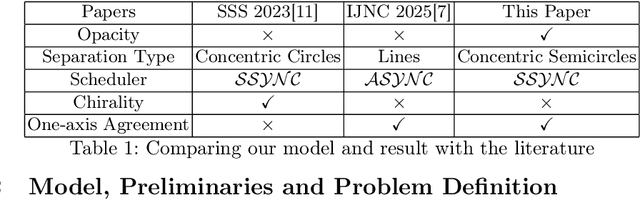
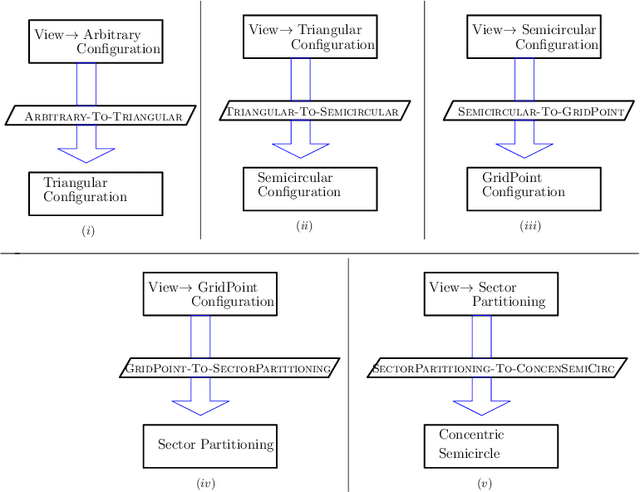
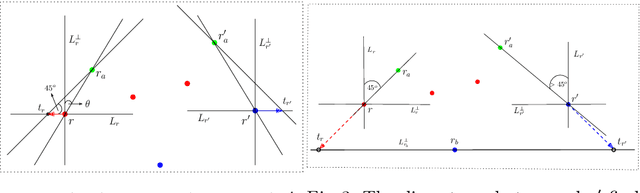
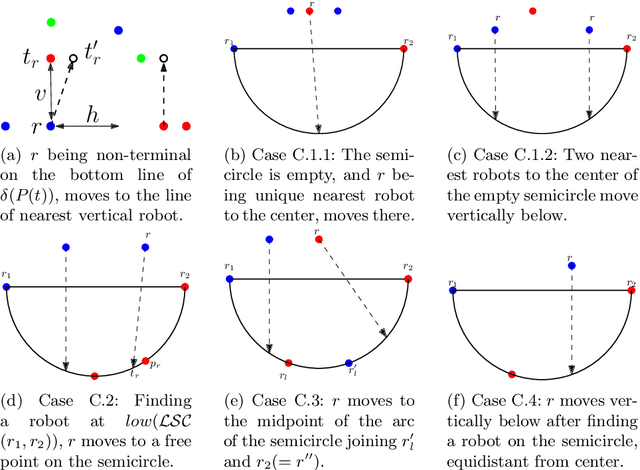
We study a recently introduced \textit{unconscious} mobile robot model, where each robot is associated with a \textit{color}, which is visible to other robots but not to itself. The robots are autonomous, anonymous, oblivious and silent, operating in the Euclidean plane under the conventional \textit{Look-Compute-Move} cycle. A primary task in this model is the \textit{separation problem}, where unconscious robots sharing the same color must separate from others, forming recognizable geometric shapes such as circles, points, or lines. All prior works model the robots as \textit{transparent}, enabling each to know the positions and colors of all other robots. In contrast, we model the robots as \textit{opaque}, where a robot can obstruct the visibility of two other robots, if it lies on the line segment between them. Under this obstructed visibility, we consider a variant of the separation problem in which robots, starting from any arbitrary initial configuration, are required to separate into concentric semicircles. We present a collision-free algorithm that solves the separation problem under a semi-synchronous scheduler in $O(n)$ epochs, where $n$ is the number of robots. The robots agree on one coordinate axis but have no knowledge of $n$.