 Add to Chrome
 Add to Firefox
 Add to Edge
Nonlinear Estimator: Dual Bayesian Affine Estimators for Parameter Learning
Jun 08, 2026
This paper presents a nonlinear parameter estimator for Wiener-type state-space models obtained as a fixed-point architecture that couples two affine minimum mean-squared error (MMSE) estimators: one for the unknown parameters and one for latent variables. The architecture retains the functional structure of the optimal affine MMSE parameter estimator while incorporating Dynamic Basis Statistics (DBS) estimates that summarize nonlinear basis-function evaluations. Two DBS construction strategies are developed, leading to two nonlinear estimator frameworks. The dual basis-parameter estimator combines an affine basis estimator with the affine parameter estimator, whereas the dual state-parameter estimator first computes affine state estimates and their covariances, then maps these state-estimate statistics through a Gaussian DBS operator to obtain DBS estimates. Both dual estimators admit fixed-point characterizations that alternate between estimating each component using the updated prior of the other, obtained from that component's plug-in estimate statistics from the previous iteration. The efficacy of the proposed methods is examined via extensive Monte Carlo experiments, showing that the dual basis-parameter estimator attains parameter mean-squared errors comparable to those of the purely affine parameter estimator, while the dual state-parameter estimator achieves the lowest parameter mean-squared error, outperforming both the dual basis-parameter and purely affine parameter estimators, as well as sequential Monte Carlo variants of classical Particle Gibbs and Expectation-Maximization schemes.

A numerical algorithm for attaining the Chebyshev bound in optimal learning
Jul 03, 2023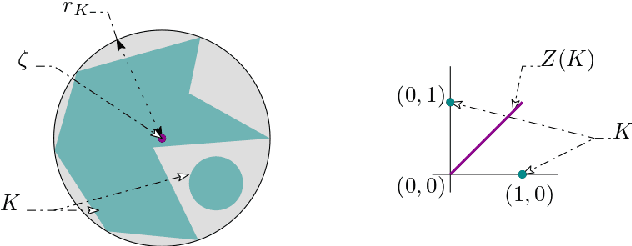
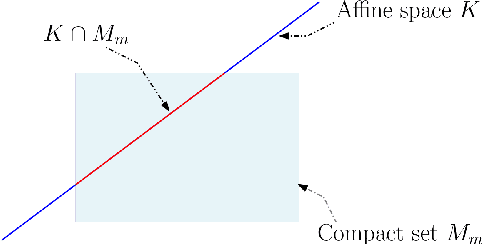
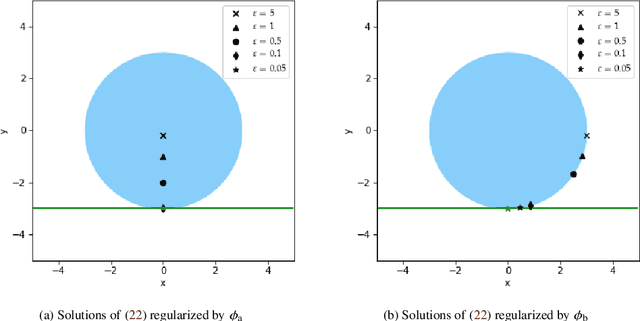
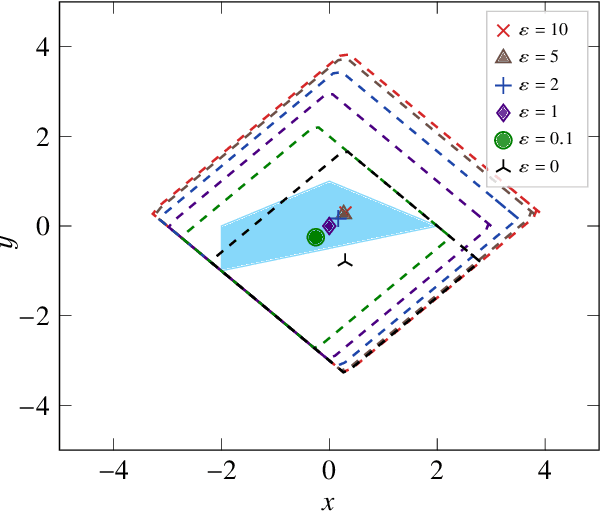
Given a compact subset of a Banach space, the Chebyshev center problem consists of finding a minimal circumscribing ball containing the set. In this article we establish a numerically tractable algorithm for solving the Chebyshev center problem in the context of optimal learning from a finite set of data points. For a hypothesis space realized as a compact but not necessarily convex subset of a finite-dimensional subspace of some underlying Banach space, this algorithm computes the Chebyshev radius and the Chebyshev center of the hypothesis space, thereby solving the problem of optimal recovery of functions from data. The algorithm itself is based on, and significantly extends, recent results for near-optimal solutions of convex semi-infinite problems by means of targeted sampling, and it is of independent interest. Several examples of numerical computations of Chebyshev centers are included in order to illustrate the effectiveness of the algorithm.