 Add to Chrome
 Add to Firefox
 Add to Edge
CARE-X: Towards Clinically Useful Radiology VLMs with Auxiliary Supervision, Reward-Aligned Learning, and Tool-Augmented Measurement
Aug 04, 2026
A clinically useful chest X-ray system must go beyond fluent report generation: it should classify findings with tunable decision thresholds, localize them spatially, and derive the anatomical measurements upon which many diagnoses depend. Today's Vision-Language Models (VLMs) treat these as separate problems, if they address them at all, leaving a gap between what radiologists need and what generative models provide. We introduce CARE-X, a chest X-ray VLM that narrows this gap by unifying auxiliary discriminative supervision with reward-aligned generation. CARE-X augments its generative backbone with focal-loss classification and composite-loss grounding heads, co-trained alongside the language-modeling objective. This auxiliary supervision produces discriminative diagnostic predictions with tunable decision thresholds and precise spatial localization while also improving report quality, providing evidence that structured prediction and generation reinforce one another. Building on this foundation, Decoupled Clip and Dynamic Sampling Policy Optimization (DAPO) leverages task-specific reward signals for report generation, visual question answering (VQA), and spatial grounding, directly optimizing the clinical quality metrics that matter in practice. The result is state-of-the-art performance on the majority of metrics across four report-generation benchmarks, 94.0% VQA accuracy on ReXVQA (+6.0 pp over the next-best baseline), and generative spatial decoding that reaches near parity with dedicated detection heads. Separately, to address measurement-dependent diagnoses, we couple Qwen3-VL-4B-Instruct with native tool-calling capabilities for invoking deterministic measurement tools, while retaining full visual access to the image. This hybrid inference yields +43.6 pp average F1 over perception-only baselines across five measurement-dependent conditions.

EIGEN: Expert-Informed Joint Learning Aggregation for High-Fidelity Information Extraction from Document Images
Nov 23, 2023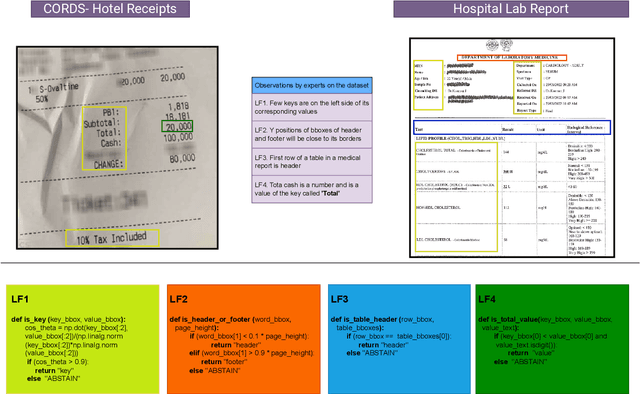
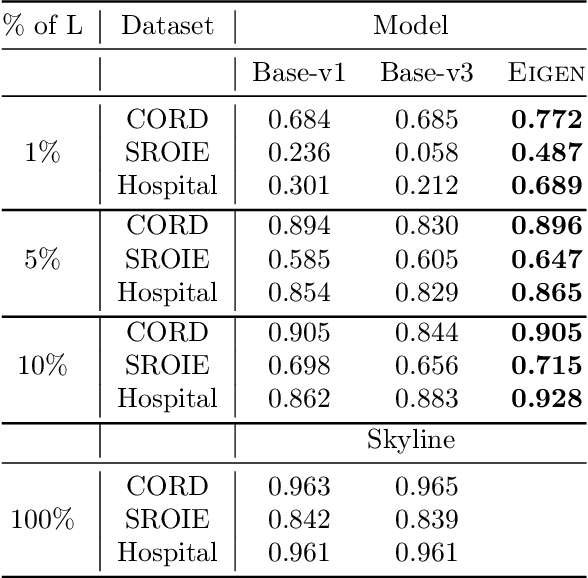

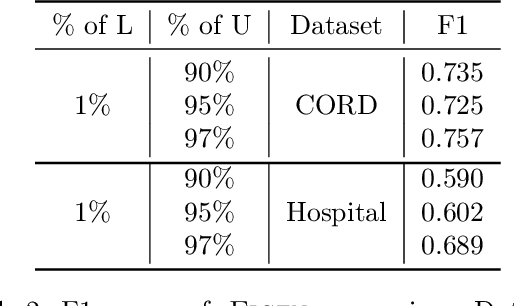
Information Extraction (IE) from document images is challenging due to the high variability of layout formats. Deep models such as LayoutLM and BROS have been proposed to address this problem and have shown promising results. However, they still require a large amount of field-level annotations for training these models. Other approaches using rule-based methods have also been proposed based on the understanding of the layout and semantics of a form such as geometric position, or type of the fields, etc. In this work, we propose a novel approach, EIGEN (Expert-Informed Joint Learning aGgrEatioN), which combines rule-based methods with deep learning models using data programming approaches to circumvent the requirement of annotation of large amounts of training data. Specifically, EIGEN consolidates weak labels induced from multiple heuristics through generative models and use them along with a small number of annotated labels to jointly train a deep model. In our framework, we propose the use of labeling functions that include incorporating contextual information thus capturing the visual and language context of a word for accurate categorization. We empirically show that our EIGEN framework can significantly improve the performance of state-of-the-art deep models with the availability of very few labeled data instances. The source code is available at https://github.com/ayushayush591/EIGEN-High-Fidelity-Extraction-Document-Images.