 Add to Chrome
 Add to Firefox
 Add to Edge
Extending Causal Metamodeling to a non-Markovian Queue
May 30, 2026
Metamodels for discrete-event simulations approximate the behavior of simulation models without running expensive simulations. Prior work introduced modular dynamic Bayesian networks (MDBNs) -- a class of metamodels that can estimate a range of probabilistic and causal queries (PCQs) using a single, trained model -- but the method was limited to Markovian systems. In this paper, we initiate an extension of MDBNs to non-Markovian queues by approximating non-exponential distributions using phase-type distributions. This approach raises novel challenges, including balancing metamodeling accuracy and tractability when choosing the number of phases, efficiently learning metamodel parameters, and choosing the sampling interval that is used to approximate a continuous-time simulation by a discrete-time MDBN. We provide preliminary solutions to these challenges, yielding the first causal metamodeling technique for non-Markovian systems. Experiments on a G/M/1 queue demonstrate that the MDBN can produce accurate answers to PCQs with orders-of-magnitude speedup of inference times relative to direct simulation.

Adaptive Selection of the Optimal Strategy to Improve Precision and Power in Randomized Trials
Oct 31, 2022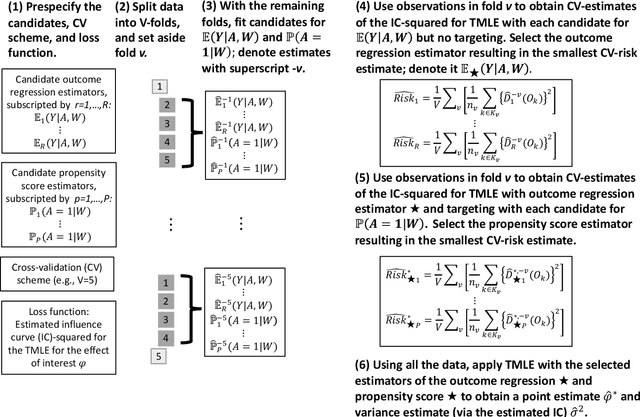
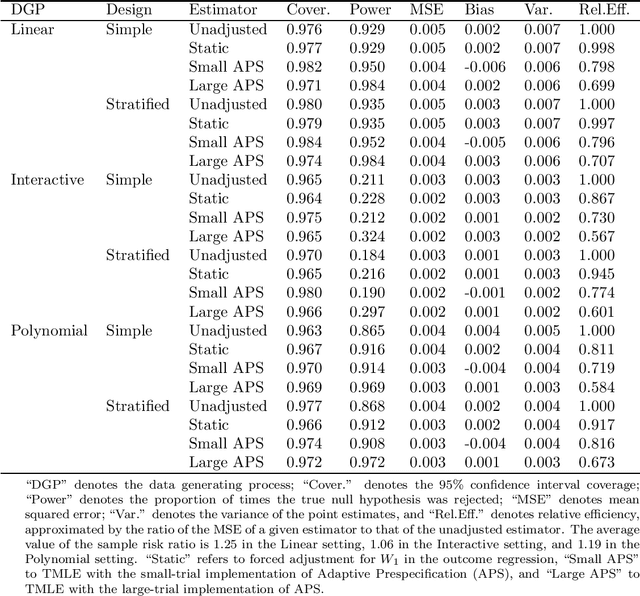
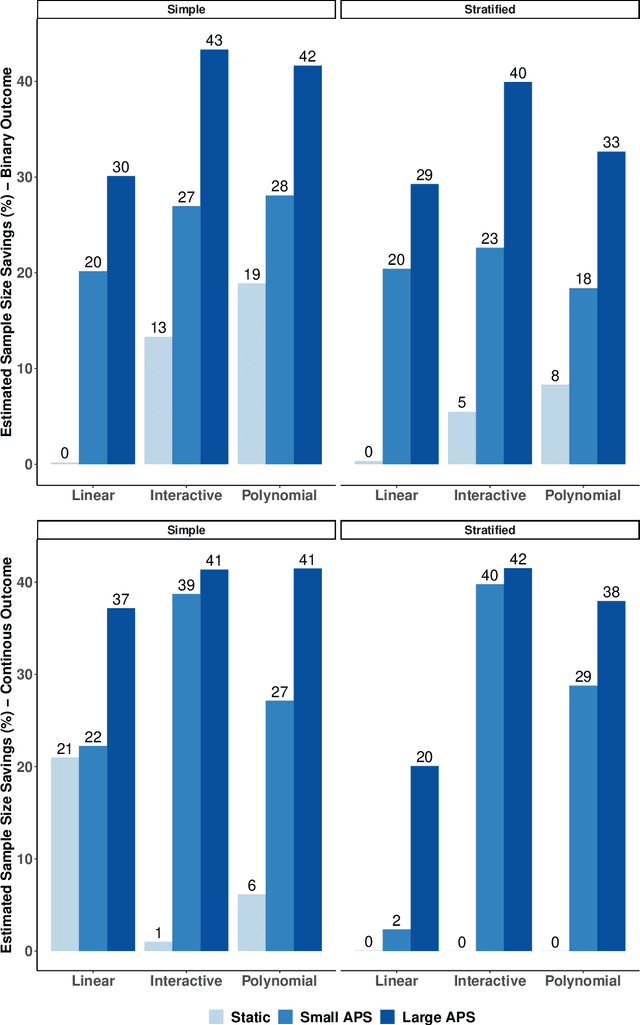
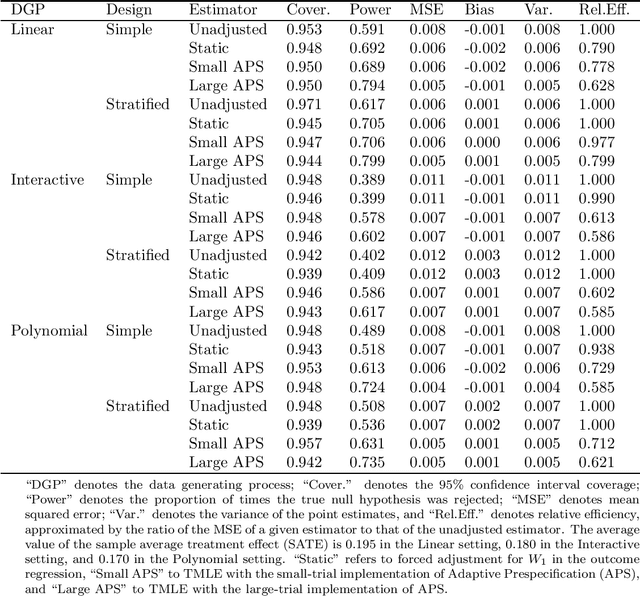
Benkeser et al. demonstrate how adjustment for baseline covariates in randomized trials can meaningfully improve precision for a variety of outcome types, including binary, ordinal, and time-to-event. Their findings build on a long history, starting in 1932 with R.A. Fisher and including the more recent endorsements by the U.S. Food and Drug Administration and the European Medicines Agency. Here, we address an important practical consideration: how to select the adjustment approach -- which variables and in which form -- to maximize precision, while maintaining nominal confidence interval coverage. Balzer et al. previously proposed, evaluated, and applied Adaptive Prespecification to flexibly select, from a prespecified set, the variables that maximize empirical efficiency in small randomized trials (N<40). To avoid overfitting with few randomized units, adjustment was previously limited to a single covariate in a working generalized linear model (GLM) for the expected outcome and a single covariate in a working GLM for the propensity score. Here, we tailor Adaptive Prespecification to trials with many randomized units. Specifically, using V-fold cross-validation and the squared influence curve as the loss function, we select from an expanded set of candidate algorithms, including both parametric and semi-parametric methods, the optimal combination of estimators of the expected outcome and known propensity score. Using simulations, under a variety of data generating processes, we demonstrate the dramatic gains in precision offered by our novel approach.
Measuring Interventional Robustness in Reinforcement Learning
Sep 19, 2022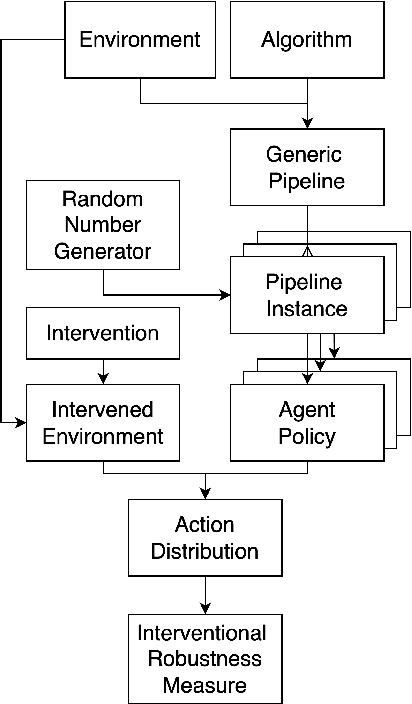
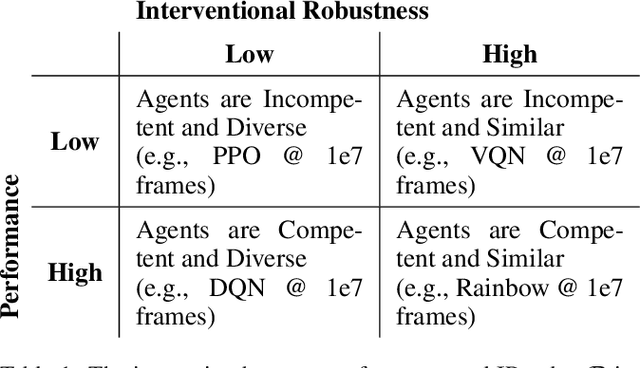
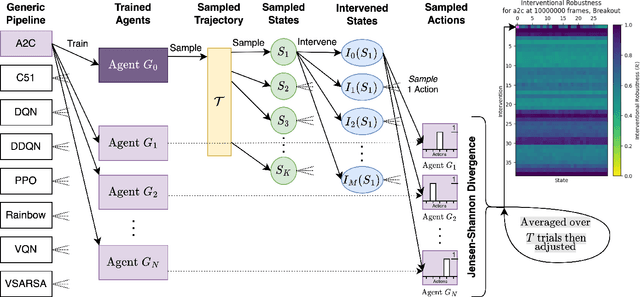
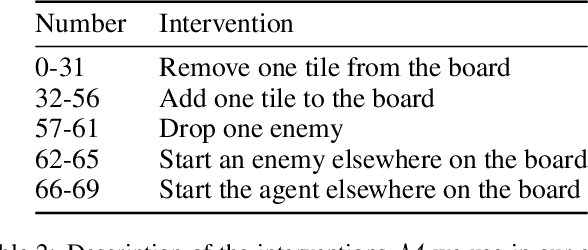
Recent work in reinforcement learning has focused on several characteristics of learned policies that go beyond maximizing reward. These properties include fairness, explainability, generalization, and robustness. In this paper, we define interventional robustness (IR), a measure of how much variability is introduced into learned policies by incidental aspects of the training procedure, such as the order of training data or the particular exploratory actions taken by agents. A training procedure has high IR when the agents it produces take very similar actions under intervention, despite variation in these incidental aspects of the training procedure. We develop an intuitive, quantitative measure of IR and calculate it for eight algorithms in three Atari environments across dozens of interventions and states. From these experiments, we find that IR varies with the amount of training and type of algorithm and that high performance does not imply high IR, as one might expect.