 Add to Chrome
 Add to Firefox
 Add to Edge
Data Efficient Complex Feature Fusion Network For Hyperspectral Image Classification
Jun 03, 2026
This work presents a data-efficient variant of the Attention-Based Dual-Branch Complex Feature Fusion Network (CFFN) for hyperspectral image classification. The proposed model, termed DE-CFFN, retains the original two-stream structure: the Real-Valued Neural Network (RVNN) processes standard hyperspectral patches, while the Complex-Valued Neural Network (CVNN) handles their Fourier-transformed counterparts. The main contribution of this work lies in the feature extraction process and architectural enhancement. Factor Analysis is used for dimensionality reduction, offering improved latent feature representation over Principal Component Analysis. Additionally, both the RVNN and CVNN streams are structurally modified by successively halving the number of filters in the 3D convolutional layers to reduce complexity. The outputs of both branches are concatenated and passed through a Squeeze and Excitation (SE) block to enhance joint feature representation. Evaluated on the Pavia University and Salinas datasets, DE-CFFN achieves classification performance comparable to CFFN, while significantly reducing model size, memory consumption, and inference latency, making it suitable for real-time hyperspectral imaging applications.
* 10 pages, 3 figures

StrideNET: Swin Transformer for Terrain Recognition with Dynamic Roughness Extraction
Apr 20, 2024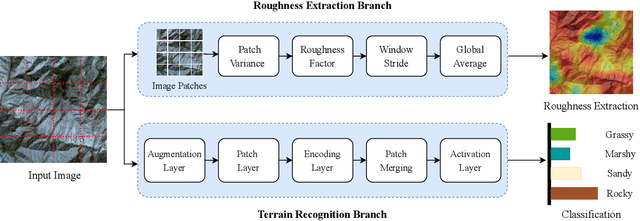
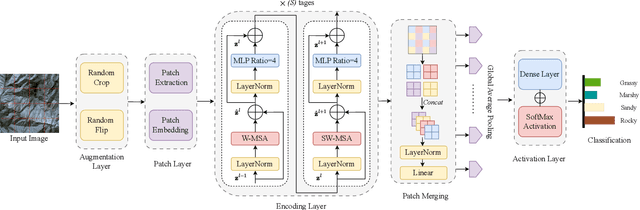
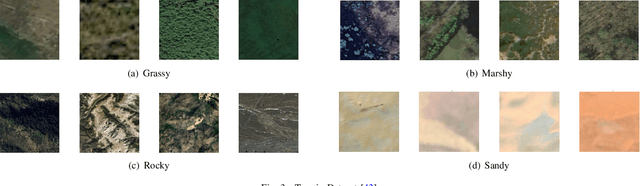
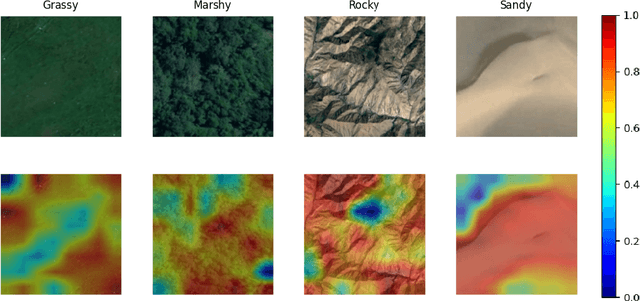
Advancements in deep learning are revolutionizing the classification of remote-sensing images. Transformer-based architectures, utilizing self-attention mechanisms, have emerged as alternatives to conventional convolution methods, enabling the capture of long-range dependencies along with global relationships in the image. Motivated by these advancements, this paper presents StrideNET, a novel dual-branch architecture designed for terrain recognition and implicit properties estimation. The terrain recognition branch utilizes the Swin Transformer, leveraging its hierarchical representation and low computational cost to efficiently capture both local and global features. The terrain properties branch focuses on the extraction of surface properties such as roughness and slipperiness using a statistical texture analysis method. By computing surface terrain properties, an enhanced environmental perception can be obtained. The StrideNET model is trained on a dataset comprising four target terrain classes: Grassy, Marshy, Sandy, and Rocky. StrideNET attains competitive performance compared to contemporary methods. The implications of this work extend to various applications, including environmental monitoring, land use and land cover (LULC) classification, disaster response, precision agriculture, and much more.