 Add to Chrome
 Add to Firefox
 Add to Edge
Differential Attention-Augmented BiomedCLIP with Asymmetric Focal Optimization for Imbalanced Multi-Label Video Capsule Endoscopy Classification
Mar 18, 2026
This work presents a multi-label classification framework for video capsule endoscopy (VCE) that addresses the extreme class imbalance inherent in the Galar dataset through a combination of architectural and optimization-level strategies. Our approach modifies BiomedCLIP, a biomedical vision-language foundation model, by replacing its standard multi-head self-attention with a differential attention mechanism that computes the difference between two softmax attention maps to suppress attention noise. To counteract the skewed label distribution, where pathological findings constitute less than 0.1% of all annotated frames, a sqrt-frequency weighted sampler, asymmetric focal loss, mixup regularization, and per-class threshold optimization are employed. Temporal coherence is enforced through median-filter smoothing and gap merging prior to event-level JSON generation. On the held-out RARE-VISION test set comprising three NaviCam examinations (161,025 frames), the pipeline achieves an overall temporal mAP@0.5 of 0.2456 and mAP@0.95 of 0.2353, with total inference completed in approximately 8.6 minutes on a single GPU.

A Multimodal Approach For Endoscopic VCE Image Classification Using BiomedCLIP-PubMedBERT
Oct 25, 2024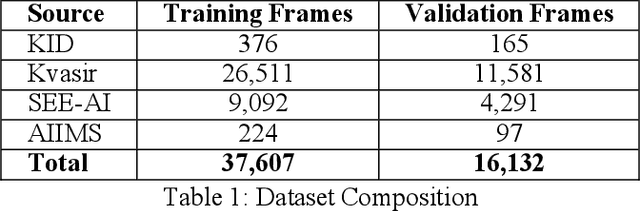
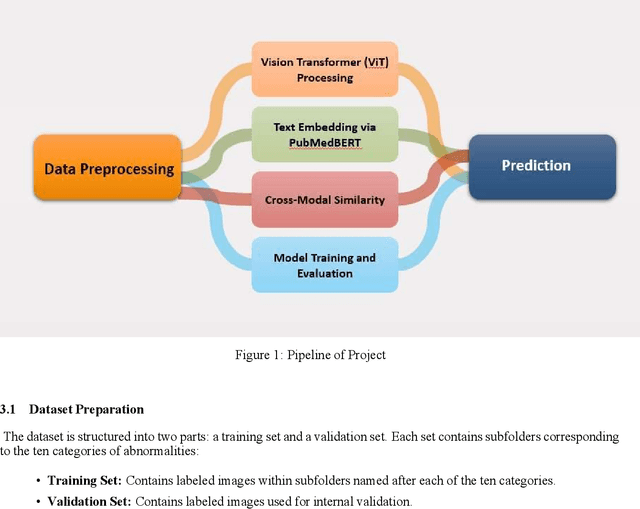
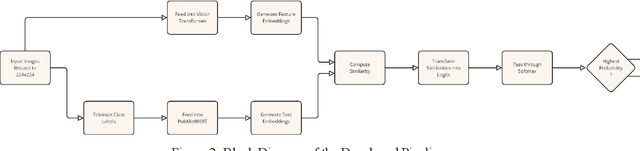
This Paper presents an advanced approach for fine-tuning BiomedCLIP PubMedBERT, a multimodal model, to classify abnormalities in Video Capsule Endoscopy (VCE) frames, aiming to enhance diagnostic efficiency in gastrointestinal healthcare. By integrating the PubMedBERT language model with a Vision Transformer (ViT) to process endoscopic images, our method categorizes images into ten specific classes: angioectasia, bleeding, erosion, erythema, foreign body, lymphangiectasia, polyp, ulcer, worms, and normal. Our workflow incorporates image preprocessing and fine-tunes the BiomedCLIP model to generate high-quality embeddings for both visual and textual inputs, aligning them through similarity scoring for classification. Performance metrics, including classification, accuracy, recall, and F1 score, indicate the models strong ability to accurately identify abnormalities in endoscopic frames, showing promise for practical use in clinical diagnostics.