 Add to Chrome
 Add to Firefox
 Add to Edge
IndicMedDialog: A Parallel Multi-Turn Medical Dialogue Dataset for Accessible Healthcare in Indic Languages
May 13, 2026
Most existing medical dialogue systems operate in a single-turn question--answering paradigm or rely on template-based datasets, limiting conversational realism and multilingual applicability. We introduce IndicMedDialog, a parallel multi-turn medical dialogue dataset spanning English and nine Indic languages: Assamese, Bengali, Gujarati, Hindi, Marathi, Punjabi, Tamil, Telugu, and Urdu. The dataset extends MDDial with LLM-generated synthetic consultations, translated using TranslateGemma, verified by native speakers, and refined through a script-aware post-processing pipeline to correct phonetic, lexical, and character-spacing errors. Building on this dataset, we fine-tune IndicMedLM via parameter-efficient adaptation of a quantized small language model, incorporating optional patient pre-context to personalise multi-turn symptom elicitation. We evaluate against zero-shot multilingual baselines, conduct systematic error analysis across ten languages, and validate clinical plausibility through medical expert evaluation.

MedAidDialog: A Multilingual Multi-Turn Medical Dialogue Dataset for Accessible Healthcare
Mar 25, 2026Conversational artificial intelligence has the potential to assist users in preliminary medical consultations, particularly in settings where access to healthcare professionals is limited. However, many existing medical dialogue systems operate in a single-turn question--answering paradigm or rely on template-based datasets, limiting conversational realism and multilingual applicability. In this work, we introduce MedAidDialog, a multilingual multi-turn medical dialogue dataset designed to simulate realistic physician--patient consultations. The dataset extends the MDDial corpus by generating synthetic consultations using large language models and further expands them into a parallel multilingual corpus covering seven languages: English, Hindi, Telugu, Tamil, Bengali, Marathi, and Arabic. Building on this dataset, we develop MedAidLM, a conversational medical model trained using parameter-efficient fine-tuning on quantized small language models, enabling deployment without high-end computational infrastructure. Our framework additionally incorporates optional patient pre-context information (e.g., age, gender, allergies) to personalize the consultation process. Experimental results demonstrate that the proposed system can effectively perform symptom elicitation through multi-turn dialogue and generate diagnostic recommendations. We further conduct medical expert evaluation to assess the plausibility and coherence of the generated consultations.
Towards Quantum Machine Learning with Tensor Networks
Jul 31, 2018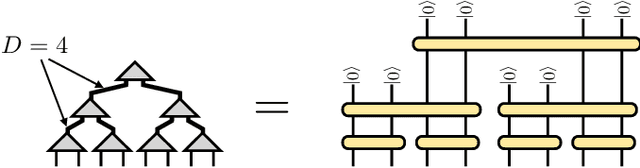
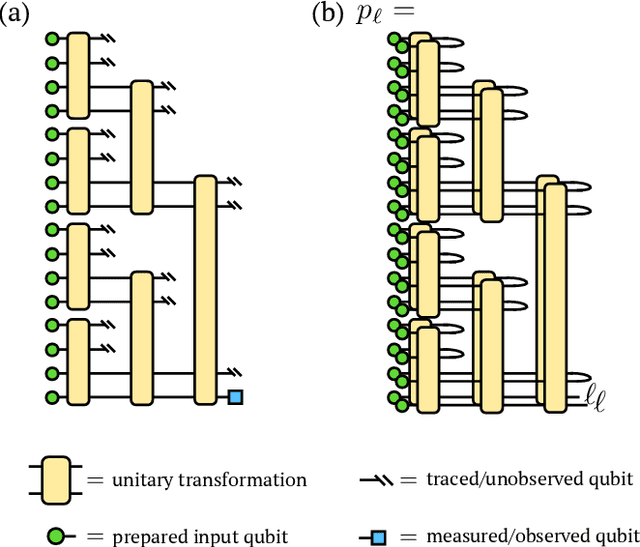
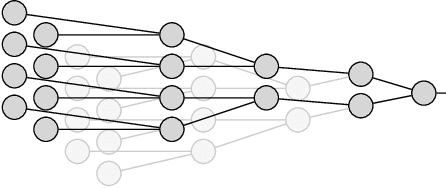
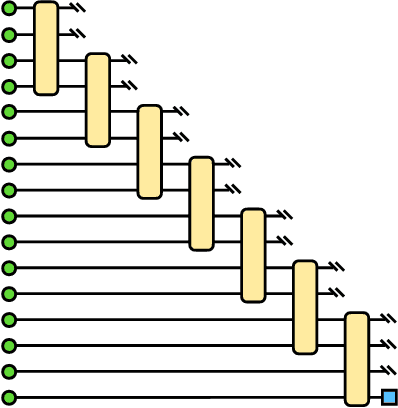
Machine learning is a promising application of quantum computing, but challenges remain as near-term devices will have a limited number of physical qubits and high error rates. Motivated by the usefulness of tensor networks for machine learning in the classical context, we propose quantum computing approaches to both discriminative and generative learning, with circuits based on tree and matrix product state tensor networks that could have benefits for near-term devices. The result is a unified framework where classical and quantum computing can benefit from the same theoretical and algorithmic developments, and the same model can be trained classically then transferred to the quantum setting for additional optimization. Tensor network circuits can also provide qubit-efficient schemes where, depending on the architecture, the number of physical qubits required scales only logarithmically with, or independently of the input or output data sizes. We demonstrate our proposals with numerical experiments, training a discriminative model to perform handwriting recognition using a optimization procedure that could be carried out on quantum hardware, and testing the noise resilience of the trained model.