 Add to Chrome
 Add to Firefox
 Add to Edge
COMET: Combinatorial Optimization for Multiplex Editing Targets Via Constraint-Preserving QAOA
Jul 02, 2026
Multiplex CRISPR-Cas9 gene editing requires selecting one guide RNA per target gene subject to cross-gene interactions: a constrained combinatorial problem that can be formulated as a Quadratic Unconstrained Binary Optimization (QUBO) and solved via the Quantum Approximate Optimization Algorithm (QAOA). The one-hot per-gene constraint is conventionally enforced by adding quadratic penalty terms to the cost Hamiltonian, but penalty coefficient selection is heuristic and penalties amplify hardware noise. An alternative is to enforce the constraint structurally via the XY-mixer, which preserves feasibility by construction. We present COMET, a systematic comparison of penalty-based and XY-mixer QAOA on a three-gene, twelve-qubit multiplex editing instance targeting the immune-checkpoint genes PDCD1, LAG3, and HAVCR2. In simulation, the XY-mixer exceeds 95% probability of the optimum by QAOA depth p=3, while three penalty variants spanning an order of magnitude in penalty coefficient remain below 6% at every depth. On IBM's ibm_kingston (Heron r2) processor, the XY-mixer's simulator-hardware energy gap stays within |0.8| across all depths, while the worst-tuned penalty variant's gap reaches +53.9. We provide an honest account of where the structural guarantee partially breaks under gate-level noise. The twelve-qubit instance is classically trivial; our contribution is a methodological comparison of constraint-enforcement strategies in a biologically motivated domain, with real-hardware validation.

Development of a Fuzzy Expert System based Liveliness Detection Scheme for Biometric Authentication
Sep 17, 2016
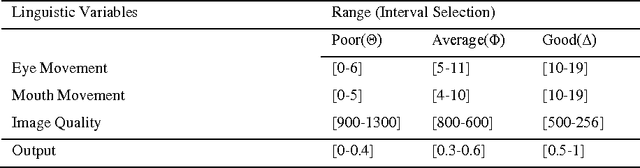
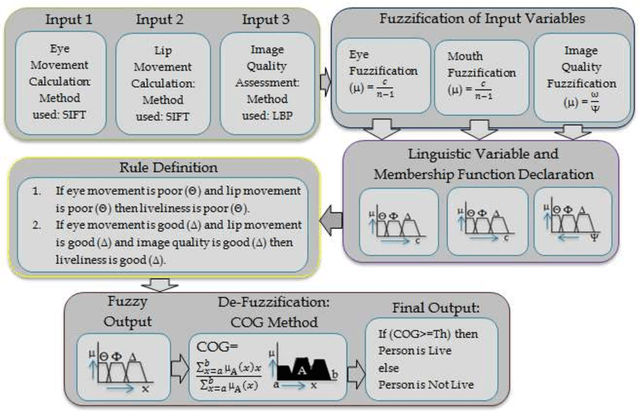
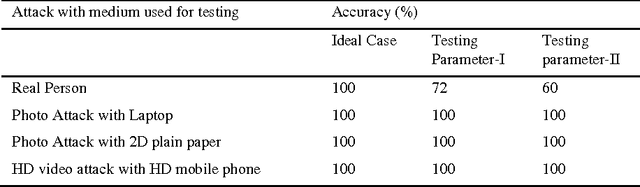
Liveliness detection acts as a safe guard against spoofing attacks. Most of the researchers used vision based techniques to detect liveliness of the user, but they are highly sensitive to illumination effects. Therefore it is very hard to design a system, which will work robustly under all circumstances. Literature shows that most of the research utilize eye blink or mouth movement to detect the liveliness, while the other group used face texture to distinguish between real and imposter. The classification results of all these approaches decreases drastically in variable light conditions. Hence in this paper we are introducing fuzzy expert system which is sufficient enough to handle most of the cases comes in real time. We have used two testing parameters, (a) under bad illumination and (b) less movement in eyes and mouth in case of real user to evaluate the performance of the system. The system is behaving well in all, while in first case its False Rejection Rate (FRR) is 0.28, and in second case its FRR is 0.4.