 Add to Chrome
 Add to Firefox
 Add to Edge
Rewrite Once, Validate Anywhere: Producing OWL-Aware SHACL Constraints (Extended Version)
Aug 14, 2026
The Shapes Constraint Language (SHACL) is a W3C recommendation to express syntactic constraints, called shapes, on RDF graphs. SHACL validators are used to test whether a given graph adheres to such a shape. However, RDF graphs often come with OWL ontologies, whose implicit knowledge needs to be taken into account. This is classically handled by first applying reasoning and then performing the constraint checking on the results, often using different technologies which makes the process inefficient and vulnerable for mistakes. To overcome this, we propose to internalise the OWL axioms in the SHACL constraints; we construct a rewriting which takes as input both shapes and an OWL EL$^-$ ontology -- a fragment of OWL EL restricting the usage of existential restrictions -- and produces SHACL constraints. This output can then be evaluated by any validator supporting SHACL core regardless of its reasoning support, while yielding the same results as the traditional approach. The implementation of our translation is evaluated both against applying state-of-the-art reasoners and validators consecutively, as against validators with built-in reasoning support. For our benchmark, we show that our approach is in general more efficient in finding violations compared to the sequential approach, thus providing a powerful tool which simplifies combining reasoning with validation.

Supporting Cybersecurity Risk Management for Medical Devices via the SECUMAN Ontology and Shapes
Aug 01, 2026We propose the SECUMAN ontology and shapes for representing and analysing cybersecurity risk-management documentation for medical devices. Cybersecurity risks are increasingly relevant for connected medical devices and may have direct consequences for patient safety. Current risk-management files are often maintained as semi-structured natural language text, which makes consistency checking, certification review, and reuse difficult. SECUMAN provides a formal OWL-based vocabulary for modelling security-risk context, assessment, control measures, and residual-risk evaluation, and uses SHACL constraints to check structural completeness and conformity with the intended documentation model. The ontology is aligned with VDE Spec 90025 and the related RISKMAN ontology and shapes, while extending their safety-oriented approach to concepts relevant to cybersecurity risk documentation such as threat scenarios, protection goals, attacker profiles, exposure levels, assets, and secure design arguments. SECUMAN is intended to support automated first-pass validation, traceability, and integration of cybersecurity and safety risk-management documentation.
Non-Monotonic S4F Standpoint Logic (Extended Version with Proofs)
Nov 16, 2025Standpoint logics offer unified modal logic-based formalisms for representing multiple heterogeneous viewpoints. At the same time, many non-monotonic reasoning frameworks can be naturally captured using modal logics, in particular using the modal logic S4F. In this work, we propose a novel formalism called S4F Standpoint Logic, which generalises both S4F and standpoint propositional logic and is therefore capable of expressing multi-viewpoint, non-monotonic semantic commitments. We define its syntax and semantics and analyze its computational complexity, obtaining the result that S4F Standpoint Logic is not computationally harder than its constituent logics, whether in monotonic or non-monotonic form. We also outline mechanisms for credulous and sceptical acceptance and illustrate the framework with an example.
A Farewell to Harms: Risk Management for Medical Devices via the Riskman Ontology & Shapes
May 22, 2024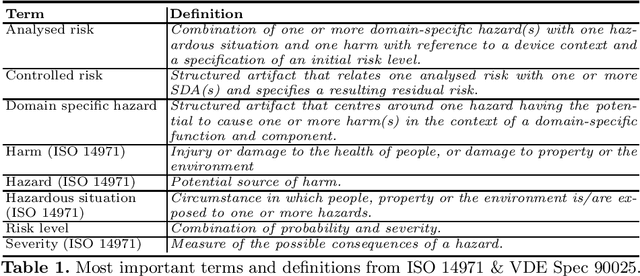
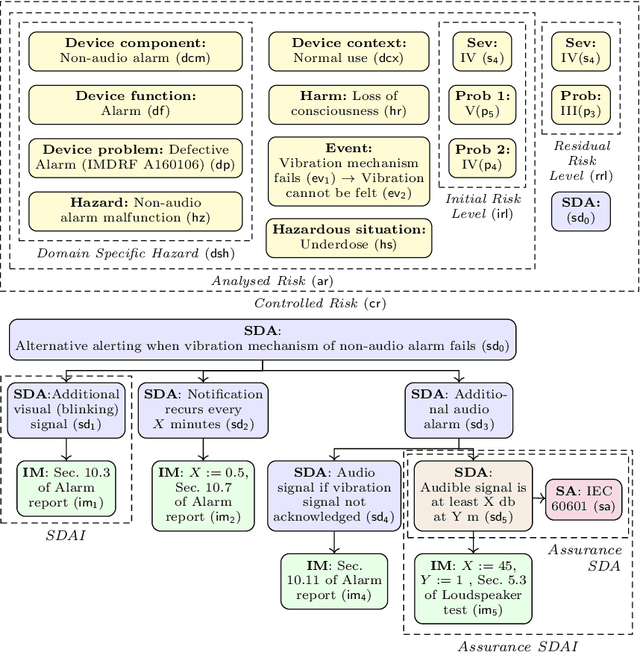
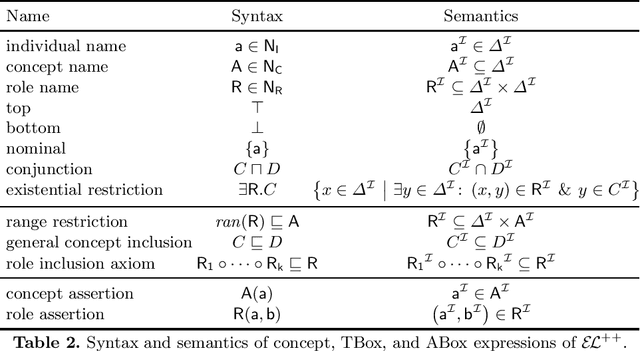
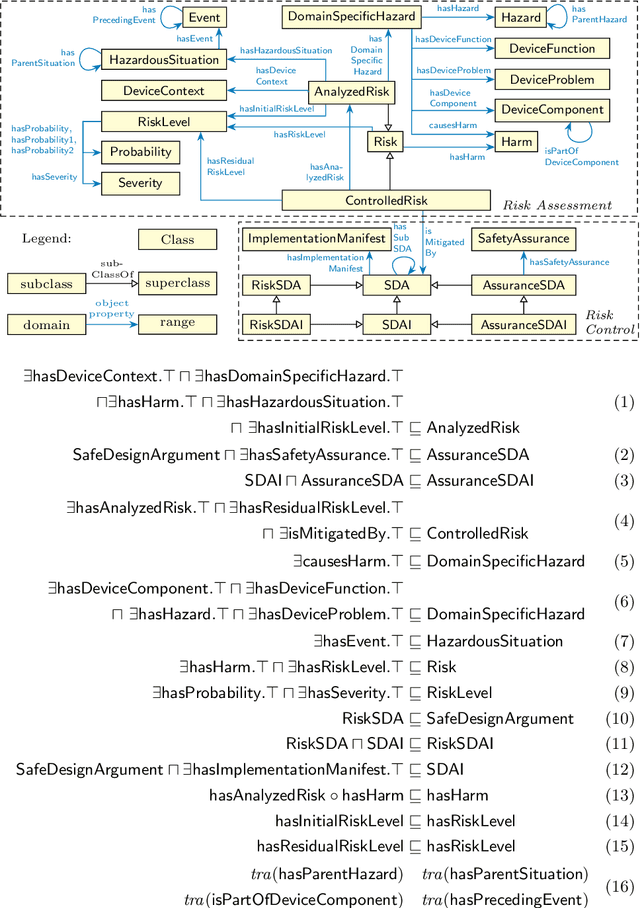
We introduce the Riskman ontology & shapes for representing and analysing information about risk management for medical devices. Risk management is concerned with taking necessary precautions so a medical device does not cause harms for users or the environment. To date, risk management documentation is submitted to notified bodies (for certification) in the form of semi-structured natural language text. We propose to use classes from the Riskman ontology to logically model risk management documentation and to use the included SHACL constraints to check for syntactic completeness and conformity to relevant standards. In particular, the ontology is modelled after ISO 14971 and the recently published VDE Spec 90025. Our proposed methodology has the potential to save many person-hours for both manufacturers (when creating risk management documentation) as well as notified bodies (when assessing submitted applications for certification), and thus offers considerable benefits for healthcare and, by extension, society as a whole.
Risk Management for Medical Devices via the Riskman Ontology & Shapes
May 16, 2024We introduce the Riskman ontology & shapes for representing and analysing information about risk management for medical devices. Risk management is concerned with taking necessary precautions so a medical device does not cause harms for users or the environment. To date, risk management documentation is submitted to notified bodies (for certification) in the form of semi-structured natural language text. We propose to use classes from the Riskman ontology to logically model risk management documentation and to use the included SHACL constraints to check for syntactic completeness and conformity to relevant standards. In particular, the ontology is modelled after ISO 14971 and the recently published VDE Spec 90025. Our proposed methodology has the potential to save many person-hours for both manufacturers (when creating risk management documentation) as well as notified bodies (when assessing submitted applications for certification), and thus offers considerable benefits for healthcare and, by extension, society as a whole.