 Add to Chrome
 Add to Firefox
 Add to Edge
Learning Treatment Effects during Resource Allocation via Priority-Queue Randomization
May 24, 2026
Public service programs often allocate limited resources under uncertainty about their benefits, creating a need for randomization to support credible evaluation. In practice, however, applicants commonly enter waitlists where resources are prioritized toward individuals judged to have higher need through tiered priority queues, making direct randomization difficult. Motivated by this, we develop an experimental design framework for learning treatment effects while treating those most in need where incoming applicants are randomized into priority queues based on their assessed risk scores. Treatments are then provided across queues in priority order and first-in-first-out within queue as budget becomes available. Our contributions are two-fold. First, we characterize what causal effects are identified under this priority-queue allocation. When arrivals are exogenous, treatments are conditionally randomized, and hence standard estimands are identified; when arrivals are endogenous, queue randomization instead provides an instrument for treatment, identifying local treatment effects induced by the queuing process. Second, we develop optimized queue-assignment designs that trade off statistical efficiency against prioritizing higher-need applicants. We show in the process that, despite dependence in treatment assignments induced by the design, usual iid efficiency bounds remain well-justified design objectives. We illustrate the proposed designs using data from a housing allocation program in a large U.S. county.

Learning treatment effects while treating those in need
Jul 10, 2024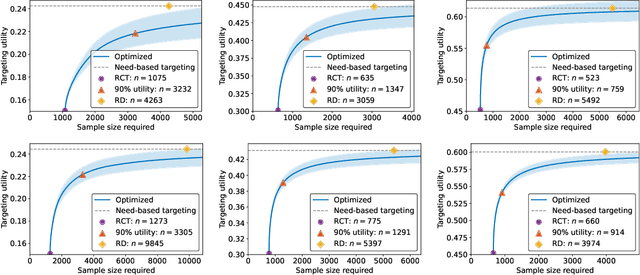
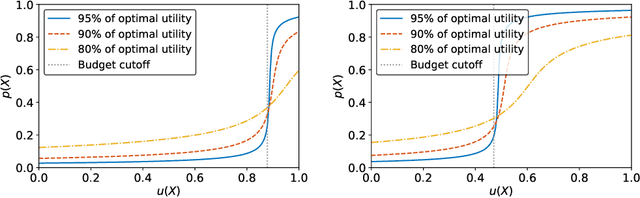
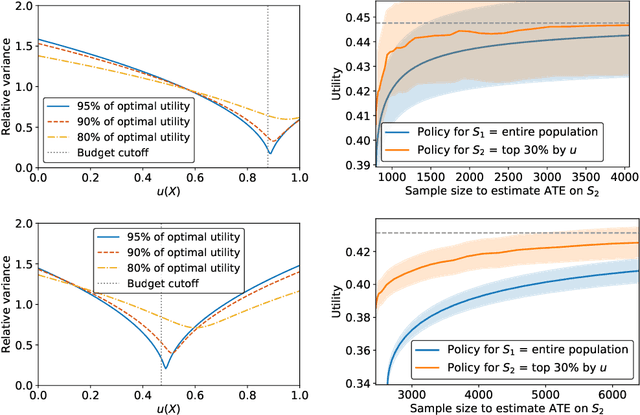
Many social programs attempt to allocate scarce resources to people with the greatest need. Indeed, public services increasingly use algorithmic risk assessments motivated by this goal. However, targeting the highest-need recipients often conflicts with attempting to evaluate the causal effect of the program as a whole, as the best evaluations would be obtained by randomizing the allocation. We propose a framework to design randomized allocation rules which optimally balance targeting high-need individuals with learning treatment effects, presenting policymakers with a Pareto frontier between the two goals. We give sample complexity guarantees for the policy learning problem and provide a computationally efficient strategy to implement it. We then apply our framework to data from human services in Allegheny County, Pennsylvania. Optimized policies can substantially mitigate the tradeoff between learning and targeting. For example, it is often possible to obtain 90% of the optimal utility in targeting high-need individuals while ensuring that the average treatment effect can be estimated with less than 2 times the samples that a randomized controlled trial would require. Mechanisms for targeting public services often focus on measuring need as accurately as possible. However, our results suggest that algorithmic systems in public services can be most impactful if they incorporate program evaluation as an explicit goal alongside targeting.