 Add to Chrome
 Add to Firefox
 Add to Edge
TNODEV: Toolbox for Neural ODE Verification
Jun 15, 2026
Neural ordinary differential equations (neural ODE) have started to appear in safety critical settings such as continuous-time controllers for cyber-physical systems and classifiers integrated into automated decision pipelines, raising the question of whether their behavior can be formally verified. Existing tools dedicated to neural ODE provide only a single reachability call without iterative input set refinement, limiting the precision of their verdicts to whatever one reachability call can deliver. We present TNODEV, the first sound formal verifier for neural ODE that integrates a falsification checker, a fast interval-based reachability backend based on continuous-time mixed monotonicity, a verification and refinement loop with three input-set splitting heuristics, and a parallel scheduler in a single end-to-end pipeline. TNODEV supports safe-set inclusion verification on pure neural ODE, neural ODE in closed loop with a neural network controller and general neural ODE (GNODE), with the safe set specified either as an interval or as the half-space intersection induced by a target classification label. We evaluate TNODEV on a range of benchmarks across safe-set inclusion and classification-robustness properties, including a direct reachability comparison against NNV~2.0 and CORA and a verification comparison against NNV2.0 on MNIST general neural ODE classifiers.

Reachability Analysis of Neural Networks with Uncertain Parameters
Mar 14, 2023The literature on reachability analysis methods for neural networks currently only focuses on uncertainties on the network's inputs. In this paper, we introduce two new approaches for the reachability analysis of neural networks with additional uncertainties on their internal parameters (weight matrices and bias vectors of each layer), which may open the field of formal methods on neural networks to new topics, such as safe training or network repair. The first and main method that we propose relies on existing reachability analysis approach based on mixed monotonicity (initially introduced for dynamical systems). The second proposed approach extends the ESIP (Error-based Symbolic Interval Propagation) approach which was first implemented in the verification tool Neurify, and first mentioned in the publication of the tool VeriNet. Although the ESIP approach has been shown to often outperform the mixed-monotonicity reachability analysis in the classical case with uncertainties only on the network's inputs, we show in this paper through numerical simulations that the situation is greatly reversed (in terms of precision, computation time, memory usage, and broader applicability) when dealing with uncertainties on the weights and biases.
Reachability analysis of neural networks using mixed monotonicity
Nov 15, 2021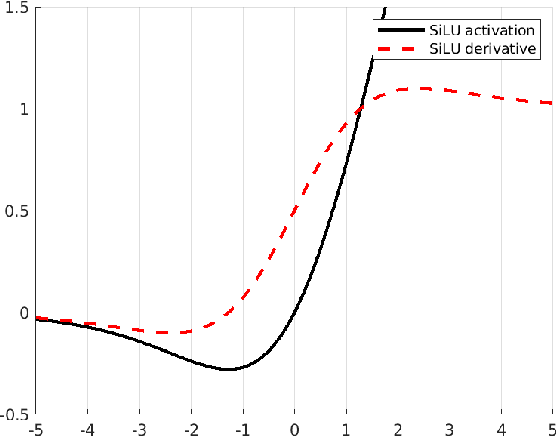
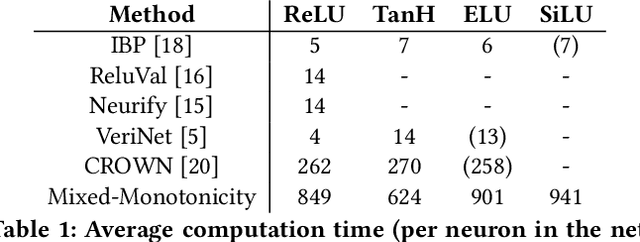
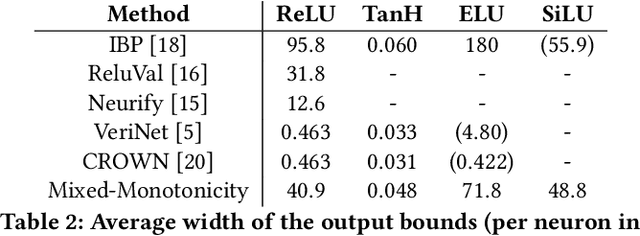
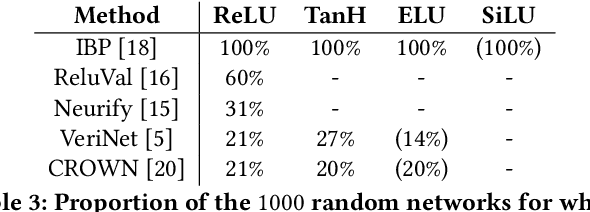
This paper presents a new reachability analysis tool to compute an interval over-approximation of the output set of a feedforward neural network under given input uncertainty. The proposed approach adapts to neural networks an existing mixed-monotonicity method for the reachability analysis of dynamical systems and applies it to all possible partial networks within the given neural network. This ensures that the intersection of the obtained results is the tightest interval over-approximation of the output of each layer that can be obtained using mixed-monotonicity. Unlike other tools in the literature that focus on small classes of piecewise-affine or monotone activation functions, the main strength of our approach is its generality in the sense that it can handle neural networks with any Lipschitz-continuous activation function. In addition, the simplicity of the proposed framework allows users to very easily add unimplemented activation functions, by simply providing the function, its derivative and the global extrema and corresponding arguments of the derivative. Our algorithm is tested and compared to five other interval-based tools on 1000 randomly generated neural networks for four activation functions (ReLU, TanH, ELU, SiLU). We show that our tool always outperforms the Interval Bound Propagation method and that we obtain tighter output bounds than ReluVal, Neurify, VeriNet and CROWN (when they are applicable) in 15 to 60 percent of cases.