 Add to Chrome
 Add to Firefox
 Add to Edge
Expected Utility Networks
Jan 23, 2013
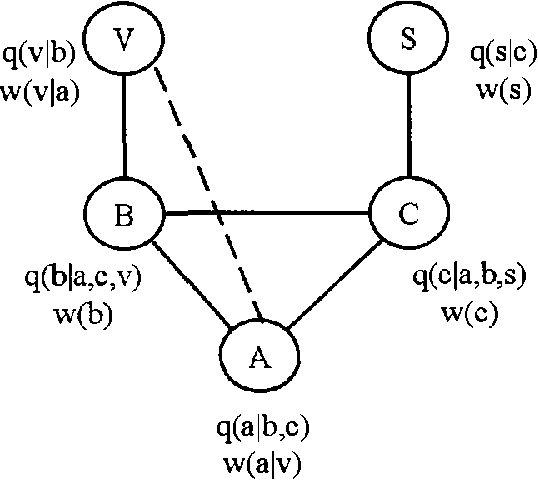
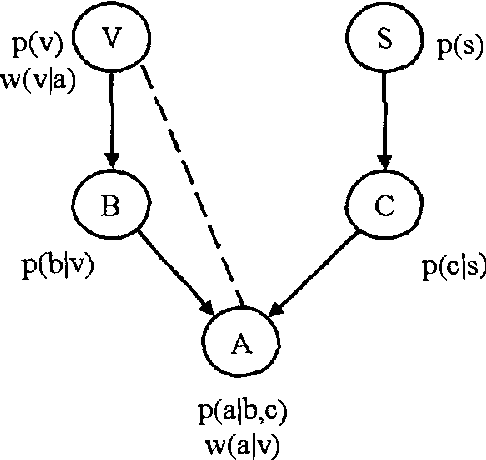
We introduce a new class of graphical representations, expected utility networks (EUNs), and discuss some of its properties and potential applications to artificial intelligence and economic theory. In EUNs not only probabilities, but also utilities enjoy a modular representation. EUNs are undirected graphs with two types of arc, representing probability and utility dependencies respectively. The representation of utilities is based on a novel notion of conditional utility independence, which we introduce and discuss in the context of other existing proposals. Just as probabilistic inference involves the computation of conditional probabilities, strategic inference involves the computation of conditional expected utilities for alternative plans of action. We define a new notion of conditional expected utility (EU) independence, and show that in EUNs node separation with respect to the probability and utility subgraphs implies conditional EU independence.

Game Networks
Jan 16, 2013
We introduce Game networks (G nets), a novel representation for multi-agent decision problems. Compared to other game-theoretic representations, such as strategic or extensive forms, G nets are more structured and more compact; more fundamentally, G nets constitute a computationally advantageous framework for strategic inference, as both probability and utility independencies are captured in the structure of the network and can be exploited in order to simplify the inference process. An important aspect of multi-agent reasoning is the identification of some or all of the strategic equilibria in a game; we present original convergence methods for strategic equilibrium which can take advantage of strategic separabilities in the G net structure in order to simplify the computations. Specifically, we describe a method which identifies a unique equilibrium as a function of the game payoffs, and one which identifies all equilibria.
Markovian Entanglement Networks
Feb 07, 2007


Graphical models of probabilistic dependencies have been extensively investigated in the context of classical uncertainty. However, in some domains (most notably, in computational physics and quantum computing) the nature of the relevant uncertainty is non-classical, and the laws of classical probability theory are superseded by those of quantum mechanics. In this paper we introduce Markovian Entanglement Networks (MEN), a novel class of graphical representations of quantum-mechanical dependencies in the context of such non-classical systems. MEN are the quantum-mechanical analogue of Markovian Networks, a family of undirected graphical representations which, in the classical domain, exploit a notion of conditional independence among subsystems. After defining a notion of conditional independence appropriate to our domain (conditional separability), we prove that the conditional separabilities induced by a quantum-mechanical wave function are effectively reflected in the graphical structure of MEN. Specifically, we show that for any wave function there exists a MEN which is a perfect map of its conditional separabilities. Next, we show how the graphical structure of MEN can be used to effectively classify the pure states of three-qubit systems. We also demonstrate that, in large systems, exploiting conditional independencies may dramatically reduce the computational burden of various inference tasks. In principle, the graph-theoretic representation of conditional independencies afforded by MEN may not only facilitate the classical simulation of quantum systems, but also provide a guide to the efficient design and complexity analysis of quantum algorithms and circuits.