 Add to Chrome
 Add to Firefox
 Add to Edge
Calibration-Free 3D Multi-Camera People Tracking for Indoor Environment
Jul 22, 2026
Multi-Camera People Tracking (MCPT) traditionally relies on precise intrinsic and extrinsic camera calibration to project 2D detections into a unified 3D world coordinate system.However, manual calibration constitutes a major bottleneck in large-scale dataset generation from unconstrained video archives. This work proposes a unified calibration-free 3D MCPT framework that infers geometric structure directly from visual data using deep foundation models. The system integrates anchor-free detection (YOLOX), robust tracking (BoT-SORT), omni-scale appearance embedding (OsNet), pose estimation (HRNet via MMPose), and transformer-based geometric reconstruction using the Visual Geometry Grounded Transformer (VGGT). A pose-guided 3D lifting strategy projects head keypoints onto a reconstructed manifold, eliminating dependence on ground-plane homography. Global identity association is formulated as hierarchical agglomerative clustering under a joint appearance-geometry cost with strict velocity gating. Evaluation on the AI City Challenge 2024 demonstrates a HOTA score of 53.13% without access to ground-truth calibration matrices, establishing a strong baseline for purely vision-based 3D tracking.

DeepRare: Generic Unsupervised Visual Attention Models
Sep 23, 2021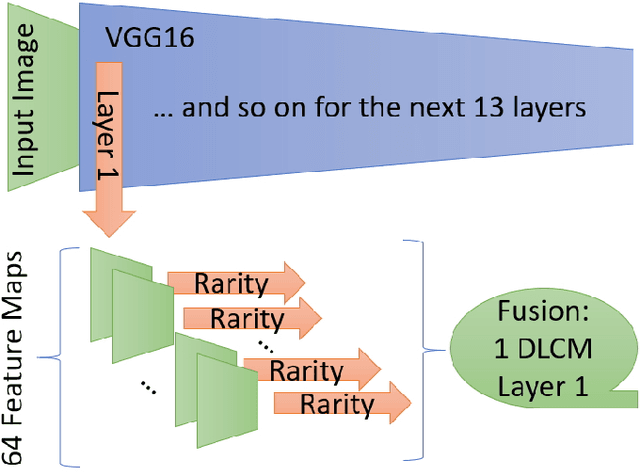
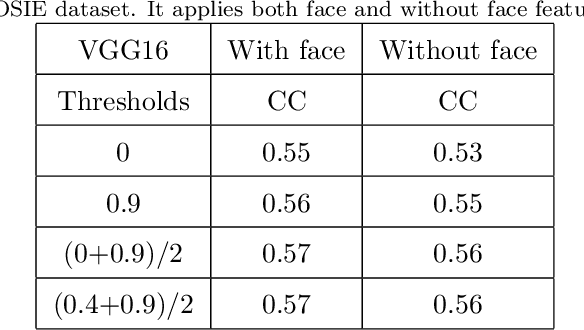
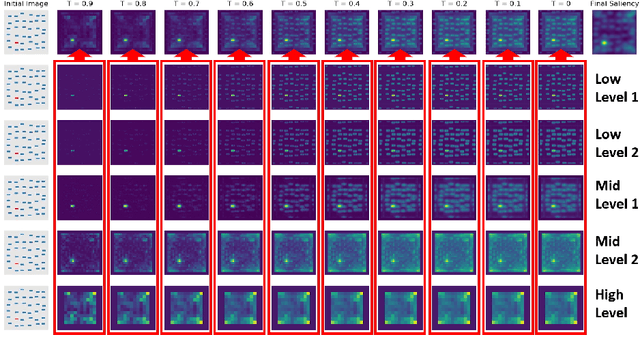
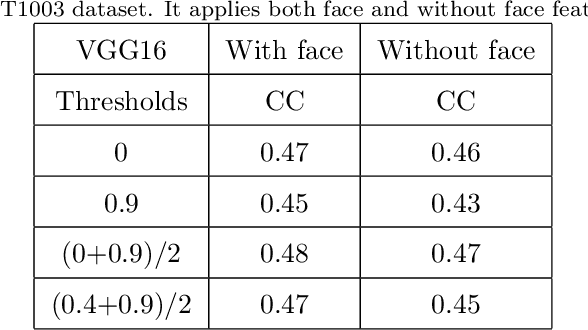
Human visual system is modeled in engineering field providing feature-engineered methods which detect contrasted/surprising/unusual data into images. This data is "interesting" for humans and leads to numerous applications. Deep learning (DNNs) drastically improved the algorithms efficiency on the main benchmark datasets. However, DNN-based models are counter-intuitive: surprising or unusual data is by definition difficult to learn because of its low occurrence probability. In reality, DNN-based models mainly learn top-down features such as faces, text, people, or animals which usually attract human attention, but they have low efficiency in extracting surprising or unusual data in the images. In this paper, we propose a new visual attention model called DeepRare2021 (DR21) which uses the power of DNNs feature extraction and the genericity of feature-engineered algorithms. This algorithm is an evolution of a previous version called DeepRare2019 (DR19) based on a common framework. DR21 1) does not need any training and uses the default ImageNet training, 2) is fast even on CPU, 3) is tested on four very different eye-tracking datasets showing that the DR21 is generic and is always in the within the top models on all datasets and metrics while no other model exhibits such a regularity and genericity. Finally DR21 4) is tested with several network architectures such as VGG16 (V16), VGG19 (V19) and MobileNetV2 (MN2) and 5) it provides explanation and transparency on which parts of the image are the most surprising at different levels despite the use of a DNN-based feature extractor. DeepRare2021 code can be found at https://github.com/numediart/VisualAttention-RareFamil}.