 Add to Chrome
 Add to Firefox
 Add to Edge
Benchmarking Sensor-Fault Robustness in Forecasting
May 11, 2026
Cyber-physical system (CPS) forecasting models depend on sensor streams with noisy, biased, missing, or temporally misaligned readings, yet standard forecasting evaluation often selects models by nominal error without showing whether they remain robust under such faults. We introduce SensorFault-Bench, a shared CPS-grounded sensor-fault stress-test protocol for evaluating forecasting architectures and robustness-improvement methods, and an operational taxonomy organizing the method comparison. Across four real-world datasets and eight scored scenarios governed by a standardized severity model, it reports worst-scenario degradation, clean mean squared error (MSE), and worst-scenario fault-time MSE, separating relative robustness from absolute error. A disjoint fault-transfer split lets explicit fault-training methods train on adjacent fault families while evaluation uses separate benchmark scenarios. Empirically, forecasting architectures favored by clean MSE can degrade sharply under faults, and clean-MSE rankings can disagree with worst-scenario fault-time error rankings. Chronos-2, the evaluated zero-shot foundation-model representative, matches or trails the last-value naive forecaster in clean MSE on the two single-target datasets and has the largest worst-scenario degradation on ETTh1 and Traffic, where all channels are forecast targets. For the evaluated robustness-improvement method set, paired deltas show selective degradation reductions: projected gradient descent adversarial training and randomized training lead where value faults dominate observed degradation, while fault augmentation leads where availability faults dominate. SensorFault-Bench provides open-source code, documented data access, and reproduction and extension guides, so new datasets, architectures, and robustness-improvement methods can be evaluated under the same CPS sensor-fault robustness protocol.

Confounder-adjusted Covariances of System Outputs and Applications to Structural Health Monitoring
Sep 26, 2024Automated damage detection is an integral component of each structural health monitoring (SHM) system. Typically, measurements from various sensors are collected and reduced to damage-sensitive features, and diagnostic values are generated by statistically evaluating the features. Since changes in data do not only result from damage, it is necessary to determine the confounding factors (environmental or operational variables) and to remove their effects from the measurements or features. Many existing methods for correcting confounding effects are based on different types of mean regression. This neglects potential changes in higher-order statistical moments, but in particular, the output covariances are essential for generating reliable diagnostics for damage detection. This article presents an approach to explicitly quantify the changes in the covariance, using conditional covariance matrices based on a non-parametric, kernel-based estimator. The method is applied to the Munich Test Bridge and the KW51 Railway Bridge in Leuven, covering both raw sensor measurements (acceleration, strain, inclination) and extracted damage-sensitive features (natural frequencies). The results show that covariances between different vibration or inclination sensors can significantly change due to temperature changes, and the same is true for natural frequencies. To highlight the advantages, it is explained how conditional covariances can be combined with standard approaches for damage detection, such as the Mahalanobis distance and principal component analysis. As a result, more reliable diagnostic values can be generated with fewer false alarms.
Artificial Intelligence in Industry 4.0: A Review of Integration Challenges for Industrial Systems
May 28, 2024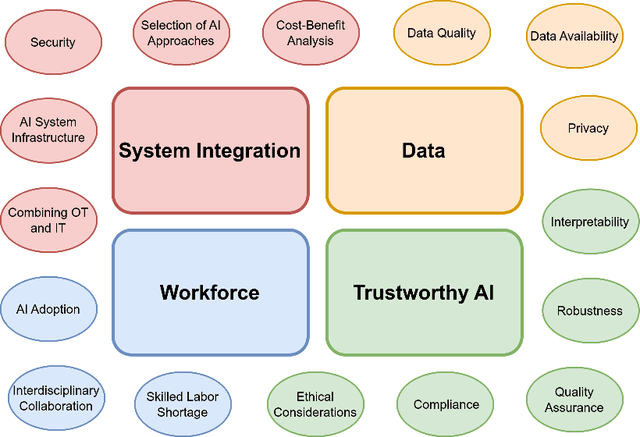

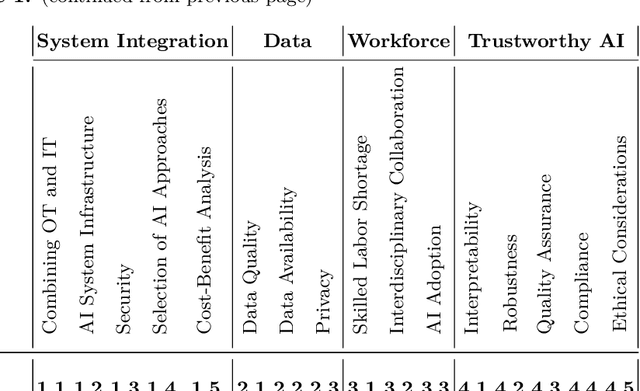

In Industry 4.0, Cyber-Physical Systems (CPS) generate vast data sets that can be leveraged by Artificial Intelligence (AI) for applications including predictive maintenance and production planning. However, despite the demonstrated potential of AI, its widespread adoption in sectors like manufacturing remains limited. Our comprehensive review of recent literature, including standards and reports, pinpoints key challenges: system integration, data-related issues, managing workforce-related concerns and ensuring trustworthy AI. A quantitative analysis highlights particular challenges and topics that are important for practitioners but still need to be sufficiently investigated by academics. The paper briefly discusses existing solutions to these challenges and proposes avenues for future research. We hope that this survey serves as a resource for practitioners evaluating the cost-benefit implications of AI in CPS and for researchers aiming to address these urgent challenges.