 Add to Chrome
 Add to Firefox
 Add to Edge
Fast and effective algorithms for fair clustering at scale
May 13, 2026
Clustering is an unsupervised machine learning task that consists of identifying groups of similar objects. It has numerous applications and is increasingly used in fairness-sensitive domains where objects represent individuals, such as customers, employees, or students. We address a fair clustering problem in which objects belong to protected groups. The problem consists of partitioning the objects into a predefined number of clusters while attaining a user-defined target level of fairness, meaning that each protected group is sufficiently represented in each cluster. The objective is to minimize the clustering cost, defined as the sum of squared Euclidean distances between the objects and the centers of their clusters. Since clustering cost and fairness are generally in conflict, managing the trade-off between them is essential in practical applications. Existing methods provide limited control over this trade-off and either fail to scale to large datasets or, when they scale, produce low-quality solutions. We propose a general framework for fair clustering that provides precise control over the cost-fairness trade-off and introduce three heuristics based on it. The first heuristic focuses on solution quality and the flexibility to incorporate additional constraints, the second improves scalability while retaining high solution quality, and the third is designed for maximum scalability, producing solutions for instances with millions of objects in seconds. The proposed heuristics outperform existing approaches in comprehensive numerical experiments on benchmark datasets. The source code of our heuristics and instructions for reproducing the experiments are publicly available on GitHub.

A Fast and Effective Method for Euclidean Anticlustering: The Assignment-Based-Anticlustering Algorithm
Jan 09, 2026The anticlustering problem is to partition a set of objects into K equal-sized anticlusters such that the sum of distances within anticlusters is maximized. The anticlustering problem is NP-hard. We focus on anticlustering in Euclidean spaces, where the input data is tabular and each object is represented as a D-dimensional feature vector. Distances are measured as squared Euclidean distances between the respective vectors. Applications of Euclidean anticlustering include social studies, particularly in psychology, K-fold cross-validation in which each fold should be a good representative of the entire dataset, the creation of mini-batches for gradient descent in neural network training, and balanced K-cut partitioning. In particular, machine-learning applications involve million-scale datasets and very large values of K, making scalable anticlustering algorithms essential. Existing algorithms are either exact methods that can solve only small instances or heuristic methods, among which the most scalable is the exchange-based heuristic fast_anticlustering. We propose a new algorithm, the Assignment-Based Anticlustering algorithm (ABA), which scales to very large instances. A computational study shows that ABA outperforms fast_anticlustering in both solution quality and running time. Moreover, ABA scales to instances with millions of objects and hundreds of thousands of anticlusters within short running times, beyond what fast_anticlustering can handle. As a balanced K-cut partitioning method for tabular data, ABA is superior to the well-known METIS method in both solution quality and running time. The code of the ABA algorithm is available on GitHub.
PCCC: The Pairwise-Confidence-Constraints-Clustering Algorithm
Dec 29, 2022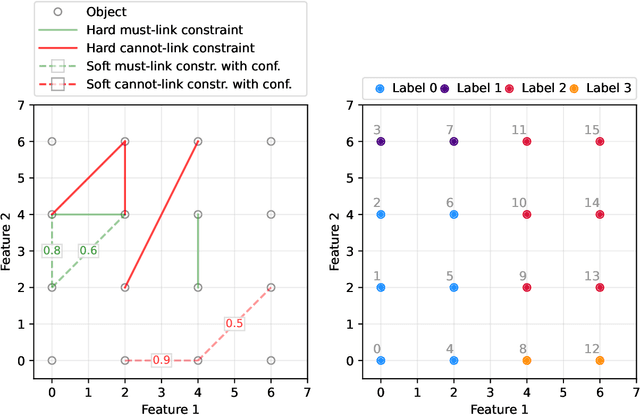
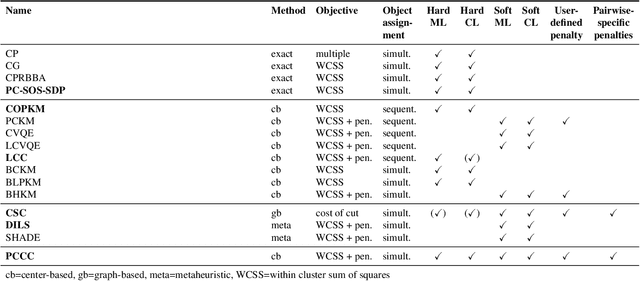
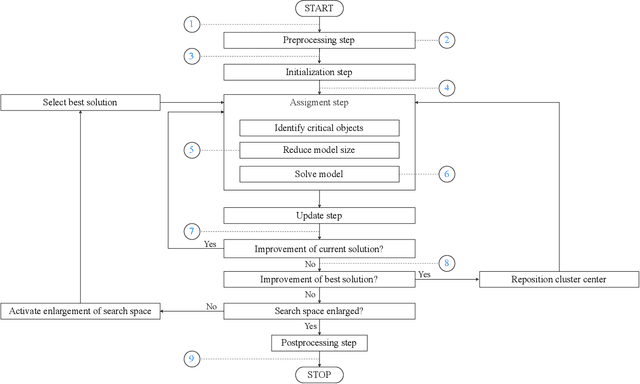
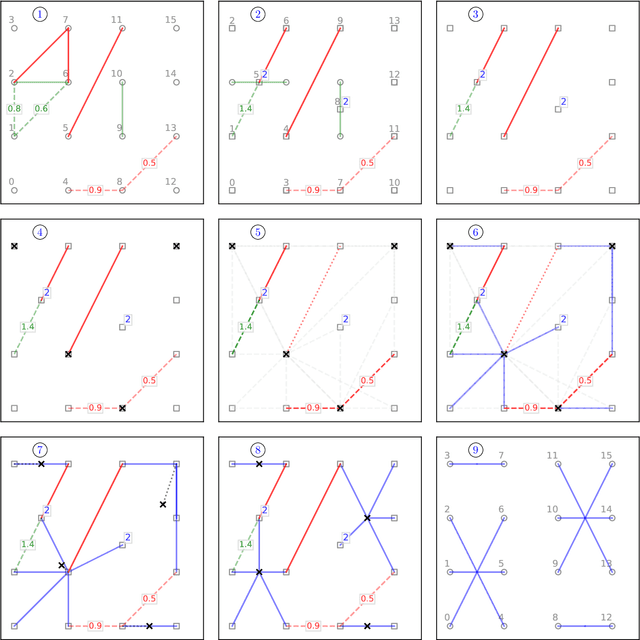
We consider a semi-supervised $k$-clustering problem where information is available on whether pairs of objects are in the same or in different clusters. This information is either available with certainty or with a limited level of confidence. We introduce the PCCC algorithm, which iteratively assigns objects to clusters while accounting for the information provided on the pairs of objects. Our algorithm can include relationships as hard constraints that are guaranteed to be satisfied or as soft constraints that can be violated subject to a penalty. This flexibility distinguishes our algorithm from the state-of-the-art in which all pairwise constraints are either considered hard, or all are considered soft. Unlike existing algorithms, our algorithm scales to large-scale instances with up to 60,000 objects, 100 clusters, and millions of cannot-link constraints (which are the most challenging constraints to incorporate). We compare the PCCC algorithm with state-of-the-art approaches in an extensive computational study. Even though the PCCC algorithm is more general than the state-of-the-art approaches in its applicability, it outperforms the state-of-the-art approaches on instances with all hard constraints or all soft constraints both in terms of running time and various metrics of solution quality. The source code of the PCCC algorithm is publicly available on GitHub.