 Add to Chrome
 Add to Firefox
 Add to Edge
Shapes are not enough: CONSERVAttack and its use for finding vulnerabilities and uncertainties in machine learning applications
Mar 14, 2026
In High Energy Physics, as in many other fields of science, the application of machine learning techniques has been crucial in advancing our understanding of fundamental phenomena. Increasingly, deep learning models are applied to analyze both simulated and experimental data. In most experiments, a rigorous regime of testing for physically motivated systematic uncertainties is in place. The numerical evaluation of these tests for differences between the data on the one side and simulations on the other side quantifies the effect of potential sources of mismodelling on the machine learning output. In addition, thorough comparisons of marginal distributions and (linear) feature correlations between data and simulation in "control regions" are applied. However, the guidance by physical motivation, and the need to constrain comparisons to specific regions, does not guarantee that all possible sources of deviations have been accounted for. We therefore propose a new adversarial attack - the CONSERVAttack - designed to exploit the remaining space of hypothetical deviations between simulation and data after the above mentioned tests. The resulting adversarial perturbations are consistent within the uncertainty bounds - evading standard validation checks - while successfully fooling the underlying model. We further propose strategies to mitigate such vulnerabilities and argue that robustness to adversarial effects must be considered when interpreting results from deep learning in particle physics.

AWEsome: An open-source test platform for airborne wind energy systems
Apr 27, 2017

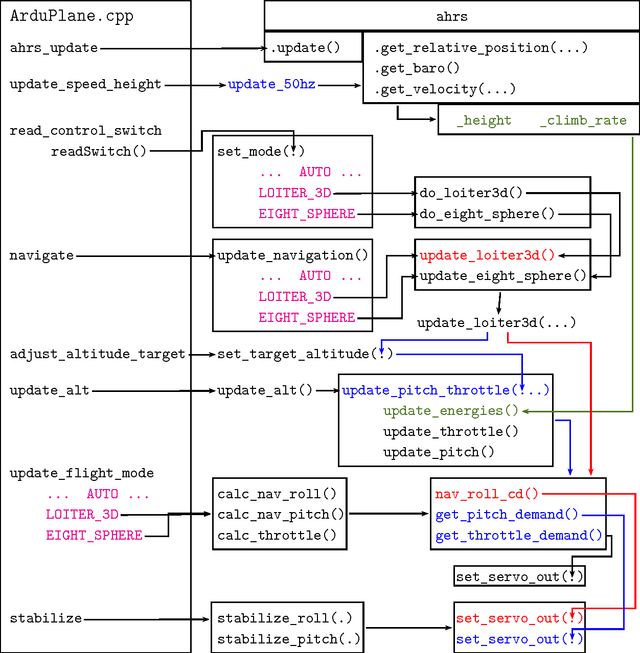

In this paper we present AWEsome (Airborne Wind Energy Standardized Open-source Model Environment), a test platform for airborne wind energy systems that consists of low-cost hardware and is entirely based on open-source software. It can hence be used without the need of large financial investments, in particular by research groups and startups to acquire first experiences in their flight operations, to test novel control strategies or technical designs, or for usage in public relations. Our system consists of a modified off-the-shelf model aircraft that is controlled by the pixhawk autopilot hardware and the ardupilot software for fixed wing aircraft. The aircraft is attached to the ground by a tether. We have implemented new flight modes for the autonomous tethered flight of the aircraft along periodic patterns. We present the principal functionality of our algorithms. We report on first successful tests of these modes in real flights.