 Add to Chrome
 Add to Firefox
 Add to Edge
HiLiftAeroML: High-Fidelity Computational Fluid Dynamics Dataset for High-Lift Aircraft Aerodynamics
May 19, 2026
This paper describes the first-ever open-source high-fidelity CFD dataset of a high-lift aircraft for the purpose of AI surrogate model development. The dataset is composed of 1800 samples, arising from 180 geometry variants and 10 angles of attack for the high-lift NASA Common Research Model (CRM) geometry, used within the AIAA High-Lift Prediction Workshop series. One of the novelties of this dataset is the use of a GPU-accelerated high-fidelity explicit, wall-modeled LES approach for each simulation, using solution-adapted grids between 300M and 500M cells. This ensures the greatest possible accuracy given known challenges in steady-state RANS approaches for these portions of the flight envelope. The entire dataset (geometries, time-averaged volume and surface variables and integral forces) are available, free of charge with a permissive open-source license (CC-BY-4.0). By making this data publicly available, we aim to accelerate the research and development of AI surrogate modeling within the aerospace industry.

NeuralFoil: An Airfoil Aerodynamics Analysis Tool Using Physics-Informed Machine Learning
Mar 20, 2025NeuralFoil is an open-source Python-based tool for rapid aerodynamics analysis of airfoils, similar in purpose to XFoil. Speedups ranging from 8x to 1,000x over XFoil are demonstrated, after controlling for equivalent accuracy. NeuralFoil computes both global and local quantities (lift, drag, velocity distribution, etc.) over a broad input space, including: an 18-dimensional space of airfoil shapes, possibly including control deflections; a 360 degree range of angles of attack; Reynolds numbers from $10^2$ to $10^{10}$; subsonic flows up to the transonic drag rise; and with varying turbulence parameters. Results match those of XFoil closely: the mean relative error of drag is 0.37% on simple cases, and remains as low as 2.0% on a test dataset with numerous post-stall and transitional cases. NeuralFoil facilitates gradient-based design optimization, due to its $C^\infty$-continuous solutions, automatic-differentiation-compatibility, and bounded computational cost without non-convergence issues. NeuralFoil is a hybrid of physics-informed machine learning techniques and analytical models. Here, physics information includes symmetries that are structurally embedded into the model architecture, feature engineering using domain knowledge, and guaranteed extrapolation to known limit cases. This work also introduces a new approach for surrogate model uncertainty quantification that enables robust design optimization. This work discusses the methodology and performance of NeuralFoil with several case studies, including a practical airfoil design optimization study including both aerodynamic and non-aerodynamic constraints. Here, NeuralFoil optimization is able to produce airfoils nearly identical in performance and shape to expert-designed airfoils within seconds; these computationally-optimized airfoils provide a useful starting point for further expert refinement.
Accelerating Transient CFD through Machine Learning-Based Flow Initialization
Mar 20, 2025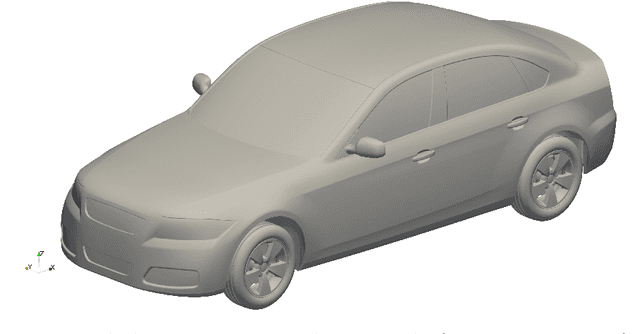
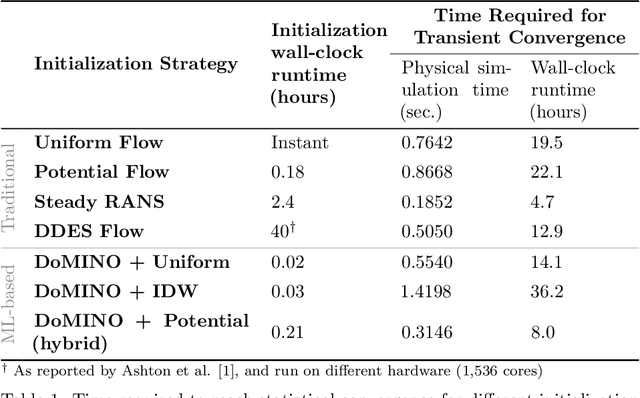
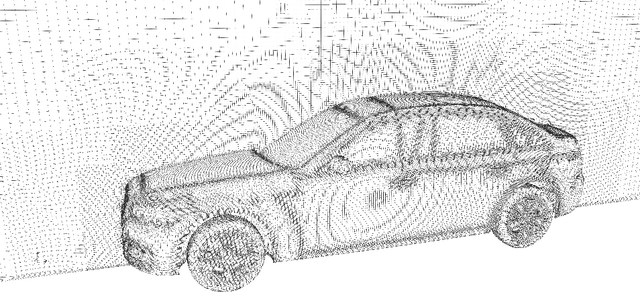
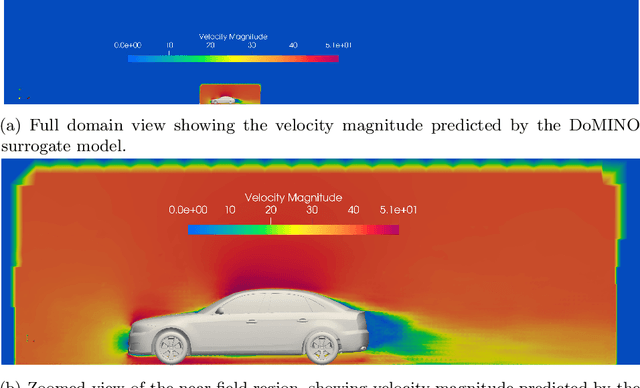
Transient computational fluid dynamics (CFD) simulations are essential for many industrial applications, but a significant portion of their computational cost stems from the time needed to reach statistical steadiness from initial conditions. We present a novel machine learning-based initialization method that reduces the cost of this subsequent transient solve substantially, achieving a 50% reduction in time-to-convergence compared to traditional uniform and potential flow-based initializations. Through a case study in automotive aerodynamics using a 16.7M-cell unsteady RANS simulation, we evaluate three ML-based initialization strategies. Two of these strategies are recommended for general use: (1) a physics-informed hybrid method combining ML predictions with potential flow solutions, and (2) a more versatile approach integrating ML predictions with uniform flow. Both strategies enable CFD solvers to achieve convergence times comparable to computationally expensive steady RANS initializations, while requiring only seconds of computation. We develop a robust statistical convergence metric based on windowed time-averaging for performance comparison between initialization strategies. Notably, these improvements are achieved using an ML model trained on a different dataset of automotive geometries, demonstrating strong generalization capabilities. The proposed methods integrate seamlessly with existing CFD workflows without requiring modifications to the underlying flow solver, providing a practical approach to accelerating industrial CFD simulations through improved ML-based initialization strategies.