 Add to Chrome
 Add to Firefox
 Add to Edge
Sub--Riemannian boundary value problems for Optimal Geometric Locomotion
Feb 12, 2026
We propose a geometric model for optimal shape-change-induced motions of slender locomotors, e.g., snakes slithering on sand. In these scenarios, the motion of a body in world coordinates is completely determined by the sequence of shapes it assumes. Specifically, we formulate Lagrangian least-dissipation principles as boundary value problems whose solutions are given by sub-Riemannian geodesics. Notably, our geometric model accounts not only for the energy dissipated by the body's displacement through the environment, but also for the energy dissipated by the animal's metabolism or a robot's actuators to induce shape changes such as bending and stretching, thus capturing overall locomotion efficiency. Our continuous model, together with a consistent time and space discretization, enables numerical computation of sub-Riemannian geodesics for three different types of boundary conditions, i.e., fixing initial and target body, restricting to cyclic motion, or solely prescribing body displacement and orientation. The resulting optimal deformation gaits qualitatively match observed motion trajectories of organisms such as snakes and spermatozoa, as well as known optimality results for low-dimensional systems such as Purcell's swimmers. Moreover, being geometrically less rigid than previous frameworks, our model enables new insights into locomotion mechanisms of, e.g., generalized Purcell's swimmers. The code is publicly available.

A variational approach to geometric mechanics for undulating robotic locomotion
Sep 17, 2024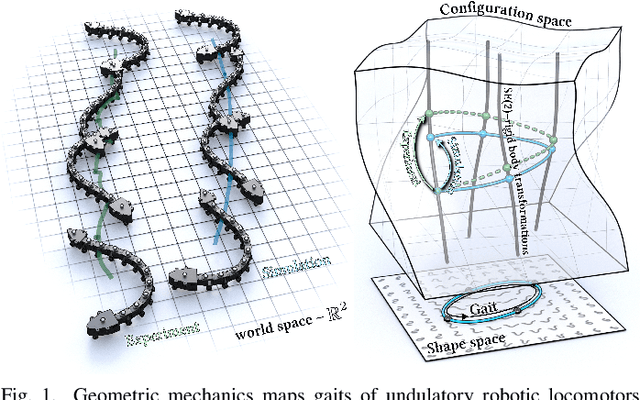
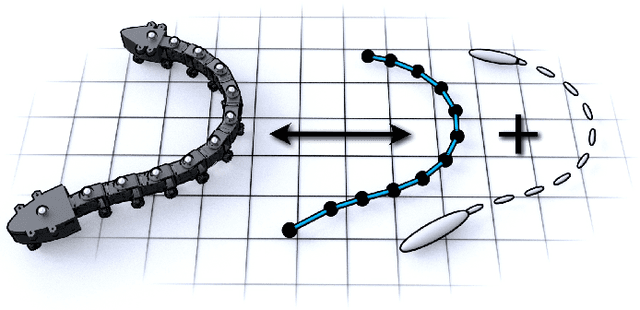


Limbless organisms of all sizes use undulating patterns of self-deformation to locomote. Geometric mechanics, which maps deformations to motions, provides a powerful framework to formalize and investigate the theoretical properties and limitations of such modes of locomotion. However, the inherent level of abstraction poses a challenge when bridging the gap between theory or simulations and laboratory experiments. We investigate the challenges of modeling motion trajectories of an undulating robotic locomotor by comparing experiments and simulations performed with a variational integrator. Despite the extensive simplifications that the model based on a geometric variation principle entails, the simulations show good agreement on average. Notably, our approach merely requires the knowledge of the \emph{dissipation metric} -- a Riemannian metric on the configuration space, which can in practice be approximated by means closely resembling \emph{resistive force theory}.