 Add to Chrome
 Add to Firefox
 Add to Edge
TerminalWorld: Benchmarking Agents on Real-World Terminal Tasks
May 21, 2026
We introduce TerminalWorld, a scalable data engine that automatically reverse-engineers high-fidelity evaluation tasks from "in-the-wild" terminal recordings. Processing 80,870 terminal recordings, the engine yields a full benchmark of 1,530 validated tasks, spanning 18 real-world categories, ranging from short everyday operations to workflows exceeding 50 steps, and covering 1,280 unique commands. From these, we curate a Verified subset of 200 representative, manually reviewed tasks. Comprehensive benchmarking on TerminalWorld-Verified across eight frontier models and six agents reveals that current systems still struggle with authentic terminal workflows, achieving a maximum pass rate of only 62.5%. Moreover, TerminalWorld captures real-world terminal capabilities distinct from existing expert-curated benchmarks (e.g., Terminal-Bench), with only a weak correlation to their scores (Pearson r=0.20). The automated engine makes TerminalWorld authentic and scalable by construction, enabling it to evaluate agents in real-world terminal environments as developer practices evolve. Data and code are available at https://github.com/EuniAI/TerminalWorld.

WybeCoder: Verified Imperative Code Generation
Mar 31, 2026Recent progress in large language models (LLMs) has advanced automatic code generation and formal theorem proving, yet software verification has not seen the same improvement. To address this gap, we propose WybeCoder, an agentic code verification framework that enables prove-as-you-generate development where code, invariants, and proofs co-evolve. It builds on a recent framework that combines automatic verification condition generation and SMT solvers with interactive proofs in Lean. To enable systematic evaluation, we translate two benchmarks for functional verification in Lean, Verina and Clever, to equivalent imperative code specifications. On complex algorithms such as Heapsort, we observe consistent performance improvements by scaling our approach, synthesizing dozens of valid invariants and dispatching of dozens of subgoals, resulting in hundreds of lines of verified code, overcoming plateaus reported in previous works. Our best system solves 74% of Verina tasks and 62% of Clever tasks at moderate compute budgets, significantly surpassing previous evaluations and paving a path to automated construction of large-scale datasets of verified imperative code.
LLMs versus the Halting Problem: Revisiting Program Termination Prediction
Jan 26, 2026Determining whether a program terminates is a central problem in computer science. Turing's foundational result established the Halting Problem as undecidable, showing that no algorithm can universally determine termination for all programs and inputs. Consequently, automatic verification tools approximate termination, sometimes failing to prove or disprove; these tools rely on problem-specific architectures and abstractions, and are usually tied to particular programming languages. Recent success and progress in large language models (LLMs) raises the following question: can LLMs reliably predict program termination? In this work, we evaluate LLMs on a diverse set of C programs from the Termination category of the International Competition on Software Verification (SV-Comp) 2025. Our results suggest that LLMs perform remarkably well at predicting program termination, where GPT-5 and Claude Sonnet-4.5 would rank just behind the top-ranked tool (using test-time-scaling), and Code World Model (CWM) would place just behind the second-ranked tool. While LLMs are effective at predicting program termination, they often fail to provide a valid witness as a proof. Moreover, LLMs performance drops as program length increases. We hope these insights motivate further research into program termination and the broader potential of LLMs for reasoning about undecidable problems.
Non-Termination Proving: 100 Million LoC and Beyond
Sep 05, 2025We report on our tool, Pulse Infinite, that uses proof techniques to show non-termination (divergence) in large programs. Pulse Infinite works compositionally and under-approximately: the former supports scale, and the latter ensures soundness for proving divergence. Prior work focused on small benchmarks in the tens or hundreds of lines of code (LoC), and scale limits their practicality: a single company may have tens of millions, or even hundreds of millions of LoC or more. We report on applying Pulse Infinite to over a hundred million lines of open-source and proprietary software written in C, C++, and Hack, identifying over 30 previously unknown issues, establishing a new state of the art for detecting divergence in real-world codebases.
Harden and Catch for Just-in-Time Assured LLM-Based Software Testing: Open Research Challenges
Apr 23, 2025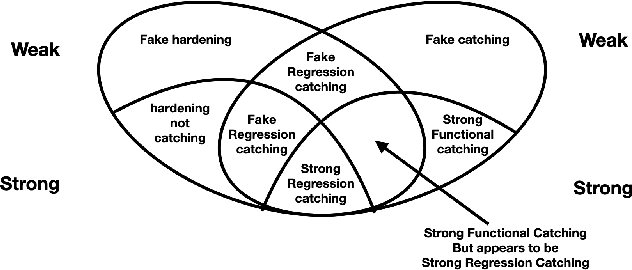
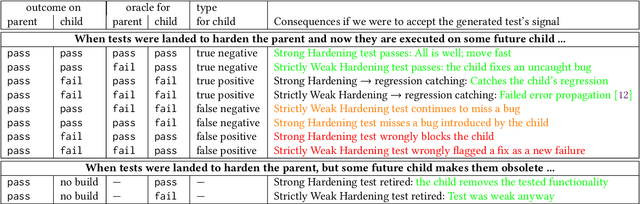
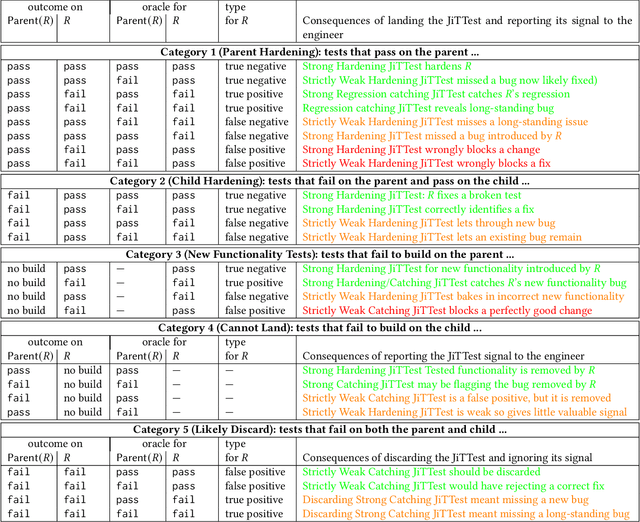
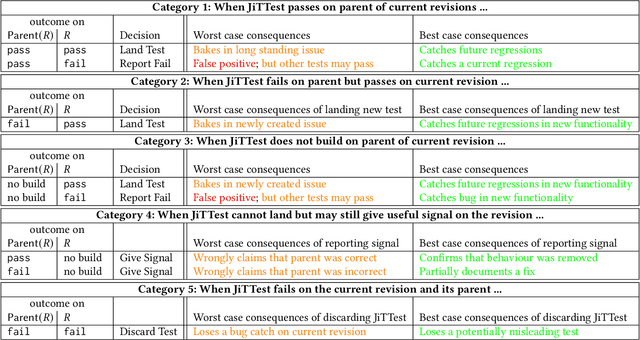
Despite decades of research and practice in automated software testing, several fundamental concepts remain ill-defined and under-explored, yet offer enormous potential real-world impact. We show that these concepts raise exciting new challenges in the context of Large Language Models for software test generation. More specifically, we formally define and investigate the properties of hardening and catching tests. A hardening test is one that seeks to protect against future regressions, while a catching test is one that catches such a regression or a fault in new functionality introduced by a code change. Hardening tests can be generated at any time and may become catching tests when a future regression is caught. We also define and motivate the Catching `Just-in-Time' (JiTTest) Challenge, in which tests are generated `just-in-time' to catch new faults before they land into production. We show that any solution to Catching JiTTest generation can also be repurposed to catch latent faults in legacy code. We enumerate possible outcomes for hardening and catching tests and JiTTests, and discuss open research problems, deployment options, and initial results from our work on automated LLM-based hardening at Meta. This paper\footnote{Author order is alphabetical. The corresponding author is Mark Harman.} was written to accompany the keynote by the authors at the ACM International Conference on the Foundations of Software Engineering (FSE) 2025.