 Add to Chrome
 Add to Firefox
 Add to Edge
Enhancing radioisotope identification in gamma spectra with transfer learning
Dec 10, 2024
Machine learning methods in gamma spectroscopy have the potential to provide accurate, real-time classification of unknown radioactive samples. However, obtaining sufficient experimental training data is often prohibitively expensive and time-consuming, and models trained solely on synthetic data can struggle to generalize to the unpredictable range of real-world operating scenarios. In this work, we pretrain a model using physically derived synthetic data and subsequently leverage transfer learning techniques to fine-tune the model for a specific target domain. This paradigm enables us to embed physical principles during the pretraining step, thus requiring less data from the target domain compared to classical machine learning methods. Results of this analysis indicate that fine-tuned models significantly outperform those trained exclusively on synthetic data or solely on target-domain data, particularly in the intermediate data regime (${\approx} 10^4$ training samples). This conclusion is consistent across four different machine learning architectures (MLP, CNN, Transformer, and LSTM) considered in this study. This research serves as proof of concept for applying transfer learning techniques to application scenarios where access to experimental data is limited.

Direct atomic number reconstruction of dual energy cargo radiographs using a semiempirical transparency model
Jul 22, 2023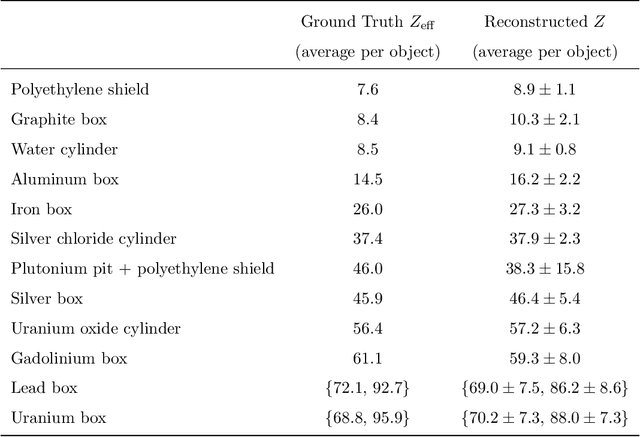
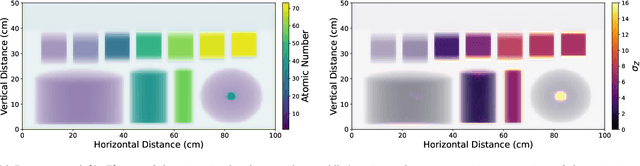
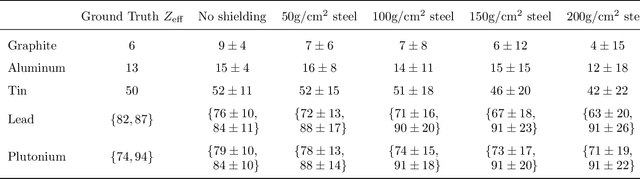
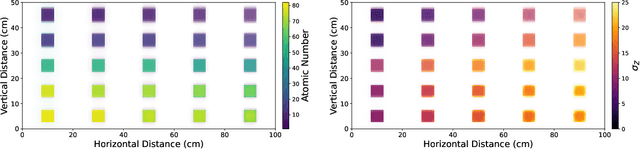
Dual energy cargo inspection systems are sensitive to both the area density and the atomic number of an imaged container due to the Z dependence of photon attenuation. The ability to identify cargo contents by their atomic number enables improved detection capabilities of illicit materials. Existing methods typically classify materials into a few material classes using an empirical calibration step. However, such a coarse label discretization limits atomic number selectivity and can yield inaccurate results if a material is near the midpoint of two bins. This work introduces a high resolution atomic number prediction method by minimizing the chi-squared error between measured transparency values and a semiempirical transparency model. Our previous work showed that by incorporating calibration step, the semiempirical transparency model can capture second order effects such as scattering. This method is benchmarked using two simulated radiographic phantoms, demonstrating the ability to obtain accurate material predictions on noisy input images by incorporating an image segmentation step. Furthermore, we show that this approach can be adapted to identify shielded objects after first determining the properties of the shielding, taking advantage of the closed-form nature of the transparency model.