 Add to Chrome
 Add to Firefox
 Add to Edge
SSplain: Sparse and Smooth Explainer for Retinopathy of Prematurity Classification
Dec 08, 2025
Neural networks are frequently used in medical diagnosis. However, due to their black-box nature, model explainers are used to help clinicians understand better and trust model outputs. This paper introduces an explainer method for classifying Retinopathy of Prematurity (ROP) from fundus images. Previous methods fail to generate explanations that preserve input image structures such as smoothness and sparsity. We introduce Sparse and Smooth Explainer (SSplain), a method that generates pixel-wise explanations while preserving image structures by enforcing smoothness and sparsity. This results in realistic explanations to enhance the understanding of the given black-box model. To achieve this goal, we define an optimization problem with combinatorial constraints and solve it using the Alternating Direction Method of Multipliers (ADMM). Experimental results show that SSplain outperforms commonly used explainers in terms of both post-hoc accuracy and smoothness analyses. Additionally, SSplain identifies features that are consistent with domain-understandable features that clinicians consider as discriminative factors for ROP. We also show SSplain's generalization by applying it to additional publicly available datasets. Code is available at https://github.com/neu-spiral/SSplain.

Tubular Curvature Filter: Implicit Pointwise Curvature Calculation Method for Tubular Objects
Nov 20, 2023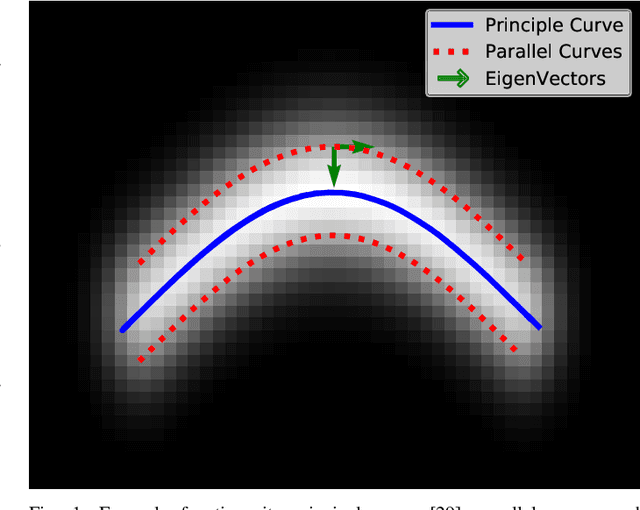
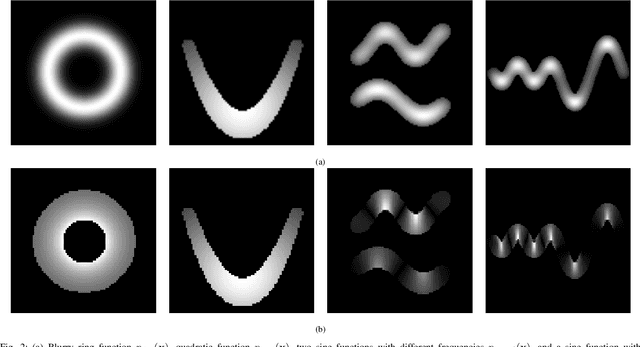
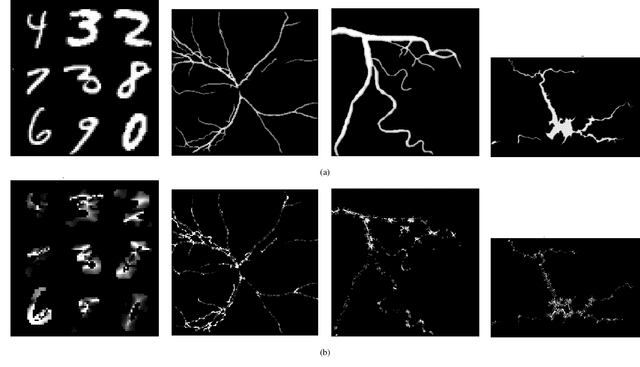
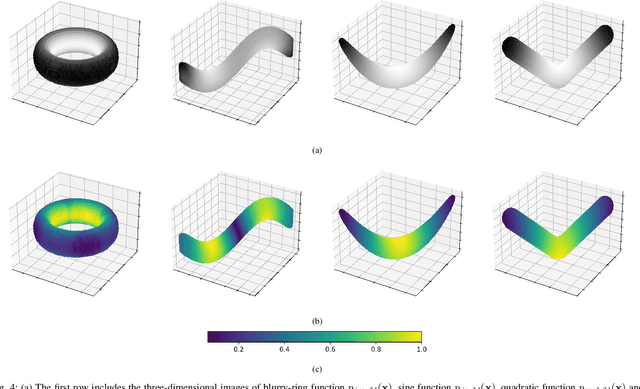
Curvature estimation methods are important as they capture salient features for various applications in image processing, especially within medical domains where tortuosity of vascular structures is of significant interest. Existing methods based on centerline or skeleton curvature fail to capture curvature gradients across a rotating tubular structure. This paper presents a Tubular Curvature Filter method that locally calculates the acceleration of bundles of curves that traverse along the tubular object parallel to the centerline. This is achieved by examining the directional rate of change in the eigenvectors of the Hessian matrix of a tubular intensity function in space. This method implicitly calculates the local tubular curvature without the need to explicitly segment the tubular object. Experimental results demonstrate that the Tubular Curvature Filter method provides accurate estimates of local curvature at any point inside tubular structures.