 Add to Chrome
 Add to Firefox
 Add to Edge
Quality-Aware Robust Multi-View Clustering for Heterogeneous Observation Noise
Feb 26, 2026
Deep multi-view clustering has achieved remarkable progress but remains vulnerable to complex noise in real-world applications. Existing noisy robust methods predominantly rely on a simplified binary assumption, treating data as either perfectly clean or completely corrupted. This overlooks the prevalent existence of heterogeneous observation noise, where contamination intensity varies continuously across data. To bridge this gap, we propose a novel framework termed Quality-Aware Robust Multi-View Clustering (QARMVC). Specifically, QARMVC employs an information bottleneck mechanism to extract intrinsic semantics for view reconstruction. Leveraging the insight that noise disrupts semantic integrity and impedes reconstruction, we utilize the resulting reconstruction discrepancy to precisely quantify fine-grained contamination intensity and derive instance-level quality scores. These scores are integrated into a hierarchical learning strategy: at the feature level, a quality-weighted contrastive objective is designed to adaptively suppress the propagation of noise; at the fusion level, a high-quality global consensus is constructed via quality-weighted aggregation, which is subsequently utilized to align and rectify local views via mutual information maximization. Extensive experiments on five benchmark datasets demonstrate that QARMVC consistently outperforms state-of-the-art baselines, particularly in scenarios with heterogeneous noise intensities.

SatFusion: A Unified Framework for Enhancing Satellite IoT Images via Multi-Temporal and Multi-Source Data Fusion
Oct 09, 2025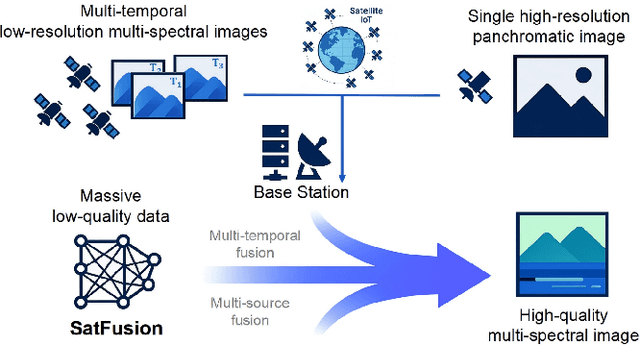
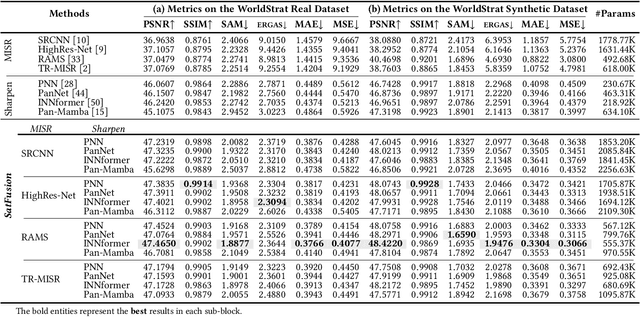
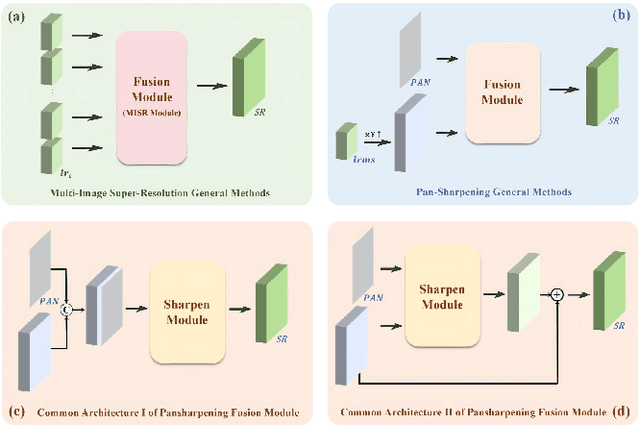
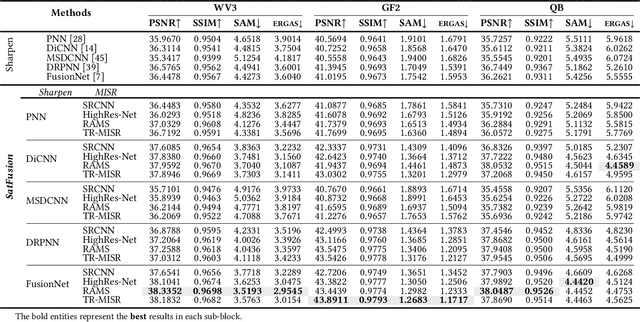
With the rapid advancement of the digital society, the proliferation of satellites in the Satellite Internet of Things (Sat-IoT) has led to the continuous accumulation of large-scale multi-temporal and multi-source images across diverse application scenarios. However, existing methods fail to fully exploit the complementary information embedded in both temporal and source dimensions. For example, Multi-Image Super-Resolution (MISR) enhances reconstruction quality by leveraging temporal complementarity across multiple observations, yet the limited fine-grained texture details in input images constrain its performance. Conversely, pansharpening integrates multi-source images by injecting high-frequency spatial information from panchromatic data, but typically relies on pre-interpolated low-resolution inputs and assumes noise-free alignment, making it highly sensitive to noise and misregistration. To address these issues, we propose SatFusion: A Unified Framework for Enhancing Satellite IoT Images via Multi-Temporal and Multi-Source Data Fusion. Specifically, SatFusion first employs a Multi-Temporal Image Fusion (MTIF) module to achieve deep feature alignment with the panchromatic image. Then, a Multi-Source Image Fusion (MSIF) module injects fine-grained texture information from the panchromatic data. Finally, a Fusion Composition module adaptively integrates the complementary advantages of both modalities while dynamically refining spectral consistency, supervised by a weighted combination of multiple loss functions. Extensive experiments on the WorldStrat, WV3, QB, and GF2 datasets demonstrate that SatFusion significantly improves fusion quality, robustness under challenging conditions, and generalizability to real-world Sat-IoT scenarios. The code is available at: https://github.com/dllgyufei/SatFusion.git.