 Add to Chrome
 Add to Firefox
 Add to Edge
UCTECG-Net: Uncertainty-aware Convolution Transformer ECG Network for Arrhythmia Detection
Feb 18, 2026
Deep learning has improved automated electrocardiogram (ECG) classification, but limited insight into prediction reliability hinders its use in safety-critical settings. This paper proposes UCTECG-Net, an uncertainty-aware hybrid architecture that combines one-dimensional convolutions and Transformer encoders to process raw ECG signals and their spectrograms jointly. Evaluated on the MIT-BIH Arrhythmia and PTB Diagnostic datasets, UCTECG-Net outperforms LSTM, CNN1D, and Transformer baselines in terms of accuracy, precision, recall and F1 score, achieving up to 98.58% accuracy on MIT-BIH and 99.14% on PTB. To assess predictive reliability, we integrate three uncertainty quantification methods (Monte Carlo Dropout, Deep Ensembles, and Ensemble Monte Carlo Dropout) into all models and analyze their behavior using an uncertainty-aware confusion matrix and derived metrics. The results show that UCTECG-Net, particularly with Ensemble or EMCD, provides more reliable and better-aligned uncertainty estimates than competing architectures, offering a stronger basis for risk-aware ECG decision support.

Uncertainty-Aware Deep Learning for Automated Skin Cancer Classification: A Comprehensive Evaluation
Jun 12, 2025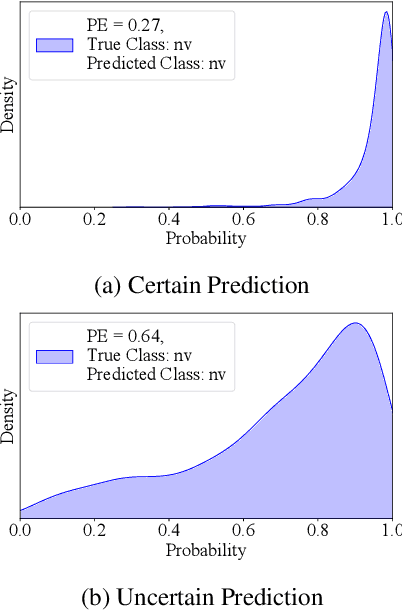
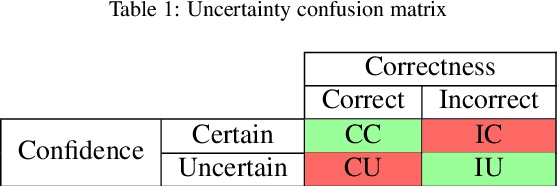
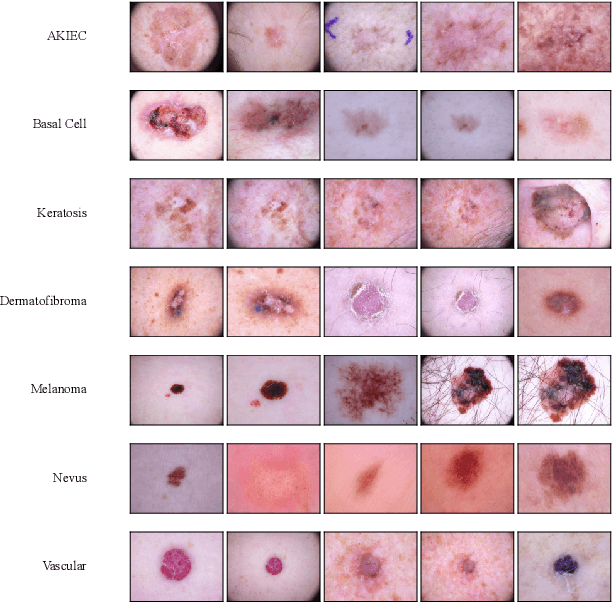
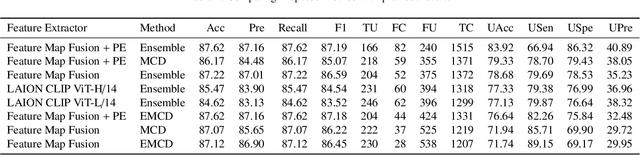
Accurate and reliable skin cancer diagnosis is critical for early treatment and improved patient outcomes. Deep learning (DL) models have shown promise in automating skin cancer classification, but their performance can be limited by data scarcity and a lack of uncertainty awareness. In this study, we present a comprehensive evaluation of DL-based skin lesion classification using transfer learning and uncertainty quantification (UQ) on the HAM10000 dataset. In the first phase, we benchmarked several pre-trained feature extractors-including Contrastive Language-Image Pretraining (CLIP) variants, Residual Network-50 (ResNet50), Densely Connected Convolutional Network (DenseNet121), Visual Geometry Group network (VGG16), and EfficientNet-V2-Large-combined with a range of traditional classifiers such as Support Vector Machine (SVM), eXtreme Gradient Boosting (XGBoost), and logistic regression. Our results show that CLIP-based vision transformers, particularly LAION CLIP ViT-H/14 with SVM, deliver the highest classification performance. In the second phase, we incorporated UQ using Monte Carlo Dropout (MCD), Ensemble, and Ensemble Monte Carlo Dropout (EMCD) to assess not only prediction accuracy but also the reliability of model outputs. We evaluated these models using uncertainty-aware metrics such as uncertainty accuracy(UAcc), uncertainty sensitivity(USen), uncertainty specificity(USpe), and uncertainty precision(UPre). The results demonstrate that ensemble methods offer a good trade-off between accuracy and uncertainty handling, while EMCD is more sensitive to uncertain predictions. This study highlights the importance of integrating UQ into DL-based medical diagnosis to enhance both performance and trustworthiness in real-world clinical applications.