 Add to Chrome
 Add to Firefox
 Add to Edge
Algorithmic Simplification of Neural Networks with Mosaic-of-Motifs
Feb 16, 2026
Large-scale deep learning models are well-suited for compression. Methods like pruning, quantization, and knowledge distillation have been used to achieve massive reductions in the number of model parameters, with marginal performance drops across a variety of architectures and tasks. This raises the central question: \emph{Why are deep neural networks suited for compression?} In this work, we take up the perspective of algorithmic complexity to explain this behavior. We hypothesize that the parameters of trained models have more structure and, hence, exhibit lower algorithmic complexity compared to the weights at (random) initialization. Furthermore, that model compression methods harness this reduced algorithmic complexity to compress models. Although an unconstrained parameterization of model weights, $\mathbf{w} \in \mathbb{R}^n$, can represent arbitrary weight assignments, the solutions found during training exhibit repeatability and structure, making them algorithmically simpler than a generic program. To this end, we formalize the Kolmogorov complexity of $\mathbf{w}$ by $\mathcal{K}(\mathbf{w})$. We introduce a constrained parameterization $\widehat{\mathbf{w}}$, that partitions parameters into blocks of size $s$, and restricts each block to be selected from a set of $k$ reusable motifs, specified by a reuse pattern (or mosaic). The resulting method, $\textit{Mosaic-of-Motifs}$ (MoMos), yields algorithmically simpler model parameterization compared to unconstrained models. Empirical evidence from multiple experiments shows that the algorithmic complexity of neural networks, measured using approximations to Kolmogorov complexity, can be reduced during training. This results in models that perform comparably with unconstrained models while being algorithmically simpler.

Climate And Resource Awareness is Imperative to Achieving Sustainable AI (and Preventing a Global AI Arms Race)
Feb 27, 2025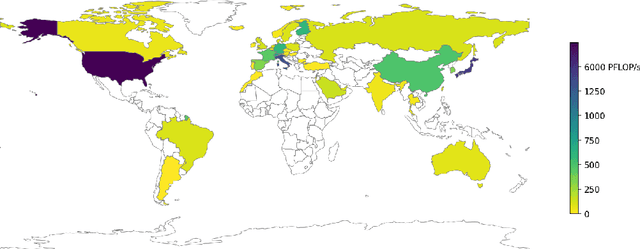

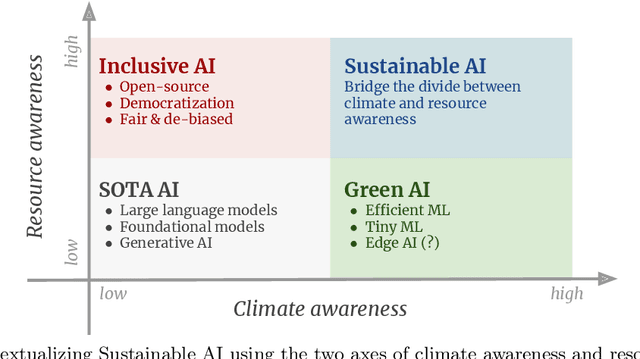
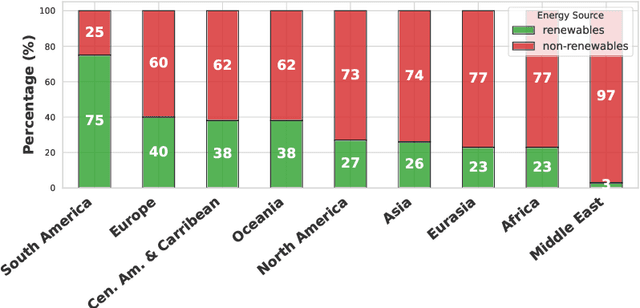
Sustainability encompasses three key facets: economic, environmental, and social. However, the nascent discourse that is emerging on sustainable artificial intelligence (AI) has predominantly focused on the environmental sustainability of AI, often neglecting the economic and social aspects. Achieving truly sustainable AI necessitates addressing the tension between its climate awareness and its social sustainability, which hinges on equitable access to AI development resources. The concept of resource awareness advocates for broader access to the infrastructure required to develop AI, fostering equity in AI innovation. Yet, this push for improving accessibility often overlooks the environmental costs of expanding such resource usage. In this position paper, we argue that reconciling climate and resource awareness is essential to realizing the full potential of sustainable AI. We use the framework of base-superstructure to analyze how the material conditions are influencing the current AI discourse. We also introduce the Climate and Resource Aware Machine Learning (CARAML) framework to address this conflict and propose actionable recommendations spanning individual, community, industry, government, and global levels to achieve sustainable AI.
Energy Consumption-Aware Tabular Benchmarks for Neural Architecture Search
Oct 12, 2022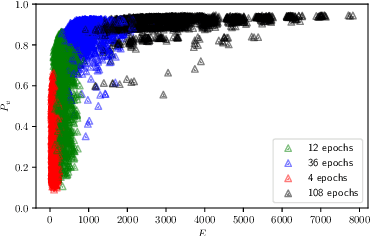
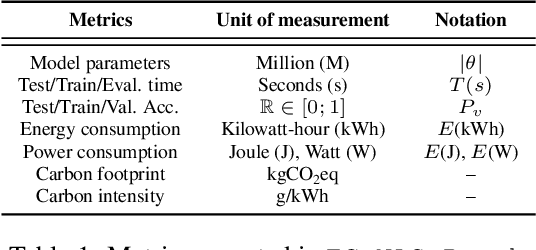
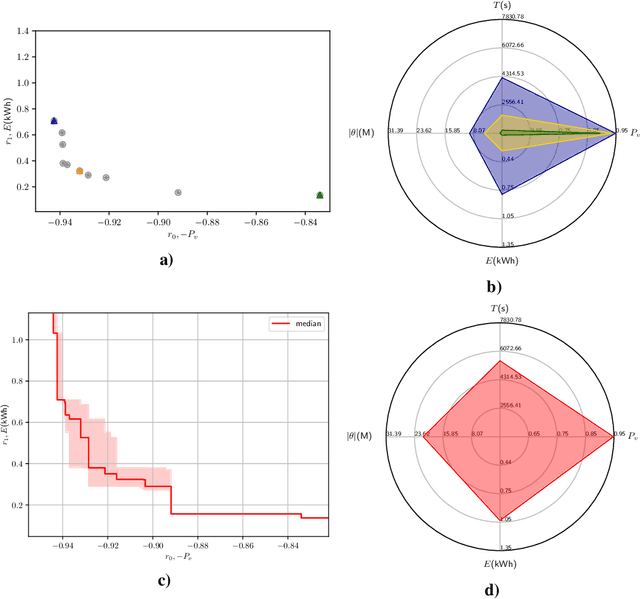
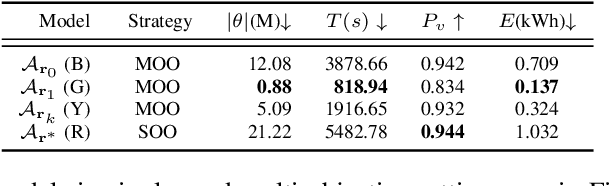
The demand for large-scale computational resources for Neural Architecture Search (NAS) has been lessened by tabular benchmarks for NAS. Evaluating NAS strategies is now possible on extensive search spaces and at a moderate computational cost. But so far, NAS has mainly focused on maximising performance on some hold-out validation/test set. However, energy consumption is a partially conflicting objective that should not be neglected. We hypothesise that constraining NAS to include the energy consumption of training the models could reveal a sub-space of undiscovered architectures that are more computationally efficient with a smaller carbon footprint. To support the hypothesis, an existing tabular benchmark for NAS is augmented with the energy consumption of each architecture. We then perform multi-objective optimisation that includes energy consumption as an additional objective. We demonstrate the usefulness of multi-objective NAS for uncovering the trade-off between performance and energy consumption as well as for finding more energy-efficient architectures. The updated tabular benchmark, EC-NAS-Bench, is open-sourced to encourage the further exploration of energy consumption-aware NAS.