 Add to Chrome
 Add to Firefox
 Add to Edge
REM-CTX: Automated Peer Review via Reinforcement Learning with Auxiliary Context
Mar 31, 2026
Most automated peer review systems rely on textual manuscript content alone, leaving visual elements such as figures and external scholarly signals underutilized. We introduce REM-CTX, a reinforcement-learning system that incorporates auxiliary context into the review generation process via correspondence-aware reward functions. REM-CTX trains an 8B-parameter language model with Group Relative Policy Optimization (GRPO) and combines a multi-aspect quality reward with two correspondence rewards that explicitly encourage alignment with auxiliary context. Experiments on manuscripts across Computer, Biological, and Physical Sciences show that REM-CTX achieves the highest overall review quality among six baselines, outperforming other systems with substantially larger commercial models, and surpassing the next-best RL baseline across both quality and contextual grounding metrics. Ablation studies confirm that the two correspondence rewards are complementary: each selectively improves its targeted correspondence reward while preserving all quality dimensions, and the full model outperforms all partial variants. Analysis of training dynamics reveals that the criticism aspect is negatively correlated with other metrics during training, suggesting that future studies should group multi-dimension rewards for review generation.

REMOR: Automated Peer Review Generation with LLM Reasoning and Multi-Objective Reinforcement Learning
May 16, 2025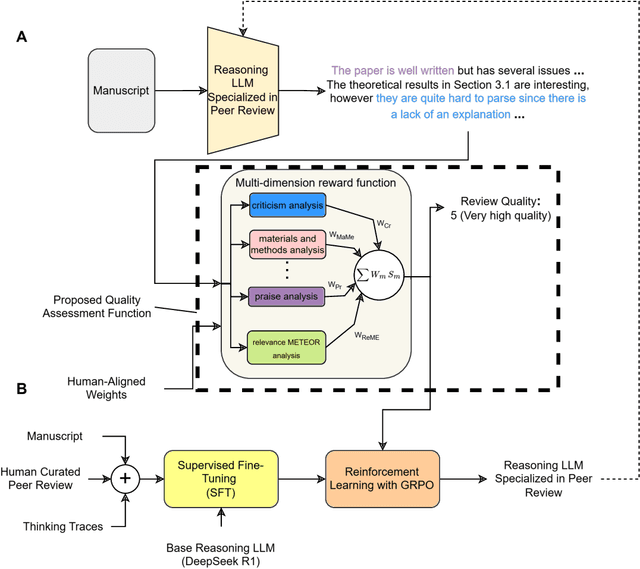
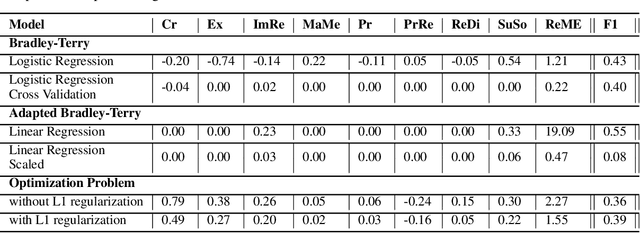
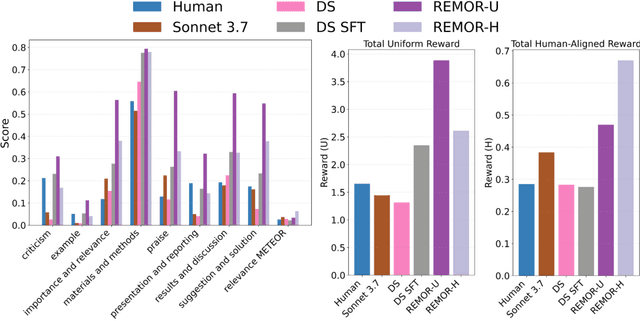
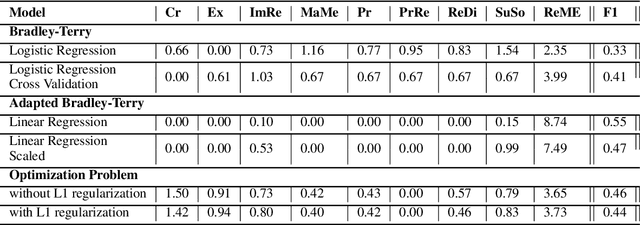
AI-based peer review systems tend to produce shallow and overpraising suggestions compared to human feedback. Here, we evaluate how well a reasoning LLM trained with multi-objective reinforcement learning (REMOR) can overcome these limitations. We start by designing a multi-aspect reward function that aligns with human evaluation of reviews. The aspects are related to the review itself (e.g., criticisms, novelty) and the relationship between the review and the manuscript (i.e., relevance). First, we perform supervised fine-tuning of DeepSeek-R1-Distill-Qwen-7B using LoRA on PeerRT, a new dataset of high-quality top AI conference reviews enriched with reasoning traces. We then apply Group Relative Policy Optimization (GRPO) to train two models: REMOR-H (with the human-aligned reward) and REMOR-U (with a uniform reward). Interestingly, the human-aligned reward penalizes aspects typically associated with strong reviews, leading REMOR-U to produce qualitatively more substantive feedback. Our results show that REMOR-U and REMOR-H achieve more than twice the average rewards of human reviews, non-reasoning state-of-the-art agentic multi-modal AI review systems, and general commercial LLM baselines. We found that while the best AI and human reviews are comparable in quality, REMOR avoids the long tail of low-quality human reviews. We discuss how reasoning is key to achieving these improvements and release the Human-aligned Peer Review Reward (HPRR) function, the Peer Review Reasoning-enriched Traces (PeerRT) dataset, and the REMOR models, which we believe can help spur progress in the area.