 Add to Chrome
 Add to Firefox
 Add to Edge
Adversarial Evasion in Non-Stationary Malware Detection: Minimizing Drift Signals through Similarity-Constrained Perturbations
Apr 23, 2026
Deep learning has emerged as a powerful approach for malware detection, demonstrating impressive accuracy across various data representations. However, these models face critical limitations in real-world, non-stationary environments where both malware characteristics and detection systems continuously evolve. Our research investigates a fundamental security question: Can an attacker generate adversarial malware samples that simultaneously evade classification and remain inconspicuous to drift monitoring mechanisms? We propose a novel approach that generates targeted adversarial examples in the classifier's standardized feature space, augmented with sophisticated similarity regularizers. By carefully constraining perturbations to maintain distributional similarity with clean malware, we create an optimization objective that balances targeted misclassification with drift signal minimization. We quantify the effectiveness of this approach by comprehensively comparing classifier output probabilities using multiple drift metrics. Our experiments demonstrate that similarity constraints can reduce output drift signals, with $\ell_2$ regularization showing the most promising results. We observe that perturbation budget significantly influences the evasion-detectability trade-off, with increased budget leading to higher attack success rates and more substantial drift indicators.

SkillScope: A Tool to Predict Fine-Grained Skills Needed to Solve Issues on GitHub
Jan 27, 2025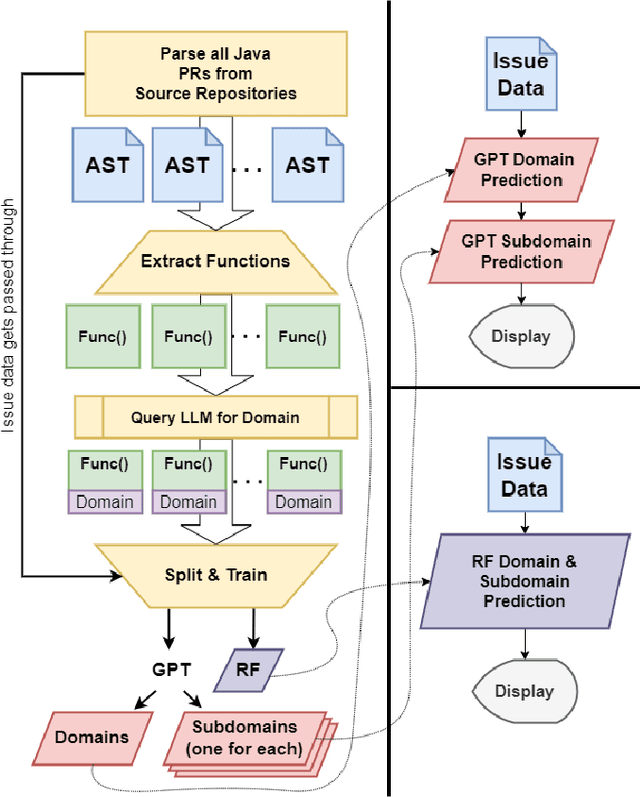
New contributors often struggle to find tasks that they can tackle when onboarding onto a new Open Source Software (OSS) project. One reason for this difficulty is that issue trackers lack explanations about the knowledge or skills needed to complete a given task successfully. These explanations can be complex and time-consuming to produce. Past research has partially addressed this problem by labeling issues with issue types, issue difficulty level, and issue skills. However, current approaches are limited to a small set of labels and lack in-depth details about their semantics, which may not sufficiently help contributors identify suitable issues. To surmount this limitation, this paper explores large language models (LLMs) and Random Forest (RF) to predict the multilevel skills required to solve the open issues. We introduce a novel tool, SkillScope, which retrieves current issues from Java projects hosted on GitHub and predicts the multilevel programming skills required to resolve these issues. In a case study, we demonstrate that SkillScope could predict 217 multilevel skills for tasks with 91% precision, 88% recall, and 89% F-measure on average. Practitioners can use this tool to better delegate or choose tasks to solve in OSS projects.