 Add to Chrome
 Add to Firefox
 Add to Edge
SGAP-Gaze: Scene Grid Attention Based Point-of-Gaze Estimation Network for Driver Gaze
Apr 21, 2026
Driver gaze estimation is essential for understanding the driver's situational awareness of surrounding traffic. Existing gaze estimation models use driver facial information to predict the Point-of-Gaze (PoG) or the 3D gaze direction vector. We propose a benchmark dataset, Urban Driving-Face Scene Gaze (UD-FSG), comprising synchronized driver-face and traffic-scene images. The scene images provide cues about surrounding traffic, which can help improve the gaze estimation model, along with the face images. We propose SGAP-Gaze, Scene-Grid Attention based Point-of-Gaze estimation network, trained and tested on our UD-FSG dataset, which explicitly incorporates the scene images into the gaze estimation modelling. The gaze estimation network integrates driver face, eye, iris, and scene contextual information. First, the extracted features from facial modalities are fused to form a gaze intent vector. Then, attention scores are computed over the spatial scene grid using a Transformer-based attention mechanism fusing face and scene image features to obtain the PoG. The proposed SGAP-Gaze model achieves a mean pixel error of 104.73 on the UD-FSG dataset and 63.48 on LBW dataset, achieving a 23.5% reduction in mean pixel error compared to state-of-the-art driver gaze estimation models. The spatial pixel distribution analysis shows that SGAP-Gaze consistently achieves lower mean pixel error than existing methods across all spatial ranges, including the outer regions of the scene, which are rare but critical for understanding driver attention. These results highlight the effectiveness of integrating multi-modal gaze cues with scene-aware attention for a robust driver PoG estimation model in real-world driving environments.

A Review of Driver Gaze Estimation and Application in Gaze Behavior Understanding
Jul 04, 2023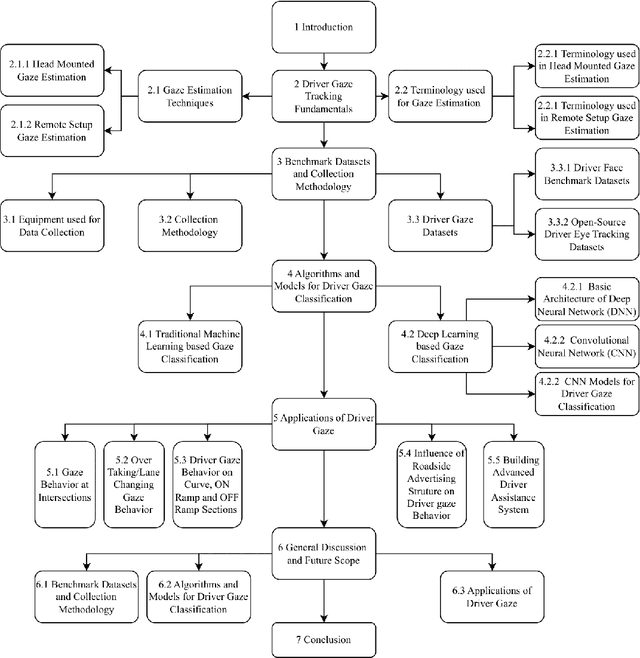
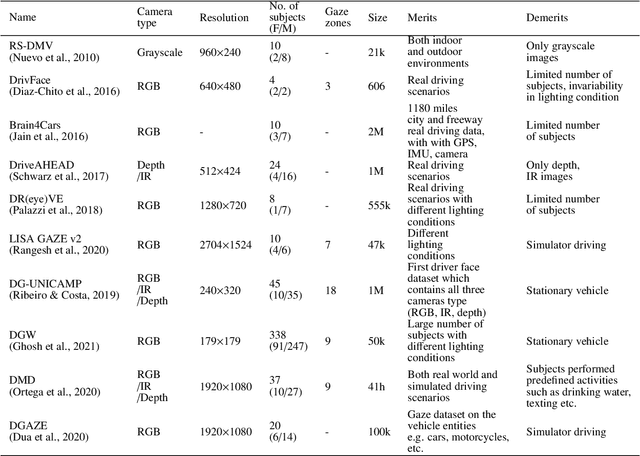
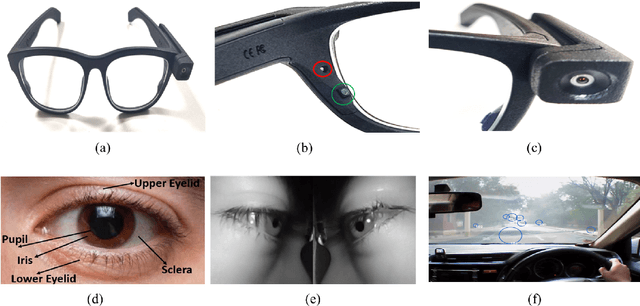
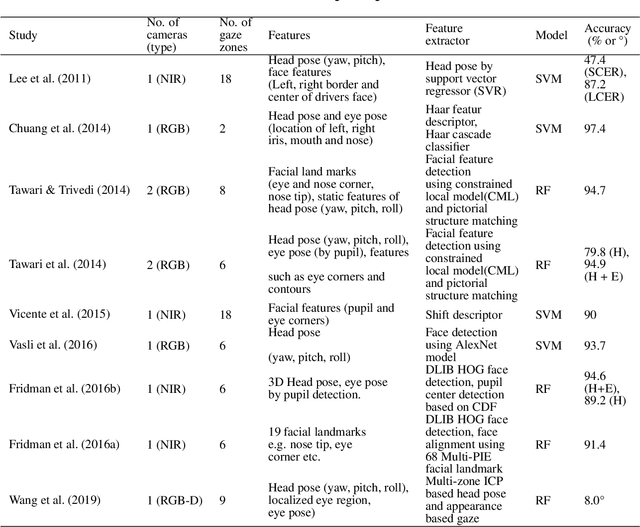
Driver gaze plays an important role in different gaze-based applications such as driver attentiveness detection, visual distraction detection, gaze behavior understanding, and building driver assistance system. The main objective of this study is to perform a comprehensive summary of driver gaze fundamentals, methods to estimate driver gaze, and it's applications in real world driving scenarios. We first discuss the fundamentals related to driver gaze, involving head-mounted and remote setup based gaze estimation and the terminologies used for each of these data collection methods. Next, we list out the existing benchmark driver gaze datasets, highlighting the collection methodology and the equipment used for such data collection. This is followed by a discussion of the algorithms used for driver gaze estimation, which primarily involves traditional machine learning and deep learning based techniques. The estimated driver gaze is then used for understanding gaze behavior while maneuvering through intersections, on-ramps, off-ramps, lane changing, and determining the effect of roadside advertising structures. Finally, we have discussed the limitations in the existing literature, challenges, and the future scope in driver gaze estimation and gaze-based applications.