 Add to Chrome
 Add to Firefox
 Add to Edge
Rethinking Positional Encoding for Neural Vehicle Routing
May 12, 2026
Transformer-based models have become the dominant paradigm for neural combinatorial optimization (NCO) of vehicle routing problems (VRPs), yet the role of positional encoding (PE) in these architectures remains largely unexplored. Unlike natural language, where tokens are uniformly spaced on a line, routing solutions exhibit several properties that render standard NLP positional encodings inadequate. In this work, we formalize three such structural properties that a routing-aware PE should respect, namely anisometric node distances, cyclic and direction-aware topology, and hierarchical depot-anchored global multi-route structure, combining them with a unifying design principle of geometric grounding. Guided by these criteria, we analyze and compare PE methods spanning NLP, graph-transformer, and routing-specific families, and propose a hierarchical anisometric PE that combines a distance-indexed, circularly consistent in-route encoding with a depot-anchored angular cross-route encoding. Extensive experiments across diverse VRP variants demonstrate that geometry-grounded PE consistently outperforms index-based alternatives, with gains that transfer across problem variants, model architectures, and distribution shifts.

Neural Deconstruction Search for Vehicle Routing Problems
Jan 07, 2025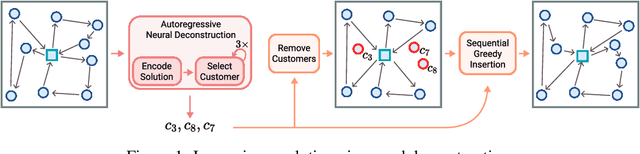
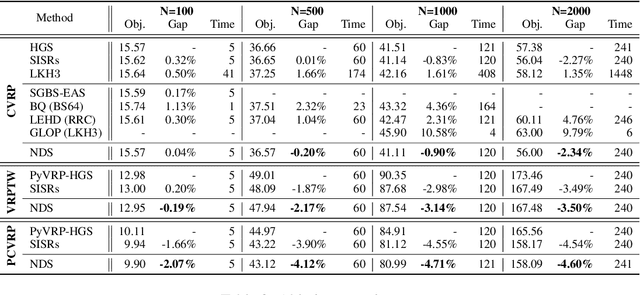

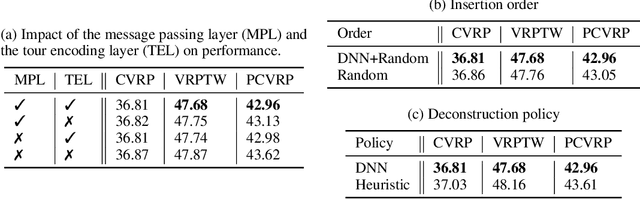
Autoregressive construction approaches generate solutions to vehicle routing problems in a step-by-step fashion, leading to high-quality solutions that are nearing the performance achieved by handcrafted, operations research techniques. In this work, we challenge the conventional paradigm of sequential solution construction and introduce an iterative search framework where solutions are instead deconstructed by a neural policy. Throughout the search, the neural policy collaborates with a simple greedy insertion algorithm to rebuild the deconstructed solutions. Our approach surpasses the performance of state-of-the-art operations research methods across three challenging vehicle routing problems of various problem sizes.