 Add to Chrome
 Add to Firefox
 Add to Edge
Soft Specialists: $α$-Rényi Ensembles for Uncertainty-Aware LLM Post-Training
May 26, 2026
Existing training approaches for large language models learn a single set of parameters, based on large volumes of data, which is typically heterogeneous, conflicting and often outright contradictory. As a result, the model is forced to compress conflicting goals, and inherent uncertainties into a single, averaged pattern of behaviour. We propose an $α$-Rényi variational framework for learning distributions over post-training parameters, offering an uncertainty-aware alternative to deep ensemble approaches. The resulting variational objective interpolates between classical variational Bayes and predictively oriented posterior learning, balancing between globally plausible individual models against systems of complementary specialists. We identify local stability criteria, demonstrating how model misspecification can make non-degenerate posterior spread locally favourable, manifesting contradictory or conflicting data as epistemic uncertainty. We apply our framework to LLM post-training, learning an ensemble of LoRA adapters attached to a shared, frozen base model, providing a scalable training procedure for both supervised fine-tuning and preference optimisation. Our approach enables training examples to be softly routed across ensemble members, promoting model specialisation and providing actionable uncertainty estimates across different tasks.

Diffusion Path Samplers via Sequential Monte Carlo
Jan 29, 2026We develop a diffusion-based sampler for target distributions known up to a normalising constant. To this end, we rely on the well-known diffusion path that smoothly interpolates between a (simple) base distribution and the target distribution, widely used in diffusion models. Our approach is based on a practical implementation of diffusion-annealed Langevin Monte Carlo, which approximates the diffusion path with convergence guarantees. We tackle the score estimation problem by developing an efficient sequential Monte Carlo sampler that evolves auxiliary variables from conditional distributions along the path, which provides principled score estimates for time-varying distributions. We further develop novel control variate schedules that minimise the variance of these score estimates. Finally, we provide theoretical guarantees and empirically demonstrate the effectiveness of our method on several synthetic and real-world datasets.
Diffusion annealed Langevin dynamics: a theoretical study
Nov 13, 2025In this work we study the diffusion annealed Langevin dynamics, a score-based diffusion process recently introduced in the theory of generative models and which is an alternative to the classical overdamped Langevin diffusion. Our goal is to provide a rigorous construction and to study the theoretical efficiency of these models for general base distribution as well as target distribution. As a matter of fact these diffusion processes are a particular case of Nelson processes i.e. diffusion processes with a given flow of time marginals. Providing existence and uniqueness of the solution to the annealed Langevin diffusion leads to proving a Poincaré inequality for the conditional distribution of $X$ knowing $X+Z=y$ uniformly in $y$, as recently observed by one of us and her coauthors. Part of this work is thus devoted to the study of such Poincaré inequalities. Additionally we show that strengthening the Poincaré inequality into a logarithmic Sobolev inequality improves the efficiency of the model.
Sampling by averaging: A multiscale approach to score estimation
Aug 20, 2025We introduce a novel framework for efficient sampling from complex, unnormalised target distributions by exploiting multiscale dynamics. Traditional score-based sampling methods either rely on learned approximations of the score function or involve computationally expensive nested Markov chain Monte Carlo (MCMC) loops. In contrast, the proposed approach leverages stochastic averaging within a slow-fast system of stochastic differential equations (SDEs) to estimate intermediate scores along a diffusion path without training or inner-loop MCMC. Two algorithms are developed under this framework: MultALMC, which uses multiscale annealed Langevin dynamics, and MultCDiff, based on multiscale controlled diffusions for the reverse-time Ornstein-Uhlenbeck process. Both overdamped and underdamped variants are considered, with theoretical guarantees of convergence to the desired diffusion path. The framework is extended to handle heavy-tailed target distributions using Student's t-based noise models and tailored fast-process dynamics. Empirical results across synthetic and real-world benchmarks, including multimodal and high-dimensional distributions, demonstrate that the proposed methods are competitive with existing samplers in terms of accuracy and efficiency, without the need for learned models.
Non-asymptotic Analysis of Diffusion Annealed Langevin Monte Carlo for Generative Modelling
Feb 13, 2025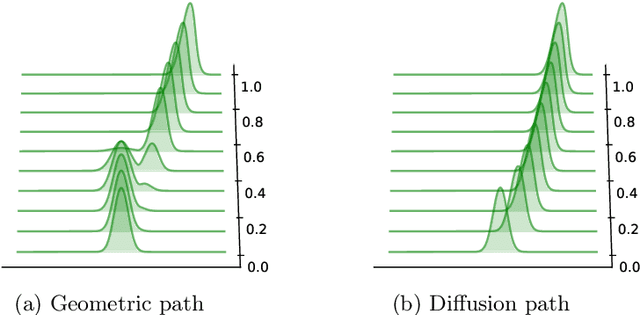
We investigate the theoretical properties of general diffusion (interpolation) paths and their Langevin Monte Carlo implementation, referred to as diffusion annealed Langevin Monte Carlo (DALMC), under weak conditions on the data distribution. Specifically, we analyse and provide non-asymptotic error bounds for the annealed Langevin dynamics where the path of distributions is defined as Gaussian convolutions of the data distribution as in diffusion models. We then extend our results to recently proposed heavy-tailed (Student's t) diffusion paths, demonstrating their theoretical properties for heavy-tailed data distributions for the first time. Our analysis provides theoretical guarantees for a class of score-based generative models that interpolate between a simple distribution (Gaussian or Student's t) and the data distribution in finite time. This approach offers a broader perspective compared to standard score-based diffusion approaches, which are typically based on a forward Ornstein-Uhlenbeck (OU) noising process.
Deep Optimal Sensor Placement for Black Box Stochastic Simulations
Oct 15, 2024Selecting cost-effective optimal sensor configurations for subsequent inference of parameters in black-box stochastic systems faces significant computational barriers. We propose a novel and robust approach, modelling the joint distribution over input parameters and solution with a joint energy-based model, trained on simulation data. Unlike existing simulation-based inference approaches, which must be tied to a specific set of point evaluations, we learn a functional representation of parameters and solution. This is used as a resolution-independent plug-and-play surrogate for the joint distribution, which can be conditioned over any set of points, permitting an efficient approach to sensor placement. We demonstrate the validity of our framework on a variety of stochastic problems, showing that our method provides highly informative sensor locations at a lower computational cost compared to conventional approaches.