 Add to Chrome
 Add to Firefox
 Add to Edge
Generalizing PDE Emulation with Equation-Aware Neural Operators
Nov 12, 2025
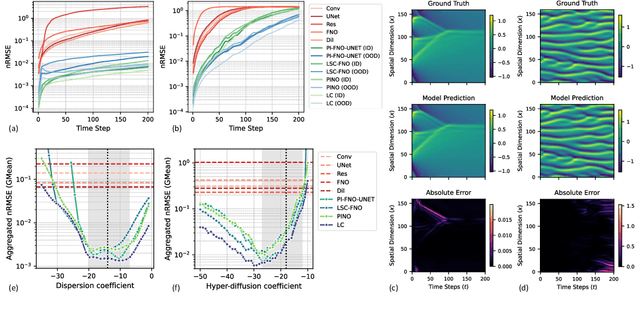
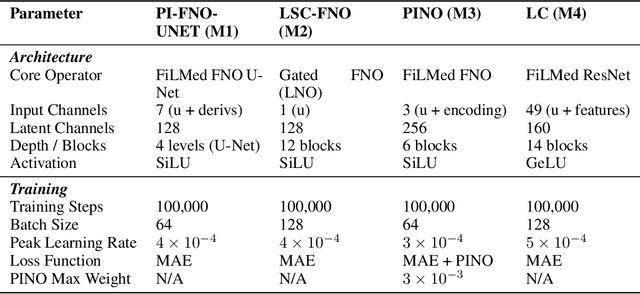
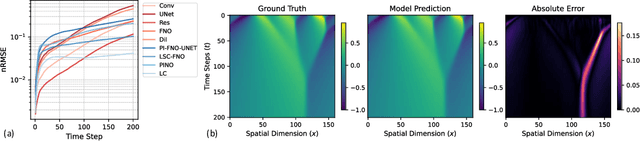
Solving partial differential equations (PDEs) can be prohibitively expensive using traditional numerical methods. Deep learning-based surrogate models typically specialize in a single PDE with fixed parameters. We present a framework for equation-aware emulation that generalizes to unseen PDEs, conditioning a neural model on a vector encoding representing the terms in a PDE and their coefficients. We present a baseline of four distinct modeling technqiues, trained on a family of 1D PDEs from the APEBench suite. Our approach achieves strong performance on parameter sets held out from the training distribution, with strong stability for rollout beyond the training window, and generalization to an entirely unseen PDE. This work was developed as part of a broader effort exploring AI systems that automate the creation of expert-level empirical software for scorable scientific tasks. The data and codebase are available at https://github.com/google-research/generalized-pde-emulator.

Expert Evaluation of LLM World Models: A High-$T_c$ Superconductivity Case Study
Nov 05, 2025Large Language Models (LLMs) show great promise as a powerful tool for scientific literature exploration. However, their effectiveness in providing scientifically accurate and comprehensive answers to complex questions within specialized domains remains an active area of research. Using the field of high-temperature cuprates as an exemplar, we evaluate the ability of LLM systems to understand the literature at the level of an expert. We construct an expert-curated database of 1,726 scientific papers that covers the history of the field, and a set of 67 expert-formulated questions that probe deep understanding of the literature. We then evaluate six different LLM-based systems for answering these questions, including both commercially available closed models and a custom retrieval-augmented generation (RAG) system capable of retrieving images alongside text. Experts then evaluate the answers of these systems against a rubric that assesses balanced perspectives, factual comprehensiveness, succinctness, and evidentiary support. Among the six systems two using RAG on curated literature outperformed existing closed models across key metrics, particularly in providing comprehensive and well-supported answers. We discuss promising aspects of LLM performances as well as critical short-comings of all the models. The set of expert-formulated questions and the rubric will be valuable for assessing expert level performance of LLM based reasoning systems.
FEABench: Evaluating Language Models on Multiphysics Reasoning Ability
Apr 08, 2025Building precise simulations of the real world and invoking numerical solvers to answer quantitative problems is an essential requirement in engineering and science. We present FEABench, a benchmark to evaluate the ability of large language models (LLMs) and LLM agents to simulate and solve physics, mathematics and engineering problems using finite element analysis (FEA). We introduce a comprehensive evaluation scheme to investigate the ability of LLMs to solve these problems end-to-end by reasoning over natural language problem descriptions and operating COMSOL Multiphysics$^\circledR$, an FEA software, to compute the answers. We additionally design a language model agent equipped with the ability to interact with the software through its Application Programming Interface (API), examine its outputs and use tools to improve its solutions over multiple iterations. Our best performing strategy generates executable API calls 88% of the time. LLMs that can successfully interact with and operate FEA software to solve problems such as those in our benchmark would push the frontiers of automation in engineering. Acquiring this capability would augment LLMs' reasoning skills with the precision of numerical solvers and advance the development of autonomous systems that can tackle complex problems in the real world. The code is available at https://github.com/google/feabench