 Add to Chrome
 Add to Firefox
 Add to Edge
High-Probability Minimax Adaptive Estimation in Besov Spaces via Online-to-Batch
Feb 12, 2026
We study nonparametric regression over Besov spaces from noisy observations under sub-exponential noise, aiming to achieve minimax-optimal guarantees on the integrated squared error that hold with high probability and adapt to the unknown noise level. To this end, we propose a wavelet-based online learning algorithm that dynamically adjusts to the observed gradient noise by adaptively clipping it at an appropriate level, eliminating the need to tune parameters such as the noise variance or gradient bounds. As a by-product of our analysis, we derive high-probability adaptive regret bounds that scale with the $\ell_1$-norm of the competitor. Finally, in the batch statistical setting, we obtain adaptive and minimax-optimal estimation rates for Besov spaces via a refined online-to-batch conversion. This approach carefully exploits the structure of the squared loss in combination with self-normalized concentration inequalities.

Minimax Adaptive Online Nonparametric Regression over Besov Spaces
May 26, 2025We study online adversarial regression with convex losses against a rich class of continuous yet highly irregular prediction rules, modeled by Besov spaces $B_{pq}^s$ with general parameters $1 \leq p,q \leq \infty$ and smoothness $s > d/p$. We introduce an adaptive wavelet-based algorithm that performs sequential prediction without prior knowledge of $(s,p,q)$, and establish minimax-optimal regret bounds against any comparator in $B_{pq}^s$. We further design a locally adaptive extension capable of dynamically tracking spatially inhomogeneous smoothness. This adaptive mechanism adjusts the resolution of the predictions over both time and space, yielding refined regret bounds in terms of local regularity. Consequently, in heterogeneous environments, our adaptive guarantees can significantly surpass those obtained by standard global methods.
Minimax Adaptive Boosting for Online Nonparametric Regression
Oct 04, 2024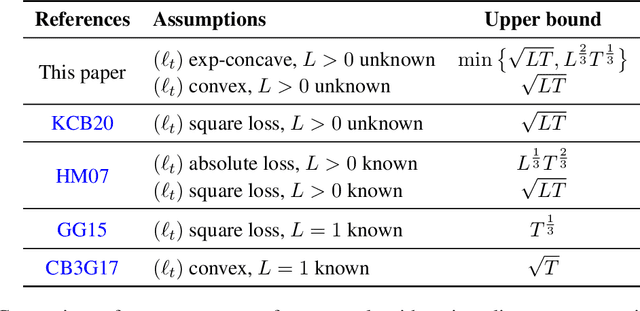
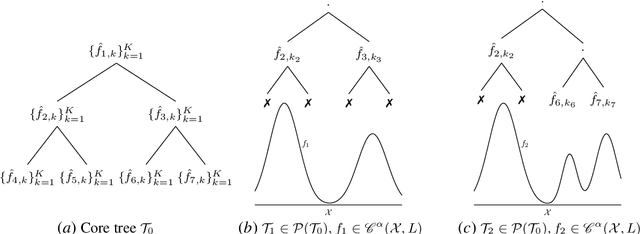
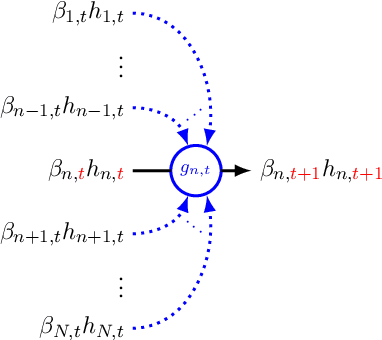
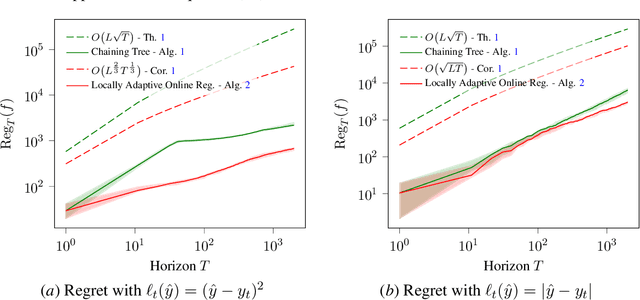
We study boosting for adversarial online nonparametric regression with general convex losses. We first introduce a parameter-free online gradient boosting (OGB) algorithm and show that its application to chaining trees achieves minimax optimal regret when competing against Lipschitz functions. While competing with nonparametric function classes can be challenging, the latter often exhibit local patterns, such as local Lipschitzness, that online algorithms can exploit to improve performance. By applying OGB over a core tree based on chaining trees, our proposed method effectively competes against all prunings that align with different Lipschitz profiles and demonstrates optimal dependence on the local regularities. As a result, we obtain the first computationally efficient algorithm with locally adaptive optimal rates for online regression in an adversarial setting.