 Add to Chrome
 Add to Firefox
 Add to Edge
Sampling-guided exploration of active feature selection policies
Mar 16, 2026
Determining the most appropriate features for machine learning predictive models is challenging regarding performance and feature acquisition costs. In particular, global feature choice is limited given that some features will only benefit a subset of instances. In previous work, we proposed a reinforcement learning approach to sequentially recommend which modality to acquire next to reach the best information/cost ratio, based on the instance-specific information already acquired. We formulated the problem as a Markov Decision Process where the state's dimensionality changes during the episode, avoiding data imputation, contrary to existing works. However, this only allowed processing a small number of features, as all possible combinations of features were considered. Here, we address these limitations with two contributions: 1) we expand our framework to larger datasets with a heuristic-based strategy that focuses on the most promising feature combinations, and 2) we introduce a post-fit regularisation strategy that reduces the number of different feature combinations, leading to compact sequences of decisions. We tested our method on four binary classification datasets (one involving high-dimensional variables), the largest of which had 56 features and 4500 samples. We obtained better performance than state-of-the-art methods, both in terms of accuracy and policy complexity.

High-dimensional multimodal uncertainty estimation by manifold alignment:Application to 3D right ventricular strain computations
Jan 21, 2025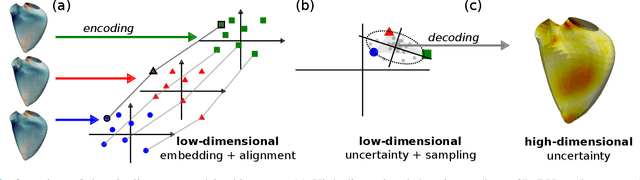
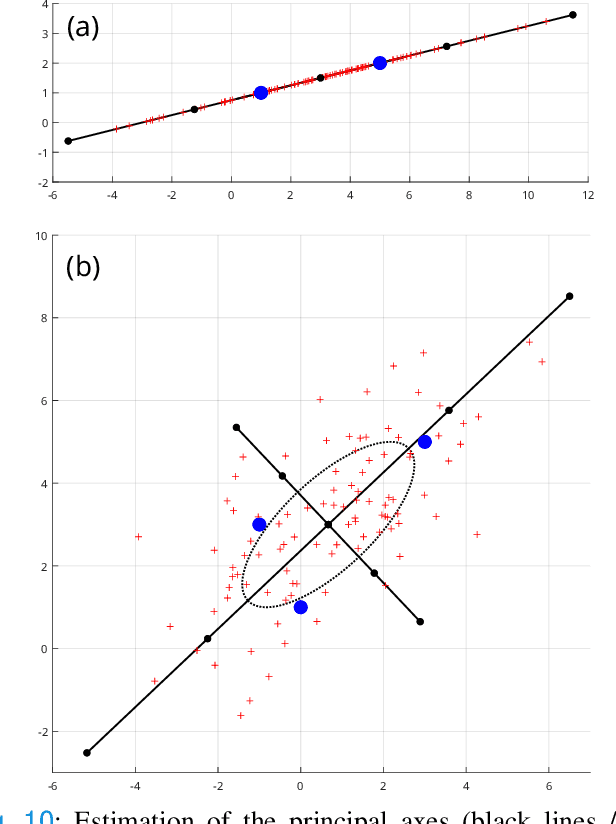
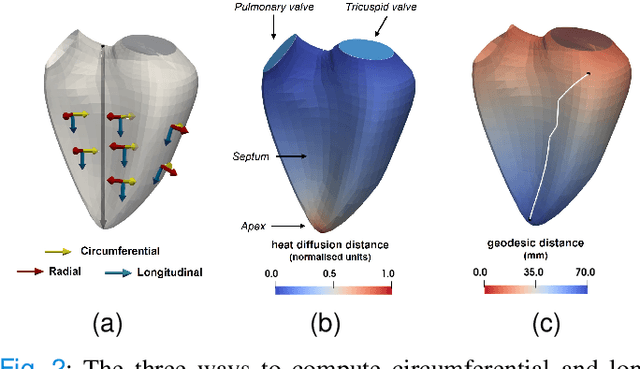
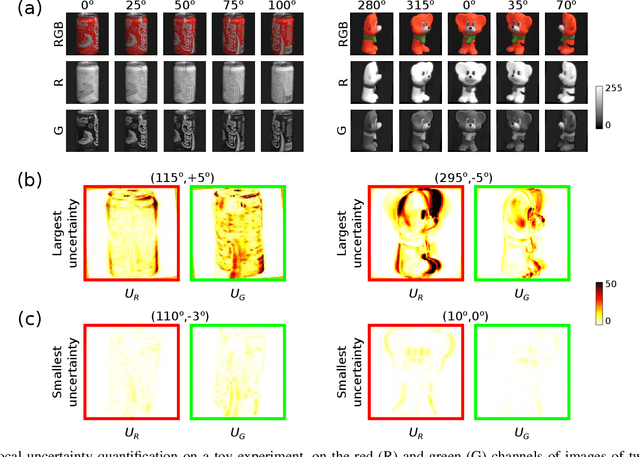
Confidence in the results is a key ingredient to improve the adoption of machine learning methods by clinicians. Uncertainties on the results have been considered in the literature, but mostly those originating from the learning and processing methods. Uncertainty on the data is hardly challenged, as a single sample is often considered representative enough of each subject included in the analysis. In this paper, we propose a representation learning strategy to estimate local uncertainties on a physiological descriptor (here, myocardial deformation) previously obtained from medical images by different definitions or computations. We first use manifold alignment to match the latent representations associated to different high-dimensional input descriptors. Then, we formulate plausible distributions of latent uncertainties, and finally exploit them to reconstruct uncertainties on the input high-dimensional descriptors. We demonstrate its relevance for the quantification of myocardial deformation (strain) from 3D echocardiographic image sequences of the right ventricle, for which a lack of consensus exists in its definition and which directional component to use. We used a database of 100 control subjects with right ventricle overload, for which different types of strain are available at each point of the right ventricle endocardial surface mesh. Our approach quantifies local uncertainties on myocardial deformation from different descriptors defining this physiological concept. Such uncertainties cannot be directly estimated by local statistics on such descriptors, potentially of heterogeneous types. Beyond this controlled illustrative application, our methodology has the potential to be generalized to many other population analyses considering heterogeneous high-dimensional descriptors.