 Add to Chrome
 Add to Firefox
 Add to Edge
Facet-Level Tracing of Evidence Uncertainty and Hallucination in RAG
Apr 10, 2026
Retrieval-Augmented Generation (RAG) aims to reduce hallucination by grounding answers in retrieved evidence, yet hallucinated answers remain common even when relevant documents are available. Existing evaluations focus on answer-level or passage-level accuracy, offering limited insight into how evidence is used during generation. In this work, we introduce a facet-level diagnostics framework for QA that decomposes each input question into atomic reasoning facets. For each facet, we assess evidence sufficiency and grounding using a structured Facet x Chunk matrix that combines retrieval relevance with natural language inference-based faithfulness scores. To diagnose evidence usage, we analyze three controlled inference modes: Strict RAG, which enforces exclusive reliance on retrieved evidence; Soft RAG, which allows integration of retrieved evidence and parametric knowledge; and LLM-only generation without retrieval. Comparing these modes enables thorough analysis of retrieval-generation misalignment, defined as cases where relevant evidence is retrieved but not correctly integrated during generation. Across medical QA and HotpotQA, we evaluate three open-source and closed-source LLMs (GPT, Gemini, and LLaMA), providing interpretable diagnostics that reveal recurring facet-level failure modes, including evidence absence, evidence misalignment, and prior-driven overrides. Our results demonstrate that hallucinations in RAG systems are driven less by retrieval accuracy and more by how retrieved evidence is integrated during generation, with facet-level analysis exposing systematic evidence override and misalignment patterns that remain hidden under answer-level evaluation.

Span-Level Hallucination Detection for LLM-Generated Answers
Apr 25, 2025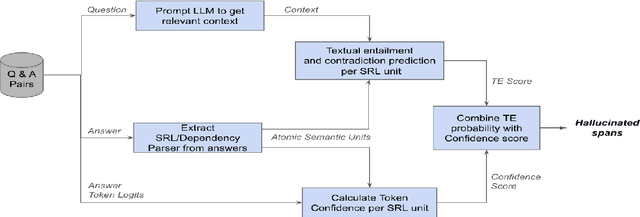
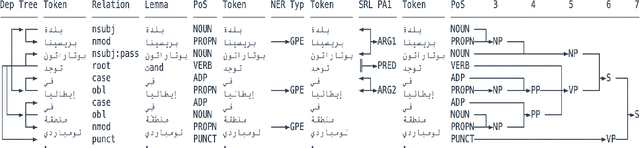
Detecting spans of hallucination in LLM-generated answers is crucial for improving factual consistency. This paper presents a span-level hallucination detection framework for the SemEval-2025 Shared Task, focusing on English and Arabic texts. Our approach integrates Semantic Role Labeling (SRL) to decompose the answer into atomic roles, which are then compared with a retrieved reference context obtained via question-based LLM prompting. Using a DeBERTa-based textual entailment model, we evaluate each role semantic alignment with the retrieved context. The entailment scores are further refined through token-level confidence measures derived from output logits, and the combined scores are used to detect hallucinated spans. Experiments on the Mu-SHROOM dataset demonstrate competitive performance. Additionally, hallucinated spans have been verified through fact-checking by prompting GPT-4 and LLaMA. Our findings contribute to improving hallucination detection in LLM-generated responses.