 Add to Chrome
 Add to Firefox
 Add to Edge
Consensus Measures for Unstructured Biomedical Text Annotations
Aug 05, 2026
Biomedical literature is increasingly mined for knowledge beyond the questions it was written to answer. Because the target concepts are not known in advance, annotators prefer open-ended labels, whose agreement is hard to quantify. We study soft inter-rater reliability for annotators providing unstructured texts for biomedical annotation tasks. Synthetic experiments show that soft reliability can be quantified using a variety of semantic equivalence measures, and that the choice of measure affects failure modes of the estimation. Embeddings are scalable, but limited when differentiating similar but distinct concepts. Large language models are promising, but limited by scalability for estimating agreement by chance. Finally, we suggest measures based on natural language inference as a sensible compromise.

FoodTaxo: Generating Food Taxonomies with Large Language Models
May 26, 2025We investigate the utility of Large Language Models for automated taxonomy generation and completion specifically applied to taxonomies from the food technology industry. We explore the extent to which taxonomies can be completed from a seed taxonomy or generated without a seed from a set of known concepts, in an iterative fashion using recent prompting techniques. Experiments on five taxonomies using an open-source LLM (Llama-3), while promising, point to the difficulty of correctly placing inner nodes.
No Gold Standard, No Problem: Reference-Free Evaluation of Taxonomies
May 16, 2025We introduce two reference-free metrics for quality evaluation of taxonomies. The first metric evaluates robustness by calculating the correlation between semantic and taxonomic similarity, covering a type of error not handled by existing metrics. The second uses Natural Language Inference to assess logical adequacy. Both metrics are tested on five taxonomies and are shown to correlate well with F1 against gold-standard taxonomies.
Tell Me Why: Explainable Public Health Fact-Checking with Large Language Models
May 15, 2024

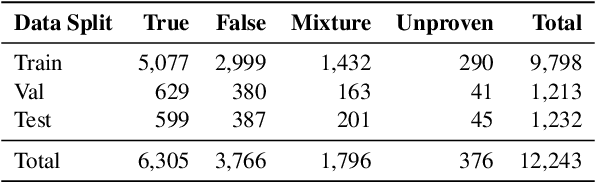
This paper presents a comprehensive analysis of explainable fact-checking through a series of experiments, focusing on the ability of large language models to verify public health claims and provide explanations or justifications for their veracity assessments. We examine the effectiveness of zero/few-shot prompting and parameter-efficient fine-tuning across various open and closed-source models, examining their performance in both isolated and joint tasks of veracity prediction and explanation generation. Importantly, we employ a dual evaluation approach comprising previously established automatic metrics and a novel set of criteria through human evaluation. Our automatic evaluation indicates that, within the zero-shot scenario, GPT-4 emerges as the standout performer, but in few-shot and parameter-efficient fine-tuning contexts, open-source models demonstrate their capacity to not only bridge the performance gap but, in some instances, surpass GPT-4. Human evaluation reveals yet more nuance as well as indicating potential problems with the gold explanations.